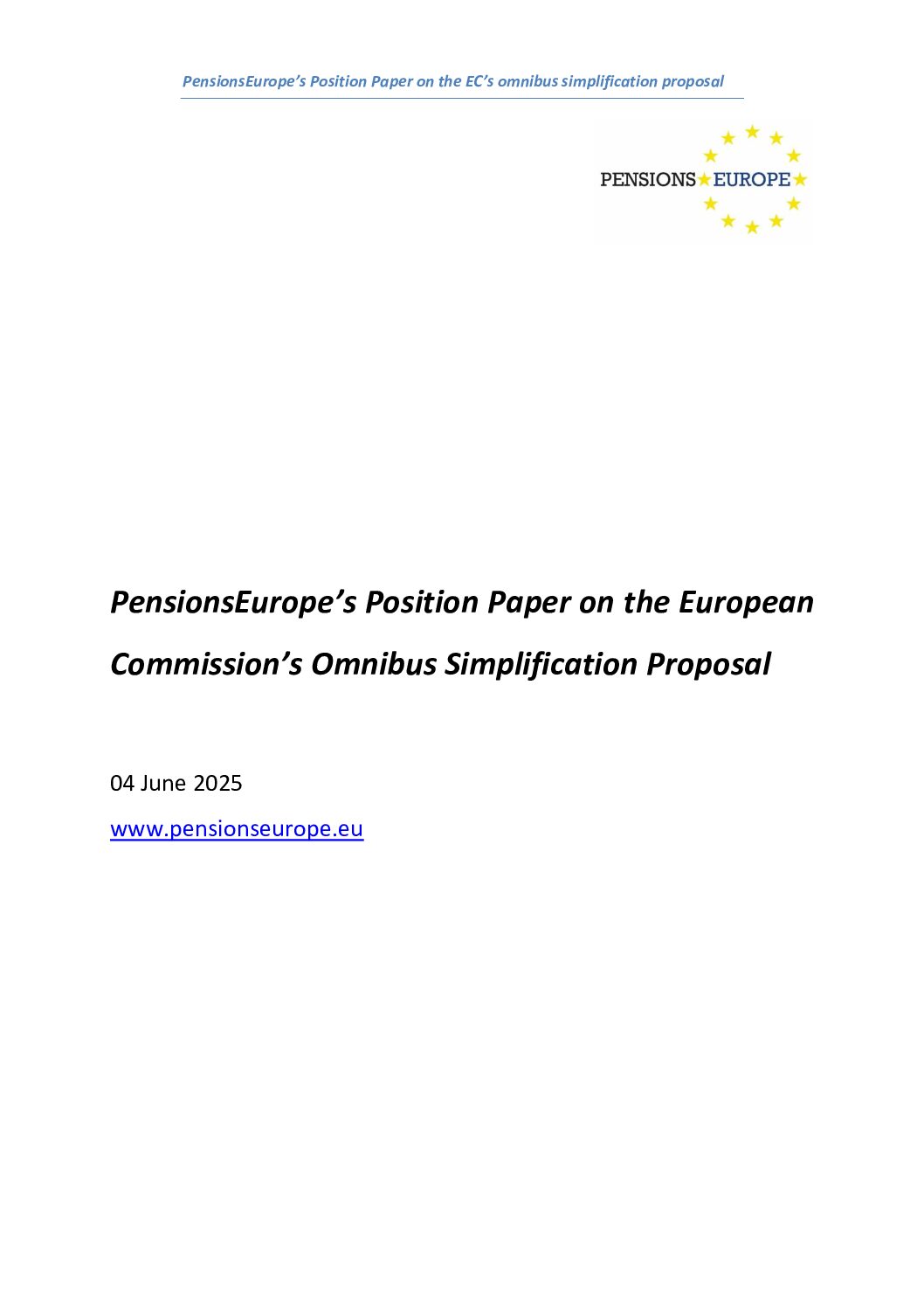
PensionsEurope’s Position Paper on the European Commission’s Omnibus Simplification Proposal
By Pension Europe
PensionsEurope welcomes the European Commission (EC) initiative which aims to align crucial EU legislation concerning Sustainable Finance. PensionsEurope firmly believes that the competitiveness of the EU economy is vital, it is possible to reduce the administrative burden without undermining the EU’s policy objectives regarding the green transition.
However, any simplification should be carefully balanced to ensure that material sustainability information on risks, opportunities, and impacts-critical to informed investor decision-making-is preserved. Accordingly, the Omnibus package should aim to streamline regulatory requirements, eliminate immaterial data, and refocus reporting on relevance and clarity.
Indeed, pension funds, as institutional investors, place a high value on companies’ transparency and reporting regarding their sustainability impact. Comparable data is necessary for pension funds to make informed investment choices. To manage sustainability risks and accomplish sustainability goals, pension funds need data when choosing which companies to include in their portfolios. In addition, engagement is based on sustainability reporting. However, to provide returns for members and beneficiaries, pension funds depend on the competitiveness of investee companies; therefore, excessive regulation should be avoided.
From an investor’s standpoint, simplification should be understood as reducing the complexity and volume of sustainability disclosures for reporting entities-without compromising the quality of decision-useful information. This can be achieved by eliminating non-material, non-investment-relevant, and duplicative data points. In this context, we support the mandate given to EFRAG to revise the ESRS in line with the European Commission’s principles, to ensure that reporting remains meaningful, proportionate, and fit for purpose.
Alignment of the Omnibus initiative and SFDR review
PensionsEurope believes that it is vital to align the Omnibus initiative and the SFDR framework as well as the IORP Il Directive. In general, it is our opinion that the reporting frameworks for the real economy and financial sector should be seamlessly connected. The initial strategy for sustainable finance, which required financial institutions to report before businesses, resulted in unnecessary implementation costs and low-quality data for financial sector reporting.
In this context, divergences between CSRD data points and SFDR-related concepts risk increasing reliance on estimates and other financial market participants, undermining data comparability and reliability. This reliance not only raises costs but also increases dependence on large non-EU ESG data providers.
To prevent any future challenges concerning consistency, the legislative processes of the Omnibus initiative should be concluded, and its outcomes fully taken into account before starting the upcoming SFDR-review. Otherwise, there will be a significant risk of inconsistency and reporting/disclosure requirements for financial market participants and financial products/pension schemes that are not connected to data points provided by companies.
Get the report here