SMU launches Longevity Societies and Economies Institute to advance knowledge and innovation for Singapore’s longevity transition
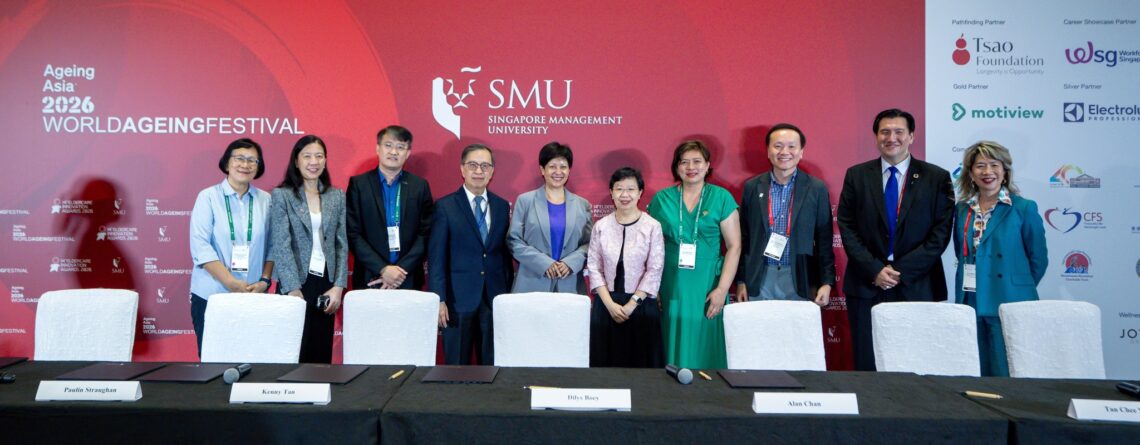
Singapore Management University (SMU) has launched the SMU Longevity Societies and Economies Institute (LSEI) which will focus on the economic and societal transitions needed for economies and societies to continue thriving despite an ageing population.
The Institute was launched on 14 April by Ms Indranee Rajah, Minister in the Prime Minister’s Office, Second Minister for Finance and Second Minister for National Development, at the World Ageing Festival 2026, organised by Ageing Asia with SMU as the Co-host and Academic Pillar Partner.
Singapore is already a super-aged society today. By 2030, one in four Singapore citizens will be aged 65 and above. Across Asia, rising life expectancy and smaller birth cohorts are reshaping labour supply, healthcare demand, retirement adequacy and community support systems. LSEI has been established to examine these shifts systematically and generate evidence to support economically sustainable and socially inclusive responses as part of an integrated systems redesign.
Advancing SMU’s ageing research to real-world impact
SMU LSEI builds on the University’s established track record in ageing research, including the Centre for Research on Successful Ageing (ROSA) and the Singapore Life Panel®, one of the world’s leading high-frequency panel surveys tracking financial and well-being outcomes.
By consolidating existing initiatives into a coordinated, university-level platform, the Institute will also focus on translating deep research into actionable insights for government agencies, employers, financial institutions and community organisations. SMU has committed a multi-year budget of more than S$10 million to seed and sustain LSEI. In addition, the Institute aims to secure external research funding to grow its partnerships and research programmes aligned with national objectives articulated in the recently launched Research, Innovation and Enterprise (RIE) 2030 Plan.
By integrating these strengths with expertise across economics, business, social sciences, law, accountancy and computing, LSEI creates a structured research agenda focused on the social, institutional and economic implications of longer life expectancy.
Noting that institutions need to keep pace with longer lifespans, SMU President Professor Lily Kong pointed out that ‘a three-stage life – learn, earn, retire’ no longer describes how most people actually live. “We have built systems that still treat later life primarily as a phase of care and cost; escalators move a little too fast; digital forms that assume one has an employer; font sizes no one quite asked for; and retirement policies written when 65 was considered a long life indeed,” she observed in her speech.
Read more @morningstar