February 2026

Liability-Driven Portfolio Choice for Pension Funds under Regime-Switching Inflation

By Myung Jun Kim, Hyeontae Jo & Bong-Gyu Jang This paper studies optimal portfolio choice for a pension fund with inflation-linked liabilities under regime-switching market dynamics. We consider a fund manager who invests in stocks, inflation-indexed bonds (IIBs), and a risk-free asset to maximize expected utility of the terminal funding ratio, subject to a Value-at-Risk (VaR) constraint. Asset returns and inflation expectations follow a two-state Markov chain representing high and low inflation regimes. The main methodological challenge is solving the...


January 2026

Scaling Sustainable Investing in Emerging and Developing Economies: Frictions and Opportunities

By Caroline Flammer, Thomas Giroux & Geoffrey M. Heal Mobilizing private capital at scale is critical for financing sustainable development, particularly in emerging and developing economies (EMDEs), where capital is most needed. We conduct a global survey of senior investment decision-makers across a broad spectrum of capital providers, including asset managers, pension and sovereign wealth funds, development finance institutions, philanthropic investors, and others. The survey provides novel evidence on investors’ risk-return expectations, risk perceptions, and investment practices in EMDEs and...

Global Pension Assets Study – 2025

By Thinking Ahead Institute The Global Pension Assets Study estimates global pension fund assets across 22 major pension markets (the P22). These geographies now stand at US$58.5 trillion in pension assets and account for 68% of the GDP of these economies. The study, conducted by WTW and the Thinking Ahead Institute since the 1990s, includes an analysis of the seven largest markets (the P7): Australia, Canada, Japan, Netherlands, Switzerland, UK and the US, which comprise 91% of total pension assets. Pension...

December 2025

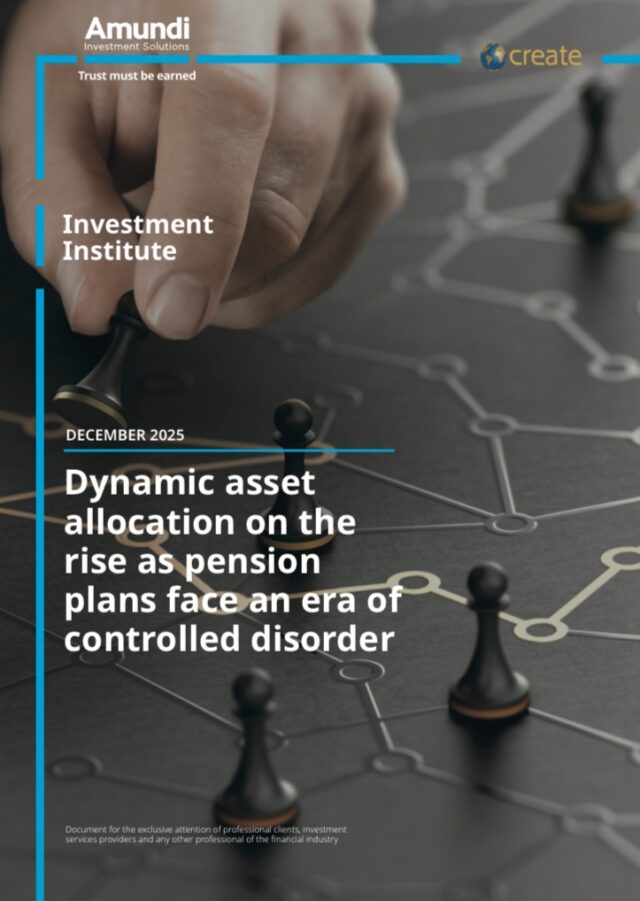
Dynamic asset allocation on the rise as pension plans face an era of controlled disorder

By Prof. Amin Rajan This question has come to the fore as the swirling clouds of geopolitical events have elevated the role of dynamic asset allocation (DAA). They have challenged the timehonoured primacy of strategic asset allocation (SAA), with fixed weights for different asset classes with long-term return targets. This rigid set-it/forget-it approach worked well in the longest bull run after the 2008 global financial crisis. Since 2022, however, concerted steep rises in interest rates by key central banks to curb...

Heterogeneous Institutional Investor Response to Firm Environmental Regulatory Risk

By Chunxiao Lu, Yuyang Zhang & Linxiang Ma This paper investigates whether institutional investors incorporate firm-level environmental regulatory risk into their portfolio decisions. We document substantial heterogeneity across investor types in their responses to changes in firm-level environmental regulatory risk. Long-horizon investors, such as banks, insurance companies, and pension funds, tend to tilt their portfolios toward stocks with higher environmental regulatory risk. In contrast, short-horizon investors, including investment advisors and mutual funds, reduce their holdings of these firms. These opposing...

October 2025

Sovereign GSSS+ Bonds: Building Blocks for Climate Ambition Analysis

By Sustainalytics Investor demand for sovereign green, social, sustainability, and sustainability-linked (GSSS+) bonds is growing. And with increasing scrutiny of climate goals, sovereign GSSS+ bonds may provide a signal of countries’ commitments to the Paris Agreement and meeting their nationally determined contributions (NDC). However, for investors looking to assess sovereign commitments and help drive meaningful climate impact, analyzing sovereign GSSS+ bonds in isolation may not be enough. This report offers insight into how investors can leverage these instruments to assess countries’...

Evolution and Growth: How Public Pension Plans Have Diversified Their Investments Amid Changing Markets

By John Sullivan, Katie Comstock & Tyler Bond A report from the National Institute on Retirement Security (NIRS) and Aon examines the changes public pension plan investing has undergone throughout the twenty-first century. After decades of investing primarily in bonds and other fixed income assets, public pension plans have shifted to more diverse investment portfolios, which enabled these funds to grow, deliver reliable benefits, and withstand market turmoil during and after the 2008 Global Financial Crisis (GFC). These findings are detailed in a...

Investments, loans, insurance or pensions with a sustainable focus: what you need to know?

By European Insurance and Occupational Pensions Authority Through the choices we make, we all play a part in shaping our future. Are you interested in contributing to a more sustainable future? Learn more about how your financial choices can support the environment and society, and keep in mind a few tips! You may, for example, make a financial decision in a sustainable way if you put your money in an investment fund that invests in companies that recycle household waste, or in...

Europe’s productive capital gap. Mobilising pension and household savings to scale up risk capital

By Patrick Augustin, Sebastien Betermier, Emma Gormley & Marie Parent The ALFI/McGill new study ‘Europe's productive capital gap’ shows that Europe is falling behind in mobilising household and pension savings into productive investment compared to reformed pension economies such as Australia, Canada, and Sweden. The study compares nine countries: four European economies with reformed, capital-based systems (Denmark, Finland, the Netherlands, and Sweden); two successful reformers outside Europe (Australia and Canada); and three major European economies still dominated by PAYG pensions (Germany,...

Venture & growth capital in Europe – mapping pension funds’ attitudes

By Pensions For Purpose Across Europe, pension funds manage over €3tn in assets, yet only roughly 0.12% is allocated to venture and growth capital (VC). Meanwhile, VC investment in Europe totalled €15bn in 2023. These numbers together highlight two persistent questions: can allocation to VC be compatible with the fiduciary duties of pension funds? If so, why has the historical aggregated allocation of pension funds to this asset class been so modest? To address these questions, we embarked on a journey...