
Korea Investment Management Links Pension Asset Allocation to AI Growth, Unveils New TDF Strategy
Korea Investment Management has presented a pension investment strategy that invests in the long-term growth of the AI industry while adjusting asset allocations according to the timing of retirement.
On the 23rd, Korea Investment Management held a seminar at Conrad Seoul in Yeouido, Seoul, to mark the launch of the Korea Investment Retirement Pension-Qualified TDF Self-Directed Global AI Value Chain Fund. The event explored investment opportunities arising from changes in AI technology and explained the investment direction and management approach of the new product, which incorporates those opportunities into pension management.
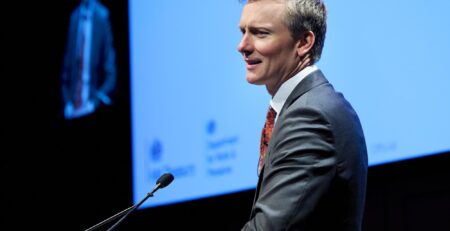
The event began with welcoming remarks by Bae Jae-kyu, president of Korea Investment Management, followed by a keynote address by Professor Jung Ji-hoon of DGIST and a product presentation by Kang Seong-su, head of the Solutions Division at Korea Investment Management.
Bae emphasized that AI is a long-term trend that will transform industries across the board for at least the next 20 years, and that investors should look to future growth directions rather than immediate market fluctuations. His assessment was that the industry and market order are now being reshaped around AI as a new technology.
He explained that the new product focuses on the AI value chain, unlike the traditional global asset investment approach of existing TDFs. Reflecting the company’s philosophy of investing for the long term in areas with future growth potential, it aims to capture opportunities to create wealth through technological innovation and pursue strong returns over the long term.
Professor Jung spoke about the impact of AI development on investment and civilization as a whole. He analyzed that the AI industry is moving beyond the stage of expanding infrastructure and into a phase in which services are spreading and tangible profits are being generated. He projected that investment in AI infrastructure centered on semiconductors and data centers would lead to physical AI, expanding both the industry’s reach and the market’s size.
He also highlighted the role of East Asian countries with manufacturing capabilities in this process. Taiwan, with strengths in foundry and packaging; South Korea, with a memory and manufacturing base; and Japan, with competitive strengths in materials and equipment, could emerge as major production hubs for physical AI.
Kang introduced the management structure of the new product, which combines investment in the AI value chain with life-cycle-based asset allocation. The fund is a TDF that invests in the global AI industry, which is expected to have long-term growth potential, while adjusting its asset allocation to match investors’ retirement dates.
Its investment targets include semiconductors, power infrastructure, data centers and cloud computing, networks, agentic AI, and physical AI. It also allocates funds to major Asian countries, including South Korea, Taiwan, and Japan, to diversify its geographic exposure.
As retirement approaches, the fund adjusts the share of risk assets according to its glide path. Its management also takes into account the possibility that the sectors and companies driving growth in the AI industry may change. The approach is to analyze each value chain’s growth phase, market conditions, and the relative value of individual stocks, then adjust investment weights flexibly.
Kang explained that the product’s core approach is to invest across the various value chains that make up the AI industry rather than concentrating investments in individual companies or specific technologies. The aim is to respond to shifts in leadership within the industry while improving long-term pension management performance.
Read more @fnnews