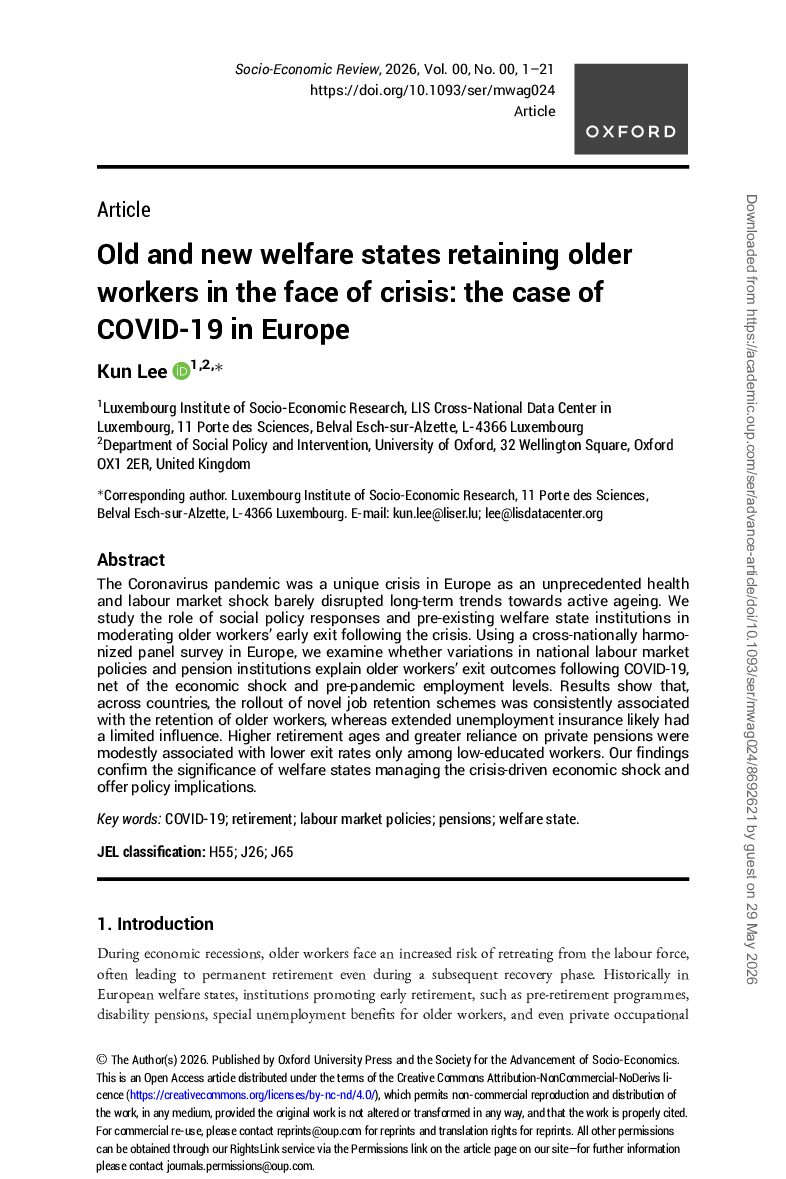
Old and new welfare states retaining older workers in the face of crisis: the case of COVID-19 in Europe
By Kun Lee
The Coronavirus pandemic was a unique crisis in Europe as an unprecedented health and labour market shock barely disrupted long-term trends towards active ageing. We study the role of social policy responses and pre-existing welfare state institutions in moderating older workers’ early exit following the crisis. Using a cross-nationally harmonized panel survey in Europe, we examine whether variations in national labour market policies and pension institutions explain older workers’ exit outcomes following COVID-19, net of the economic shock and pre-pandemic employment levels. Results show that, across countries, the rollout of novel job retention schemes was consistently associated with the retention of older workers, whereas extended unemployment insurance likely had a limited influence. Higher retirement ages and greater reliance on private pensions were modestly associated with lower exit rates only among low-educated workers. Our findings confirm the significance of welfare states managing the crisis-driven economic shock and offer policy implications.
Get the report here