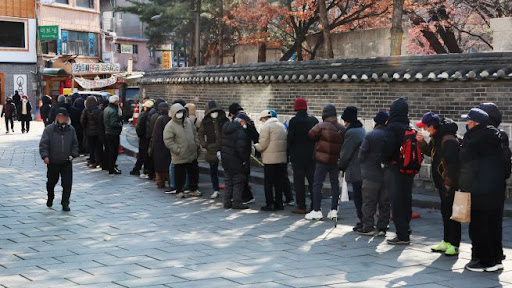
South Korea. Six in Ten Incheon Districts Enter Super-Aged Society
Incheon is transforming from a “young city” into a “rapidly aging city.” The Incheon Social Service Agency released results of its 6th Community Welfare Survey on the 9th, warning that demand for care, medical services, and mobility support could surge within the next five to ten years.
Incheon’s elderly dependency ratio growth rate stands at 38.4%, which is 5.6 percentage points higher than the national average of 32.8%. Six of the city’s ten districts have already entered super-aged society status: Ganghwa-gun (40.3%), Ongjin-gun (35.7%), Dong-gu (28.5%), Michuhol-gu (21.2%), Namdong-gu (20.1%), and Bupyeong-gu (20.0%). Only Yeonsu-gu (13.8%) remains at the aging society stage, revealing stark regional disparities.
The problem is that welfare infrastructure falls far short of keeping pace with the aging speed. The number of doctors per 1,000 residents is 2.7, below the national average of 3.2. Unmet medical care rates are highest in Ongjin-gun at 19%, followed by Michuhol-gu at 8.9% and Seo-gu at 8.1%. The city has 21 comprehensive social welfare centers, at least nine short of the standard 30. Ganghwa-gun has no comprehensive social welfare center at all, while Seo-gu and Gyeyang-gu have only one each.
Population polarization is also intensifying. Incheon’s total population stands at 3,046,754 (as of September last year), making it the only metropolitan city maintaining the 3 million level nationwide, yet regional variation is significant. Compared to 2020, new development areas such as Jung-gu (25%), Seo-gu (19.7%), and Yeonsu-gu (5.3%) saw population increases, while Dong-gu (-9.2%), Namdong-gu (-8.4%), and Gyeyang-gu (-6.4%) showed notable declines.
Mental health indicators are also concerning. The suicide rate per 100,000 people is 31.2, higher than the national average of 29.1. Economic hardship was the primary reason for suicidal thoughts at 31.4%. Among those who experienced depression or suicidal thoughts, 54.9% said they “dealt with it alone,” highlighting the urgent need to strengthen mental health support systems.
Residents ranked urgent policy priorities as childcare, elderly care, and disability care, in that order. More than half cited “eligibility and information restrictions” as reasons for not using elderly care services. Housing and employment were identified as areas of high urgency but insufficient effort.
Lee Seon-jeong, a research fellow at the Incheon Social Service Agency, said, “Aging is progressing rapidly, so we must prepare for a surge in care demand,” adding, “Regional imbalances must be considered when establishing the 6th Community Welfare Plan.”
Read more @sedaily