February 2026

As China Ages, a Pension Crisis Looms

On October 23, 2025, the Fourth Plenary Session of the 20th Chinese Communist Party Central Committee concluded with approval of the 15th Five-Year Plan, covering the period from 2026 to 2030. Chinese leaders have described this plan as a “crucial link” in the country’s long-term goal of achieving fundamental modernization by 2035. Yet beneath these ambitions lies a structural challenge that threatens to erode many of its gains. Amid rapid economic growth and ambitions for a highly modernized industrial system,...


January 2026

UN Pension Review Raises Concerns Among Staff and Retirees

The United Nations General Assembly’s latest pension fund resolution — adopted at the end of December 2025 — has triggered concerns among current and former staff members of the organization that their retirement security may be at risk. The resolution invites the UN Pension Board to carry out a full review of the pension system, including consideration of defined-contribution and hybrid models and exploring ways to “lower contributions.” That last phrase signals the review’s underlying intent: cost reduction rather than benefit enhancement. While framed...

December 2025

European Financial Ecosystems. Comparing France, Sweden, UK and Italy.

By Stefano Caselli & Marta Zava The study examines the structure, functioning, and strategic implications of financial ecosystems across four European countries-France, Sweden, the United Kingdom, and Italy-to identify institutional best practices relevant to the ongoing transformation of Italy's financial system. Building on a comparative analysis of legislation and regulation, taxation, investor bases, and financial intermediation, the report highlights how distinct historical and institutional trajectories have shaped divergent models: the French dirigiste system anchored by powerful state-backed institutions and deep...

Luxembourg’s Pension Outlook: Strong Forecasting Today, Hard Reform Choices Ahead

A study on the IMF's December 2025 Technical Assistance Report on Luxembourg's pension projections offers a detailed examination of how reliably the country has been forecasting the financial future of its public pension system. Prepared by the International Monetary Fund's Fiscal Affairs Department in cooperation with Luxembourg's General Inspectorate of Social Security (IGSS), the national statistical institute STATEC, and within the EU framework coordinated by the Ageing Working Group (AWG), the report reflects a collaborative, evidence-based effort to assess...

Albania. 13 thousand pensioners added, scheme at risk, growing faster than contributors

The number of beneficiaries in the public pension scheme expanded further during 2022, reaching a total of 686,923 people or over 13 thousand more than in 2021. Official data from the Institute of Social Insurance show that the number of pensioners is growing faster than the number of contributors. Pensioners increased by 13 thousand, while contributors by 10 thousand. In 2022 for every beneficiary there were only 1.1 contributors from 1.2 which was this ratio in 2018. In the following years,...

Adequacy and Sustainability of Pensions

By Commission European Pensions are the main source of income for older people in Europe, coming mostly from 'pay-as-you-go' public schemes. Retired people drawing a pension are a significant and — due to demographic ageing — a growing part of the EU population (about 124 million, or a quarter of the total population1). European pension systems are facing the dual challenge of remaining financially sustainable and being able to provide Europeans with an adequate income in retirement. The key purpose of...

November 2025

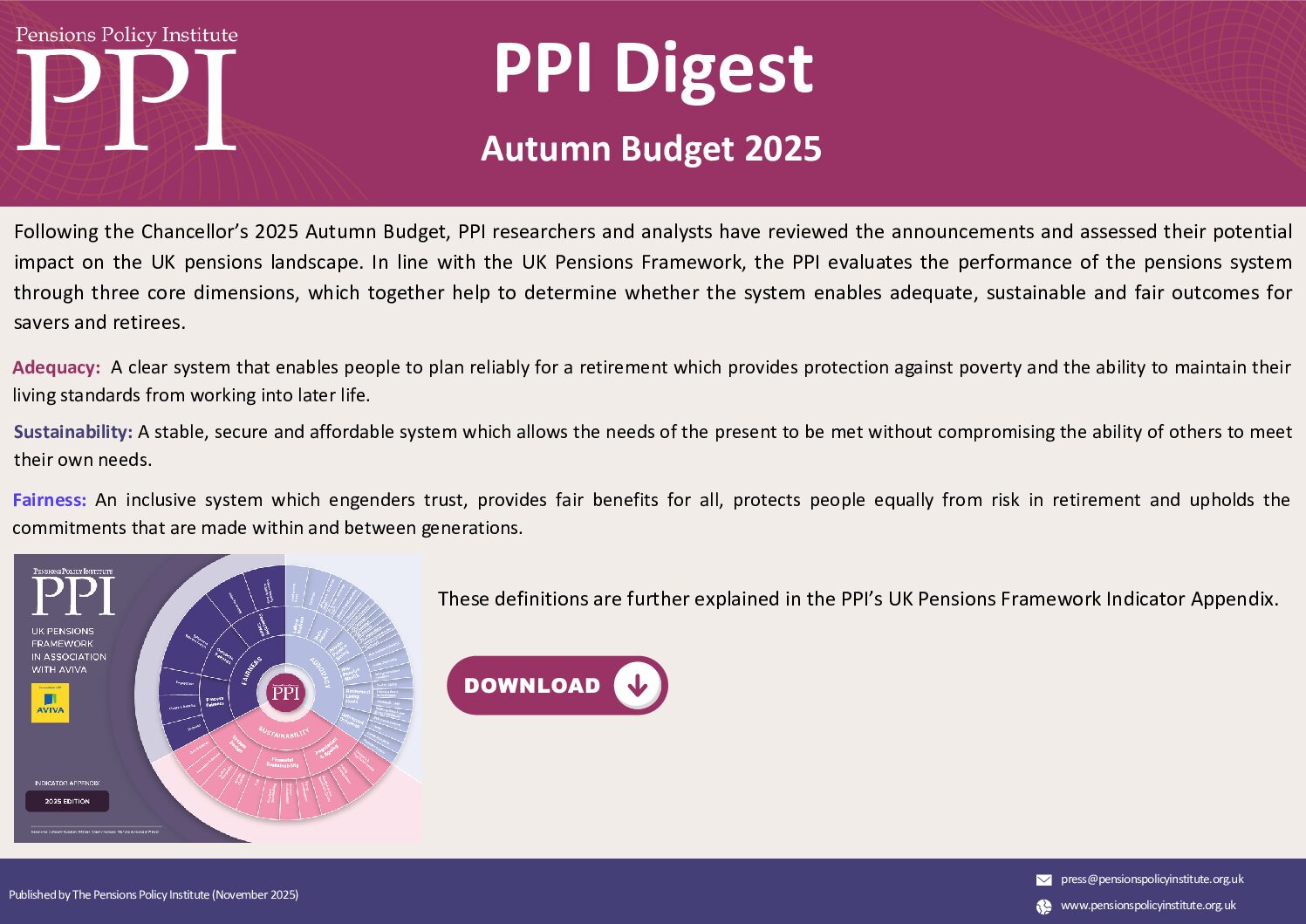
PPI Digest: Autumn Budget 2025

By Pensions Policy Institute Clearly, very difficult choices have had to be made in the Budget today. It was always unlikely that pensions would escape completely from this, even though both the Pensions Schemes Bill and the new Pensions Commission are seeking ways to increase the amount of money that future generations will have to support themselves in retirement. The introduction of a contributions cap of £2,000 on salary sacrificed pension contributions from 2029 will not affect many of those who...

Pensions at a Glance 2025: OECD and G20 Indicators

By Organisation for Economic Co-operation and Development The 2025 edition of Pensions at a Glance highlights the pension reforms undertaken by OECD countries over the last two years. It includes a special chapter focusing on pension differences between men and women. It shows recent and projected trends in the pensions of women relative to those of men in OECD countries, analyses the key drivers of the gender pension gap, and reviews the pension rules that directly or indirectly affect gender disparities in...

Digital finance and retirement planning: The role of information cost reduction and trust enhancement channels

By Liang Liu & Zhen Ju With the rapid development of digitalization, retirement decisions are increasingly being mediated by digital finance platforms, which help individuals in effectively managing and planning their retirement. Existing literature primarily focuses on the impacts of financial literacy, risk attitudes, and awareness of retirement goals. Using data from the 2015 China Household Finance Survey, we investigate the effect of digital finance on household retirement planning. Our analysis reveals that digital payment lowers the acquisition cost of pension finance...

Pension sustainability and government effectiveness in the presence of population aging

By Dooyeon Cho & Kyung-woo Lee This study investigates the nonlinear effect of population aging on pension sustainability, contingent on perceived government effectiveness. Analyzing heterogeneous panel data for 15 OECD economies over the period 2002–2019, our findings reveal nonlinear patterns and evolving dynamics over time. We find that the negative impact of population aging on pension sustainability intensifies significantly as government effectiveness diminishes, indicating that the manner in which government policies are implemented and managed significantly influences how effectively pension systems can...