December 2025

Retirement by the Numbers: How participant behavior and glide path design can drive stronger retirement outcomes

By JPMorgan  How are participants interacting with their defined contribution retirement plans, and what are the implications for target date fund glide path design? For more than two decades, J.P. Morgan Asset Management has closely examined this question, analyzing real-world saving and spending patterns to provide actionable insights into how to help more people achieve the retirement they’ve earned. Retirement by the Numbers offers a unique view of how participants save, invest and spend throughout their working lives and retirement, leveraging...
Dynamic asset allocation on the rise as pension plans face an era of controlled disorder

By Prof. Amin Rajan This question has come to the fore as the swirling clouds of geopolitical events have elevated the role of dynamic asset allocation (DAA). They have challenged the timehonoured primacy of strategic asset allocation (SAA), with fixed weights for different asset classes with long-term return targets. This rigid set-it/forget-it approach worked well in the longest bull run after the 2008 global financial crisis. Since 2022, however, concerted steep rises in interest rates by key central banks to curb...

Comparing Socialist Approaches: Economics and Social Security in Cuba, China, and Vietnam

By Carmelo Mesa-Lago In Comparing Socialist Approaches, Carmelo Mesa-Lago examines the two main socialist models across Cuba, China, and Vietnam to compare central planning and socialist markets. Under the Cuban central plan, large state enterprises have been unable to generate economic growth, even with mild structural market reforms and a small controlled private sector. In the Sino-Vietnamese model of a socialist marketplace, dynamic private enterprises of all sizes, together with large state enterprises, operate under a decentralized plan with state regulation and...

State of OECD Pension Funds’ Climate Transition: Insights and recommendations from the Net Zero Finance Tracker

By Frederick Fabian, Claris Parenti, Maddy Taylor & Valerio Micale Unlike other institutional investors, which often focus on short-term performance, pension providers have a fiduciary duty to address long-term systemic issues and act in their beneficiaries’ best interests. In many jurisdictions, this obligation includes setting credible climate targets, implementing internal changes to strategy, governance, and process, and actively supporting the decarbonization of the real economy. Pension funds’ role in financing the climate transition is drawing sharper focus as the limits of...

Adequacy and Sustainability of Pensions

By Commission European Pensions are the main source of income for older people in Europe, coming mostly from 'pay-as-you-go' public schemes. Retired people drawing a pension are a significant and — due to demographic ageing — a growing part of the EU population (about 124 million, or a quarter of the total population1). European pension systems are facing the dual challenge of remaining financially sustainable and being able to provide Europeans with an adequate income in retirement. The key purpose of...

November 2025

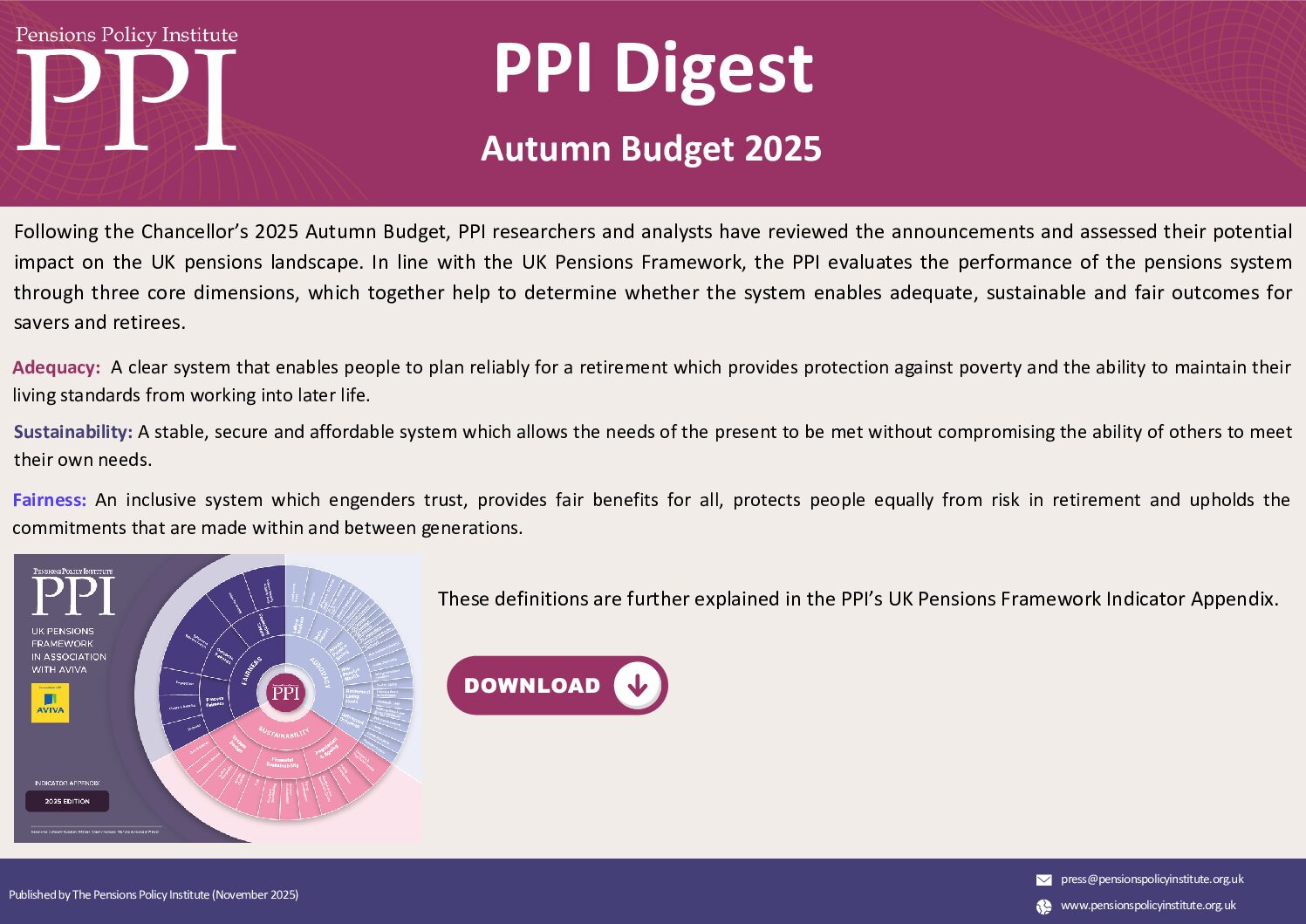
PPI Digest: Autumn Budget 2025

By Pensions Policy Institute Clearly, very difficult choices have had to be made in the Budget today. It was always unlikely that pensions would escape completely from this, even though both the Pensions Schemes Bill and the new Pensions Commission are seeking ways to increase the amount of money that future generations will have to support themselves in retirement. The introduction of a contributions cap of £2,000 on salary sacrificed pension contributions from 2029 will not affect many of those who...

Pensions at a Glance 2025: OECD and G20 Indicators

By Organisation for Economic Co-operation and Development The 2025 edition of Pensions at a Glance highlights the pension reforms undertaken by OECD countries over the last two years. It includes a special chapter focusing on pension differences between men and women. It shows recent and projected trends in the pensions of women relative to those of men in OECD countries, analyses the key drivers of the gender pension gap, and reviews the pension rules that directly or indirectly affect gender disparities in...

The longevity revolution: Preparing for a new reality

By Fidelity International There is a quiet revolution happening. It is not about climate change, market cycles or artificial intelligence. It is about time - more specifically, how much more of it we have, and the ability to do what we want with that extra time. For the first time in human history, older populations are growing at a faster pace than the youngest cohorts, ushering in an unprecedented demographic shift worldwide. By 2050, 2.1 billion people - nearly 22%...

Global pension trends: What to expect in 2026

By Julien Halfon  Pension reforms are at an inflection point as UK and Dutch pension systems enter 2026 with high funding ratios, regulatory clarity, and the scope to re-risk in controlled ways. We expect much wider adoption of cash-flow driven investing strategies for defined benefit plans and some re-risking for the forthcoming Dutch Collective Defined Contribution system. The high equity tolerance of US defined contribution plans is broadening, while allocations to private markets, particularly private credit and infrastructure, continue to...

The Nucleus UK Retirement Confidence Index 2025

By Nucleus Retirement is one of the most significant milestones in life, yet for many people across the UK it carries as much uncertainty as it does anticipation. Our Retirement Confidence Index offers a unique, in-depth look at attitudes, expectations, and concerns surrounding retirement across the UK at different life stages. Whether you're refining your client communications or shaping your advice proposition, these insights can help you stay ahead of your clients' expectations and build deeper trust. Surveying over 4,300 UK adults,...