April 2026

Dutch pension funds cut US exposure as rebalancing drives shift to Europe

Dutch pension funds were net sellers of US assets last year, reallocating capital towards Europe, according to figures from regulator DNB. On balance, funds sold €30bn of US equities and bonds, while purchasing €23bn of European securities. In 2025, pension funds sold €18bn of US government and corporate bonds and €12bn of equities. The decline was largely driven by civil servant scheme ABP, which divested more than €10bn of US government bonds. While US debt securities were predominantly sold, flows into European fixed...
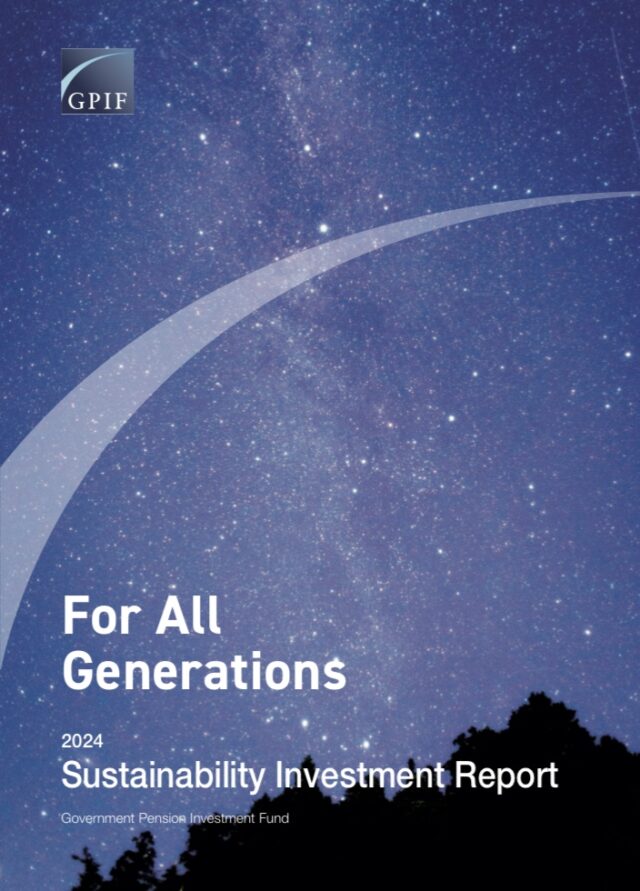

2024 Sustainability Investment Report

By Government Pension Investment Fund  The Government Pension Investment Fund, Japan (GPIF) has published the "2024 Sustainability Investment Report" as a way of reporting on GPIF's sustainability-related initiative, including Environmental, Social, and Governance (ESG), and the effects thereof to all pension beneficiaries and other stakeholders. In the "2024 Sustainability Investment Report," in addition to presenting the initiatives on sustainability investment undertaken during the year and the ESG evaluation of the portfolio, we also conducted the "Analysis of the Exercise of...

Climate Change as a Threat Multiplier in Contemporary Conflicts: Pathways, Evidence, and Legal-Policy Responses

By Hope Tendo This paper examines climate change as a “threat multiplier” in contemporary conflicts by analysing its causal pathways, empirical support, and the legal-policy responses required to mitigate associated security risks. It argues that climate change rarely operates as a direct driver of violence but instead intensifies existing socio-economic, political, and institutional vulnerabilities. The study evaluates scholarly and policy literature demonstrating that climatic stress interacts with fragile governance, contested land and resource tenure, livelihood insecurity, migration pressures, and state...

Large Language Models in Financial Decision-Making: A Methodological Framework for Evaluating AI Trading Strategies

By Theo Nicolas Sitjar Large Language Models (LLMs) offer new possibilities for financial decision-making, but evaluating their effectiveness in trading requires systematic approaches. This paper describes a practical framework for assessing LLM performance in stock market scenarios. Our method follows a 5-step process: data preparation, prompt engineering, LLM inference, backtesting, and statistical analysis. We include memory mechanisms and standard risk metrics to evaluate trading strategies comprehensively. Through testing against fifteen traditional quantitative baseline strategies, we examine both the potential benefits...

March 2026

US issues draft rules on private assets in 401k plans

The U.S. Department of Labor on Monday issued long-awaited proposed new rules intended to clarify how trustees can add alternative assets ranging from private ​equity to cryptocurrencies to 401(k) retirement plans. The measure, which is intended to ‌ease long-standing barriers to incorporating these less liquid assets in American retirement nest eggs, follows an executive order by President Donald Trump last summer and could clear the way for alternative ​asset management firms to tap a large and potentially lucrative new source ​of capital. Shares...

Australian $240 billion pension fund snaps up Japanese, European stocks and UK bonds

Australia's No.2 pension fund has ​increased its global equities, Australian and British bond investments, some of the world's most sold-off ‌asset classes, in the past month to take advantage of financial market volatility created by the Iran war. The Australian Retirement Trust, which has A$350 billion ($240.42 billion) in funds under management, is carrying out more direct market trading than usual, according to ​Jimmy Louca, a senior portfolio manager at the fund. ART has a dynamic asset allocation strategy in ​which...

US. Private-Credit Wobbles Could Prove Perilous for Trump

At a meeting of the Financial Stability Oversight Council this month, Trump administration officials moved ahead with plans to scale back scrutiny of hedge funds, encouraged financial firms to experiment with artificial intelligence and lamented the burden of onerous regulation. What wasn’t discussed during the public session was the segment of the financial system that has Washington and Wall Street most on edge: private credit. The once-booming corner of lending markets has been showing signs of shakiness recently, raising alarm...

UK. Pension investment in affordable housing constrained by ‘practical barriers’

Pension investment in affordable housing is being constrained by a series of practical barriers, rather than a lack of capital or willingness to invest, a report from Nest Insight has shown. Its research, which explored whether money from pension funds could help build more social and affordable homes, highlighted two ‘parallel crises’ in the UK housing system. These were a crisis of home ownership for those who cannot afford to buy a house, and a crisis of options for people living...

Pensions get selective as geopolitical risk, energy shocks hits global markets

As geopolitical turmoil continues to shape markets, pension investors are being forced to adjust their portfolio playbook accordingly. But David Kletz, lead portfolio manager at Forstrong Global Asset Management, warns that complacency remains a dangerous undercurrent across institutional portfolios. He sees a disconnect between the scale of geopolitical turmoil and how markets are responding to it. And despite significant moves in asset prices, global equity markets have not priced in the possibility that current conflicts could escalate further "I think there's...

​Climate risks ‘still mispriced’ despite $1.3trn corporate exposure

Financial markets may still be underestimating the investment impact of extreme weather, despite listed companies facing an estimated $1.3trn (£1trn) in losses over the next year alone, according to a new report from the Sustainable Markets Initiative (SMI). The report, developed by Marsh Risk along with Impax Asset Management’s Sustainability Centre, argues that physical climate risks are already affecting portfolios through asset damage, supply chain disruption, and impaired company performance – but are not yet being fully reflected in valuations. Its...