October 2026

Japan pension fund GPIF broadens sustainability investing beyond ESG indexes

Japan’s Government Pension Investment Fund (GPIF) is broadening its sustainability investment approach beyond its reliance on ESG index strategies as it seeks to improve long-term performance across its portfolio. GPIF outlines the shift in its 2025 Sustainability Investment Report, published on October 15. The report reflects the Sustainability Investment Policy established in March 2025 and sets out a broader approach combining multiple strategies to reduce sustainability-related risks, improve market sustainability and secure market-average returns. The pension fund says its fiscal 2025...


Do the Japanese elderly prefer robotic care?

Population aging and shortages of long-term care workers have increased interest in care-giving robots and information and communication technology (ICT). This paper provides novel large-scale evidence on older individuals’ perceptions of such technologies, drawing on a custom-designed internet survey of 4,314 Japanese individuals aged 55 to 75. Respondents choose between two otherwise identical nursing homes: one in which all care is provided by human caregivers, and one in which robots and ICT are used to provide a substantial share...

September 2026

Japan centenarian population reaches 100,000 as welfare costs rise

The number of centenarians in Japan now exceeds 100,000 for the first time, a milestone that highlights the country’s remarkable longevity as well as the mounting costs of caring for its rapidly ageing population. The number of people who are 100 years old or older climbed to a record 107,677 as of Sept 15, according to a Health Ministry report released that day. The tally has risen sharply over the decades, from just 153 centenarians when records began in 1963...

Pensions from Capital: How Pension Funds in the United States, Japan and Europe Invest -and What Private Investors Can Learn from Them

By Roland Rupprechter This paper examines the pension funds of the large industrial countries — with more than USD 68 trillion between them, the heaviest group of investors in the world. It compares how funded retirement provision is organised in the United States, in Japan and in Europe: how state, occupational and private provision differ, who grants which tax advantages to whom and at what level, and why equity quotas diverge so widely across regions — from 25 per cent...

August 2026

Japan’s inflation paradox is creating winners and losers. Pensioners are the second

In the coastal city of Murakami, the 72-year-old widow relies on a monthly pension of ¥110,000 ($671). In April kerosene costs alone ate up more than a third of her budget, because of the Iran war. “When I don’t have money, I just have to put up with it because I have no other choice,” she says. With many senior citizens facing a similar situation in her community, Murakami passed a petition in December, urging Prime Minister Sanae Takaichi to...

Japan proposes tougher income, pension rules for permanent residency

Japan’s immigration agency on Aug 4 proposed tougher requirements for granting permanent residency to foreigners, including requiring applicants to maintain income above the average for Japanese households and a certain level of projected pension benefits. The proposed guidelines are part of Prime Minister Sanae Takaichi’s push to create an “orderly society” in which Japanese and foreign nationals coexist while cracking down on illegal activities. The Immigration Services Agency will solicit public comments before implementing the new rules from April 2027. Permanent residents can...

June 2026

Why Hasn’t the Labor Shortage Pushed Up Real Wages?

For a dozen years, the Bank of Japan, the government, and stockbrokers have all been promising that a labor shortage in Japan will soon push up wages. And that faith is behind the BOJ’s decision that it’s time to normalize interest rates. Here’s the argument. Due to the declining working-age population, companies in 2014 offered 1.2 jobs for every job seeker. By 2019, the ratio had climbed to 1.6 and is now 1.2. So, it is argued: when demand...

April 2026

Japan pension fund GPIF urges stronger stewardship to boost long-term returns

Japan’s Government Pension Investment Fund (GPIF) said on Friday it will step up expectations for external asset managers to strengthen stewardship activities, including deeper corporate engagement, as part of efforts to enhance long-term investment returns. Stewardship — including environmental, social and governance (ESG) considerations — would be pursued from the perspective of improving long-term returns, said the world’s largest pension fund, with about US$1.8 trillion in assets under management, in its 2025/2026 stewardship activities report, which outlined its approach for the five-year period through March...

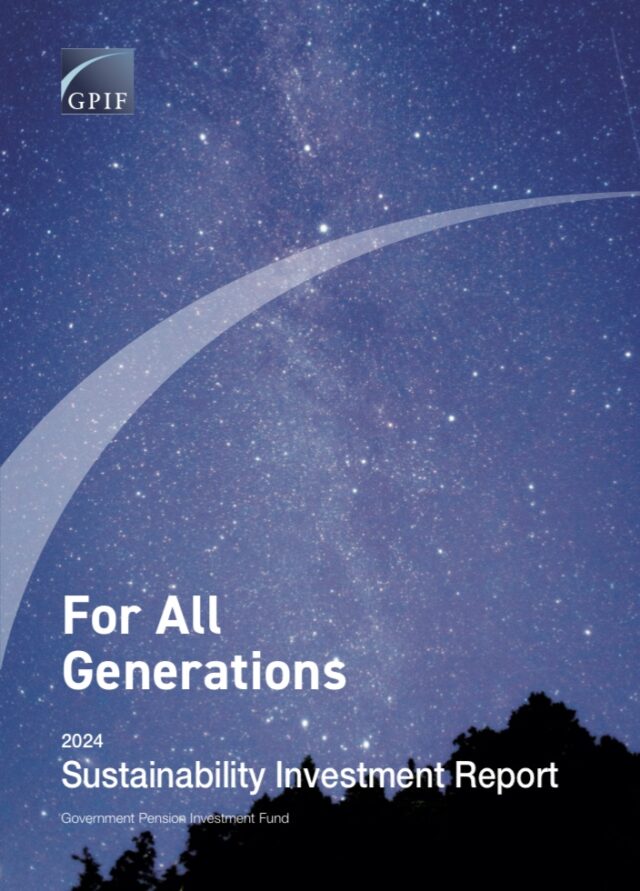
2024 Sustainability Investment Report

By Government Pension Investment Fund  The Government Pension Investment Fund, Japan (GPIF) has published the "2024 Sustainability Investment Report" as a way of reporting on GPIF's sustainability-related initiative, including Environmental, Social, and Governance (ESG), and the effects thereof to all pension beneficiaries and other stakeholders. In the "2024 Sustainability Investment Report," in addition to presenting the initiatives on sustainability investment undertaken during the year and the ESG evaluation of the portfolio, we also conducted the "Analysis of the Exercise of...

March 2026

Universal Owner and Impact of Its Engagement Program: An Analysis of Engagement Records of Japan’s GPIF

By Masahiro Shibata & Kazunori Suzuki This study examines the impact of Japan’s Government Pension Investment Fund (GPIF) engagement program, leveraging a proprietary dataset of 26,792 engagements across 21 externally managed funds from fiscal years 2017 to 2022. As one of the largest universal owners globally, GPIF plays a pivotal role in influencing corporate behavior through structured engagements aimed at improving corporate governance, environmental sustainability, and financial performance. Despite growing global interest in engagement-driven stewardship, empirical evidence on its effectiveness...