May 2026

The Duty to Explain: Fiduciary Intelligibility Under ERISA

By Ian Edwards This Essay examines whether the Employee Retirement Income Security Act of 1974 (“ERISA”) contains an emerging principle of fiduciary intelligibility within its participant disclosure framework. ERISA requires Summary Plan Descriptions (“SPDs”) to be written in a manner “calculated to be understood by the average plan participant.” While modern pension disclosure has become increasingly sophisticated and financially technical, this Essay argues that administrative and financial disclosure are not necessarily equivalent to fiduciary intelligibility. The Essay does not propose a...

Zero-Trust Architecture for Multi-Tenant SaaS Platforms on AWS:A Practitioner Framework for Authentication, Authorisation, and KYC in Regulated Financial Services

By Alan Terriaga Multi-tenant Software-as-a-Service (SaaS) platforms operating in regulated financial services face a unique intersection of security, compliance, and operational challenges that traditional perimeter-based architectures cannot adequately address. This paper presents a practitioner framework for implementing Zero-Trust Architecture (ZTA) across all layers of an AWS-hosted SaaS application, with particular focus on the authentication, authorisation, and Know Your Customer (KYC) verification pipelines that underpin financial compliance obligations. Drawing on direct engineering delivery experience leading IAM systems in regulated multi-tenant environments, we...

Agency Costs Beyond Corporations: Evidence from Pension Funds

By Clemens Böhlen This paper examines the role of agency costs in pension fund performance. Grounded in corporate agency theory, it exploits institutional variation in a unique dataset on the Swiss pension system to assess how differences in monitoring incentives affect investment outcomes. Specifically, I examine the role of the sponsoring company and show that multi-employer funds underperform institutionally comparable single-employer funds by 25-31 basis points per year, in line with weaker governance incentives. Consistent with corporate agency theory, these...

Iran Conflict: How Long, and How Bad?

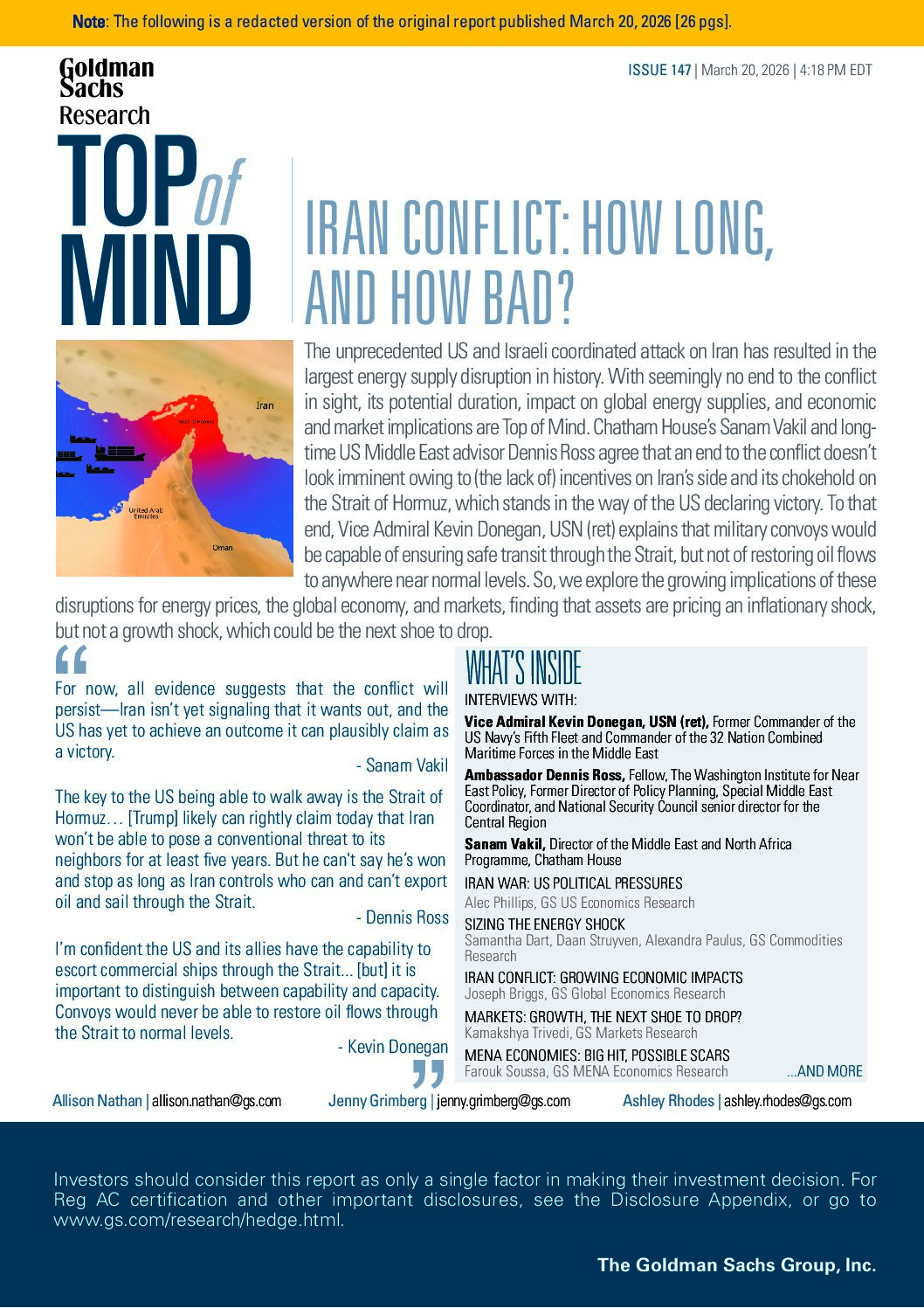
By Goldman Sachs The unprecedented US and Israeli coordinated attack on Iran has resulted in the largest energy supply disruption in history. With seemingly no end to the conflict in sight, its potential duration, impact on global energy supplies, and economic and market implications are Top of Mind. Chatham House’s Sanam Vakil and longtime US Middle East advisor Dennis Ross agree that an end to the conflict doesn’t look imminent owing to (the lack of) incentives on Iran’s side and...

March 2026

Universal Owner and Impact of Its Engagement Program: An Analysis of Engagement Records of Japan’s GPIF

By Masahiro Shibata & Kazunori Suzuki This study examines the impact of Japan’s Government Pension Investment Fund (GPIF) engagement program, leveraging a proprietary dataset of 26,792 engagements across 21 externally managed funds from fiscal years 2017 to 2022. As one of the largest universal owners globally, GPIF plays a pivotal role in influencing corporate behavior through structured engagements aimed at improving corporate governance, environmental sustainability, and financial performance. Despite growing global interest in engagement-driven stewardship, empirical evidence on its effectiveness...

Non-contributory Pension Programs and Intra-household Inequality

By José L. Casco Non-contributory pension schemes are increasingly prevalent as countries seek to combat poverty, yet their role in shaping inequality remains underexplored. This paper studies how such programs alter intra-household inequality using data from Mexican household income and expenditure surveys. The analysis first examines a local pension program in Mexico City, embedding an age-based quasi-experimental design to identify beneficiaries within a structural model of extended households. Results show that the program shifted resources from men to women and...

Mortality Risk Valuation in Policy Assessment. A Global Meta-Analysis of Value of Statistical Life Studies

By OECD Policymakers are often faced with decisions affecting human health and mortality risk. For example, new vehicle fuel efficiency standards may lead to higher costs for consumers but could also save lives by improving air quality in urban areas, thus creating a trade-off between economic costs and the value of reducing mortality risk. Yet, too often, these economic trade-offs are not assessed in a systematic manner using a consistent methodology. This report aims to equip policymakers with the methodologies and economic...

Managing Retirement Risk: Policy Choices in Pension Fund Administration

By Fawaz Adediran & Oluwatobiloba Yomi-Oshatimi This article critically examines the legal and institutional framework governing pension administration and Pension Fund Administrators in Nigeria under the Pension Reform Act 2014. It analyses the structure of the contributory pension scheme, focusing on the statutory separation between Pension Fund Administrators and Pension Fund Custodians as well as the fiduciary obligations imposed on administrators, and the supervisory mandate of the National Pension Commission. The study situates Nigeria's pension reforms within the broader global...

February 2026

Mission Driven Public Sector Pension Investment Board

By PSP Investments  Our mission inspires us. Together with our mandate. it shapes how we invest. We focus on the long term and seek to caretully consider sustainability-related risks and opportunities that may affect long-term value creation and the resilience of our portfolio. We are progressively embedding accountability for sustainability across the organization. As we proceed, we are learning and evolving our strategies with the aim of reaching better investment outcomes and improving our ability to deliver on our mandate. This report...

Multidisciplinary Pathways to Retirement Financial Literacy: An Experimental Comparison of Gamified and Infographic Interventions

By Chrizaan Grobbelaar & Liezel Alsemgeest Due to population ageing and a decline in the working-age population, retirees can no longer rely on government support in retirement, making financial literacy even more important for society to plan for retirement. The current low financial literacy levels globally are evident in the vast number of retirees retiring unprepared. Educating a society on the basics of financial literacy is not enough for them to make sense of pension rules, tax implications, or make...