March 2024

U.S. Centenarians Projected To Quadruple By 2054—Will You Be Prepared?

In 30 years. the number of people reaching age 100 in the U.S. is projected to quadruple, according to a recent report from the Pew Research Center. The center projects that by 2054, the U.S. will be the home of 422,000 centenarians, up from 101,000 in 2024. And the percentage of the total population that is age 100 or older will increase from 0.03% today to 0.1% in 2054. The projected increase in super-agers is one sign of the increased health and...


US. More households are prepared for retirement – but this good news might not last

Even with the improvement, two out of five households are still at risk, according to the National Retirement Risk Index. The release of the Federal Reserve's 2022 Survey of Consumer Finances (SCF) offers an opportunity to reassess Americans' retirement preparedness as measured by the National Retirement Risk Index (NRRI). The NRRI estimates the share of American households that are at risk of being unable to maintain their preretirement standard of living in retirement. Constructing the NRRI involves three steps: 1) projecting a replacement...

UK. Updated: Risk of ‘unintended consequences’ from DC pension reforms

Plans to force defined contribution (DC) schemes to publicly disclose their level of investment in the UK and improve the performance of poorly performing schemes could risk having “unintended consequences” – causing plans to become more risk averse and potentially “compromising” trustee fiduciary duties. On Saturday (2 March), chancellor Jeremy Hunt announced proposals to require DC funds to disclose their levels of investment in British businesses, as well as their costs and net investment returns. He said they would also need...

US. Pension Funds Are Tapping Affordable Housing for High Returns — Not the Social Benefits

While affordable multi-family housing has become a key part of some pension funds’ real estate allocations, most of these funds are selecting investments that don’t have long term affordability in mind. This is according to new research from the Federal Reserve Bank of New York. The FRBNY has embarked on a research project to explore investments by institutions, specifically state pension plans, in multifamily housing. This is the second in a series of papers on the subject. The first, “Alternative...

US. Retirement Account Balances Hit Their Highest Levels in Nearly Two Years

Key Takeaways 37% of workers increased their retirement savings contribution in 2023, boosting average account balances to their highest levels in nearly two years. Fidelity recommends that individuals save at least ten times their income by age 67, or 15% of their annual pre-tax income each year, to retire comfortably. As of year-end 2023, the average 401(k) balance of Gen X workers had reached more than half a million dollars ($501,000). Improved market conditions and consistent contributions boosted average retirement...

Pension Funding Index February 2024

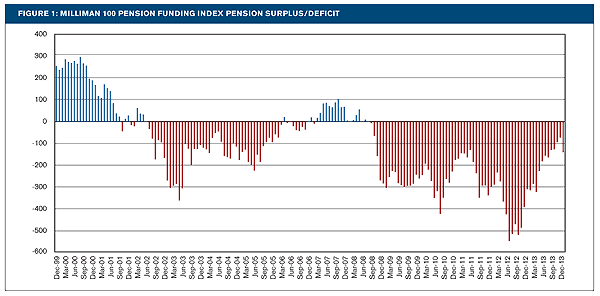
By Zorast Wadia The funded status of the 100 largest U.S. corporate defined benefit pension plans increased by $12 billion during January as measured by the Milliman 100 Pension Funding Index (PFI). The funding surplus improved to $40 billion as a result of liability decreases that outweighed asset losses during the month. Pension liabilities fell due to an increase in the benchmark corporate bond interest rates used to value those liabilities. As of January 31, the plans’ funded ratio climbed...

Fiscal Stimulus or Debt Relief: The Effect of Federal Pandemic Aid on State and Local Pensions

By Grace Brang, Sewin Chan & Travis St. Clair Between 2020-2021, the U.S. federal government passed four major pieces of legislation that included nearly $1 trillion in aid to state and local governments. One concern with distributing federal stimulus in the form of intergovernmental transfers is that subnational governments may use the aid to pay down unfunded pension liabilities or other debt rather than preserve employment. We examine the effect of fiscal stimulus passed in response to Covid-19 on public...

Financial Fragility, Financial Resilience, and Pension Distributions

By Robert L. Clark & Olivia S. Mitchell We evaluate Americans’ financial robustness during the Covid-19 pandemic, using measures of financial resilience and financial fragility derived from US surveys of persons age 45-75 from 2020 to 2022. We analyze which factors were associated with resilience and fragility, discuss how these measures changed during the pandemic, and assess whether pre-pandemic resilience led to better outcomes during the period. Results show that stronger resilience was protective in terms of financial fragility, and financial literacy...

US. Retirement Savings System Under Fire at Senate Hearing

A hearing that was billed as “taking a serious look at the retirement crisis in America” with a focus on improving the defined benefit system ended with witnesses agreeing that some reforms are needed, but calling for drastically different measures. The Feb. 28 hearing was held by the Senate Health, Education, Labor and Pensions (HELP) Committee, which is chaired by Sen. Bernie Sanders (I-Vt.). Included among the single panel of witnesses testifying were: Teresa Ghilarducci, Irene and Bernard L Schwartz Professor of...

US. New York Fed Case Study Finds Pension Funds Invested More Frequently in Preserving Existing Affordable Housing than New Development

The Federal Reserve Bank of New York today released a case study focused on pension fund investments in affordable apartments. The case study, “Alternative Investments in Community Development: A Case Study of Pension Fund Investments in Multifamily Affordable Housing,” is based on a survey of a non-representative sample of seven pension funds that made commitments totaling over $2.7 billion for investments in affordable apartments during a five and a half-year period ending June 2023. The case study also found...