March 2024

Unpackaging ESG: Evidence from 401(k) Investment

By Jiaxing Tian & Jiahong Shi We study how investors respond to scandals related to three distinct aspects of ESG--E(nvironmental), S(ocial) and G(overnance)--in their retirement savings. Using data on 401(k) investments, we show that nearby ESG scandals correlate with increased ESG fund additions and flows, possibly through ``evoking'' their existing sustainable preferences. Investors with different characteristics respond heterogeneously to E, S and G scandals. In magnitude, old investors are twice as likely as young investors to add ESG funds to...


The Lifelong Benefits of Improved Financial Literacy

By Annamaria Lusardi Annamaria Lusardi talked with Retirement Management Journal Editorial Advisory Board Members in June 2023 about benchmarking and assessing financial literacy, how it compares globally and why it matters, and providing financial education to improve retirement readiness. Source SSRN

An Assessment of the 2019 and 2020 Pension Reforms in Mexico

By Boele Bonthuis In recent years the Mexican pension system has changed significantly. In 2019 the existing means-tested social pension was made universal – covering everyone over the age of 65 – and the benefit level increased. In 2020, the main regime of the private sector was substantially reformed, increasing contribution rates for the funded defined contribution system, lowering the minimum years of contributions needed to receive an earnings-related pension, and increasing minimum pensions. This paper tries to assess the...

Tras la catástrofe de los retiros, los fondos de pensiones se recuperan

Por Observatorio Perspectivas  Informe Financiero-Primer Trimestre 2024. Tras la catástrofe de los retiros, los fondos de pensiones se recuperan. Tomó más de tres años y medio recuperar el nivel de ahorro para las pensiones que había antes de los retiros del 10%, pero se perdió la oportunidad de ir más allá con las ganancias por rentabilidad. Asimismo, se constata que persisten amenazas de la misma índole, como los autopréstamos. Libro completo aquí   

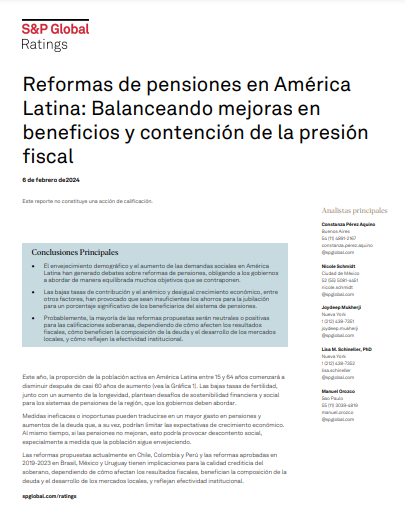
Reformas de pensiones en América Latina: Balanceando mejoras en beneficios y contención de la presión fiscal

Por Constanza Pérez Aquino, Nicole Schmidt, Joydeep Mukherji, Lisa M. Schineller & Manuel Orozco El envejecimiento demográfico y el aumento de las demandas sociales en América Latina han generado debates sobre reformas de pensiones, obligando a los gobiernos a abordar de manera equilibrada muchos objetivos que se contraponen. Las bajas tasas de contribución y el anémico y desigual crecimiento económico, entre otros factores, han provocado que sean insuficientes los ahorros para la jubilación para un porcentaje significativo de los beneficiarios...

Estudio de los mecanismos de mitigación del riesgo de longevidad en seguros y pensiones

Por Manuel Jesús López Bausan El presente trabajo tiene dos objetivos principales. El primero es el estudio de los mecanismos de transferencia del riesgo de longevidad en los mercados financieros que se han desarrollado en los últimos años, sus características y ventajas e inconvenientes. El segundo objetivo es desarrollar modelos de valoración de estos instrumentos según diferentes hipótesis de mortalidad futura y distintos mecanismos de formación de precios. Fuente Universitat de Barcelona  

Análisis financiero y tributario del sistema de pensiones portugués semejanzas y diferencias con el sistema de pensiones español

Por Carlos David Aguilar Segado  El sistema de pensiones portugués se asemeja al modelo español al estructurarse en torno a los tres pilares básicos de las pensiones públicas obligatorias, tanto contributivas como no contributivas, y de las pensiones privadas complementarias, tanto empresariales como individuales, basadas en el modelo de seguro profesional prusiano del siglo XIX. Ambos países han reformado estos sistemas, tanto por los problemas demográficos de descenso de la natalidad y aumento de la longevidad, como por el alcance...

The gender pensions gap report 2024

By Joanne Segars, Lizzy Holliday & Laura Wilkinson The gender pensions gap- the difference in pension savings wealth between men and women at retirement age - is substantial. Allowing for typical working patterns, women's pension wealth is a third (33%) less, relative to men. These figures are the result of a lifetime of reduced earnings potential, increased time out of the workforce and other contributory factors. To bridge this gap themselves, women would need to work an extra 19 years in...

Gender Pension Gap in EU Countries: A Between-Group Inequality Approach

By Antonio Abatemarco, Elena Lagomarsino & Maria Russolillo  Pension entitlements are influenced by individual career paths and labor market conditions, which often result in gender-based disparities. Women face several challenges during their working lives, such as late entry into the labor market, the gender pay gap, discontinuous working careers, and early retirement due to family caregiving, which lead to lower pension incomes. This paper investigates the gender pension gap in nine European Union countries from 2004 to 2020. Our study...

The gender pension gap: What does it tell us and what should be done about it?

By Miglena Abels, Loli Arribas-Banos & Gustavo Demarco Despite recent attention in the media, progress in closing the gender pension gap in most countries has halted. These sources point to a stark disparity in retirement outcomes, with women receiving pensions that are between 25% to 30% lower than those of men. Methodological differences to estimate the gap don’t make it less striking and are no excuse for inaction. Source World Bank