October 2025

Pension Design and General Public Finances: Beyond Baseline Actuarial Neutrality

By Didier Blanchet & Gilbert Cette The design of pension benefits cannot be considered in disconnection from the constraints related to the general public finances. A change in the average retirement age has an impact not only on pension funding, but also on resources available for other public spending. Incorporating this externality implies penalties/bonuses for earlier/later retirement that are much higher than those designed to balance the pension system alone. Source SSRN


September 2025

Boosting Retirement Income through Dynamic Withdrawals

By Ravi Saraogi Dynamic withdrawal strategies, extensively researched internationally, remain underexplored in India. This paper bridges this significant research gap by rigorously evaluating popular dynamic withdrawal methods using Indian data. Employing simulations based on historical equity, debt and inflation data from the Indian market, we compare 10 different adaptive and dynamic withdrawal strategies. The study demonstrates that dynamic strategies can improve withdrawals and sustainability compared to static withdrawal methods. However, this improvement comes at a significant cost of volatility in...

2025 Read on Retirement survey

By BlackRock Workplace savers are feeling more confident about retirement—but plan sponsors aren’t on the same page. As the gap in outlook widens, advisors have a critical role to play. Uncover the insights shaping this divide. Navigating uncertainty and a growing divide Saver confidence is up but fragile. This year’s dip underscores how closely confidence tracks with market volatility. And while savers feel increasingly sure, only 38% of employers believe the majority of their employees are truly on track—a record low. The...

Ndc Benchmarking and Actuarial Fairness in Spain’s Db Pensions: Retirement, Disability, and Survivor Reversibility

By Carlos Vidal-Meliá We apply an actuarially grounded Notional Defined Contribution (NDC) counterfactual to benchmark Spain’s pay‑as‑you‑go Defined Benefit (DB) pensions using administrative microdata (MCVL, 2015–2023). From observed contribution histories we reconstruct notional capital, price DB liabilities with contingency‑, gender‑ and income‑stratified mortality—adding severity‑ and onset‑adjusted tables for disability—and quantify actuarial fairness via money’s‑worth ratios (MWR), real internal rates of return (IRR), and notional–cost gaps. A unified treatment of retirement, disability, and survivor reversibility employs joint‑life valuation.Results show pervasive actuarial...

Economic and Distributional Effects of Demographic Shifts: Evaluating Pay-as-You-Go and Fully Funded Pension Schemes Based on the Greek Experience

By Zois Gerasimos Katsimigas, Christos Papatheodorou This paper examines economic and distributional consequences of demographic shifts by comparing pay-as-you-go (PAYG) and fully funded (FF) pension schemes in a macroeconomic framework, using Greece as a case study. Facing acute ageing and population decline, Greece provides a unique context to assess the performance of these schemes. We develop a post-Keynesian stock-flow consistent (SFC) model calibrated to the Greek economy to simulate the macroeconomic and distributional outcomes of both schemes under projected demographic...

Integrating Risk Management into Personal Financial Decisions

By Navin Kumar Effective personal financial planning demands navigating a landscape of uncertainty. This chapter explores how integrating risk management practices into personal finance decisions empowers individuals to achieve their financial goals. We begin by outlining the contemporary challenges individuals face and the importance of proactive planning. The chapter then delves into the concept of risk in personal finance, categorizing potential threats and their impact on financial stability. We highlight the benefits of a risk management approach, emphasizing its role...

Digital Pension Systems, Economic Growth, and Alleviation of Elderly Poverty

By Xue Wu Based on panel data from 31 provinces and municipalities in China (excluding Taiwan, Hong Kong, and Macau) from 2011 to 2023, this study empirically examines the relationship among the digital pension system, economic growth, and the alleviation of elderly poverty. The empirical analysis yields the following findings: (1) A well-developed digital pension system helps to alleviate elderly poverty; (2) Economic growth significantly mitigates elderly poverty; (3) The digital pension system serves as a mediating factor in the effect...

August 2025

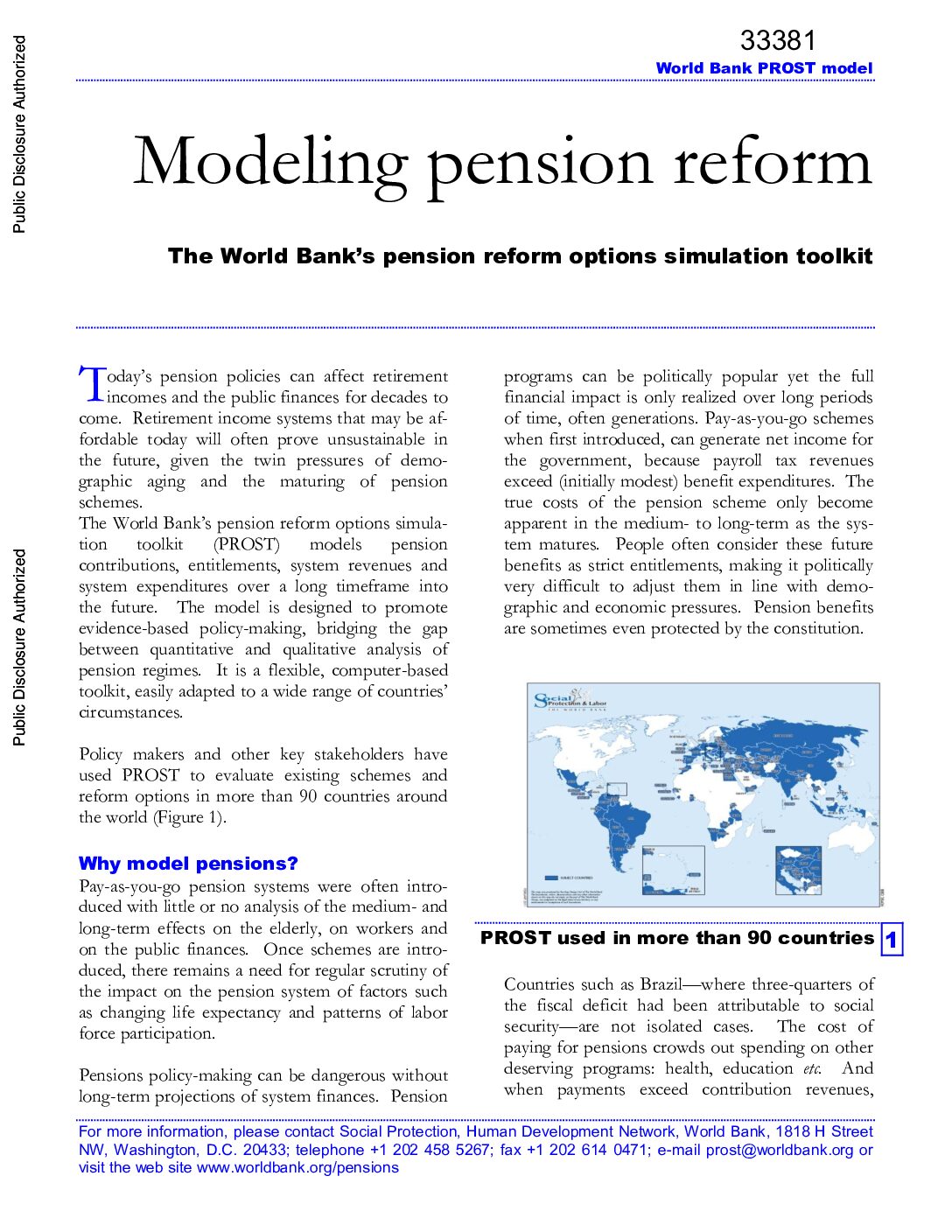
Modeling pension reform: The World Bank’s pension reform options simulation toolkit

By World Bank Group Today's pension policies can affect retirement incomes and the public finances for decades to come. Retirement income systems that are affordable today, will often prove unsustainable in the future, given the twin pressures of demographic aging and the maturing of pension schemes. The World Bank's pension reform options simulation toolkit (PROST) models pension contributions, entitlements, system revenues, and system expenditures over a long time frame. The model is designed to promote informed policymaking, bridging the gap between...

Shocks to Income in a Lifecycle Model: An Undervalued Risk

By Sebastian Gomez-Cardona Lifecycle models are increasingly popular in financial planning. However, they often overlook the significant risk posed by income shocks-such as career disruptions, economic downturns, or technological advancements-that can affect financial plans, including retirement. This paper explores the role these shocks have on shaping saving rates, financial capital accumulation, and asset-allocation decisions, with particular attention to the possible relationship between income shocks and equity returns. By integrating industry-specific income risk into asset allocation decisions, this research provides practical...

Pensions in Aging Asia and the Pacific: Policy Insights and Priorities

By Rafal Chomik, Philip O’Keefe & John Piggott This paper looks at how pension systems across Asia and the Pacific can overcome common challenges of low contributory coverage, inadequate social pensions, and failure to include the informal sector. Pension systems in the region also exhibit gender inequities, a lack of policy flexibility and attention to labor incentives, and underdeveloped governance. The paper reviews the structure and performance of regional pension systems, and makes proposals for an expanded role for social pensions...