December 2024

The widening gender wage gap in the gig economy in China: the impact of digitalisation

The gig economy, fundamentally relying on the digital economy, is often celebrated for its potential to expand employment opportunities and close gender wage gaps. However, research on its gender impacts in China, the largest developing country with a rapidly expanding gig sector, is notably lacking. Employing discrimination theory, the findings challenge the prevailing optimistic view on the role of the gig economy. Utilising the China Labour Dynamics Survey data from 2014, 2016, and 2018, and applying the Bourguignon, Fournier,...

November 2024

Chinese Pension Insurance, Risk Attitudes, and Household Asset Allocation

By Hua Chen, Han Xiao, Yunxiao Guo & Ding Li Optimising household asset allocation is vital for expanding domestic demand in developing countries. This study uses 2017, 2019, and 2021 China Household Finance Survey (CHFS) data to explore pension insurance's effect on asset allocation among Chinese households. Key findings include that higher pension balances encourage investments in riskier assets. Specifically, for every 10% increase in pension account balances, the likelihood of investing in the risk asset market rises by 5%, and...

Demanding dignity for delivery drivers in China’s precarious gig economy

In August 2024, a viral video from Hangzhou showed a delivery driver kneeling before a security guard after being fined for scaling a fence to save time. The incident ignited protests among delivery riders, exposing the exploitation embedded in China’s food delivery industry. This moment, combined with the release of Upstream, a Chinese blockbuster highlighting the struggles of gig workers, has intensified public discussion about the plight of the 12 million Chinese delivery riders navigating precarious conditions. Their challenges expose deeper...

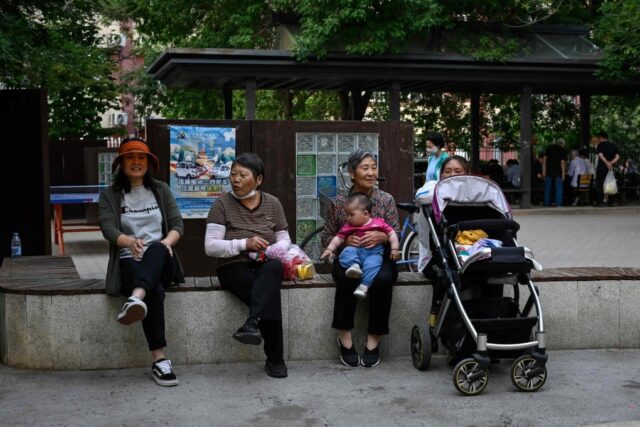
China’s economy adapts to serve older people

One person's aging is another's opportunity. In China, companies and services are adapting to serve what demographers call the silver economy - hundreds of millions of people over the age of 60. NPR's Emily Feng has this report. (SOUNDBITE OF MUSIC) EMILY FENG, BYLINE: This is a drumming club in southwestern China for people over 65 years of age only. They've occupied a large warehouse base and filled it with rows of drums and disco lights. ZHU NANFEI: (Speaking Mandarin). FENG: Zhu Nanfei,...

China. Recommendations made for strict implementation of China’s Social Insurance Law

The Standing Committee of the National People's Congress, China's top legislature, urges more sound and scientific regulations and law on the nation's social insurance operation after it sent an inspection team to review the implementation of the Social Insurance Law in recent months. The inspection team, consisting of 19 members, visited 16 cities and prefectures in six provinces from June to July, including Shanghai, Heilongjiang and Guangdong, to review the implementation of the social insurance law. The team also authorized...

October 2024

China. Beijing unveils policies for strengthening financial services

China's capital city Beijing has announced a series of policy initiatives for five key financial areas: tech finance, green finance, inclusive finance, pension finance, and digital finance. These initiatives aim to bolster the capital's new quality productive forces and foster high-quality development in each sector. The guidelines for advancing inclusive finance in Beijing encourage banks to increase lending to small and micro enterprises, focusing on first-time loans, renewals, credit loans, and long-term financing options. The document also promotes developing insurance...

Well-Being of Older People in East Asia: The People’s Republic of China, Japan, and the Republic of Korea

By Hidehiko Ichimura, Xiaoyan Lei, Chulhee Lee, Jinkook Lee, Albert Park, & Yasuyuki Sawada East Asia is undergoing a rapid demographic transition and “super” aging. As a result of steadily decreasing fertility and increasing life expectancy, older people’s proportion of the population and the old-age dependency ratio is rising across all countries in East Asia, particularly in the People’s Republic of China (PRC), Japan, and the Republic of Korea (ROK). In this paper, we empirically investigate the well-being of older...

Deep Dive: China raises retirement ages as birth rate drops and ageing population grows

Deep Dive delves into hot issues in Hong Kong and mainland China. Our easy-to-read articles provide context to grasp what’s happening, while our questions help you craft informed responses. Check sample answers at the end of the page. News: China raises retirement age as it battles economic slump Country’s top legislative body announced the move as a way to deal with its ageing population of workers More people are set to retire than to enter the workforce, putting China’s pension...

China sovereign wealth fund registers benchmark-beating return

China Investment Corporation (CIC) delivered a benchmark-beating return in 2023 on the back of putting greater emphasis on private assets such as private credits and green energy investments. CIC posted 6.57% of ten-year annualised net return as of year-end 2023, outperforming its long-term performance benchmark by 31 basis points, the sovereign wealth fund says in its annual report. The fund’s cumulative annualised net return was 6.23% since its inception in 2007. CIC says the global macroeconomic paradigm shift continued to evolve in...

China: Gradual increase to statutory retirement age

Employer Action Code: Act The government has approved legislation to increase the social security statutory retirement age by three to five years gradually over a 15-year period starting January 1, 2025. Key details Over the 15-year period starting January 1, 2025, normal retirement age (NRA) will gradually increase: From age 60 to 63 for men From age 55 to 58 for women in salaried positions From age 50 to 55 for women factory workers These are the first increases to NRA since the...