February 2024

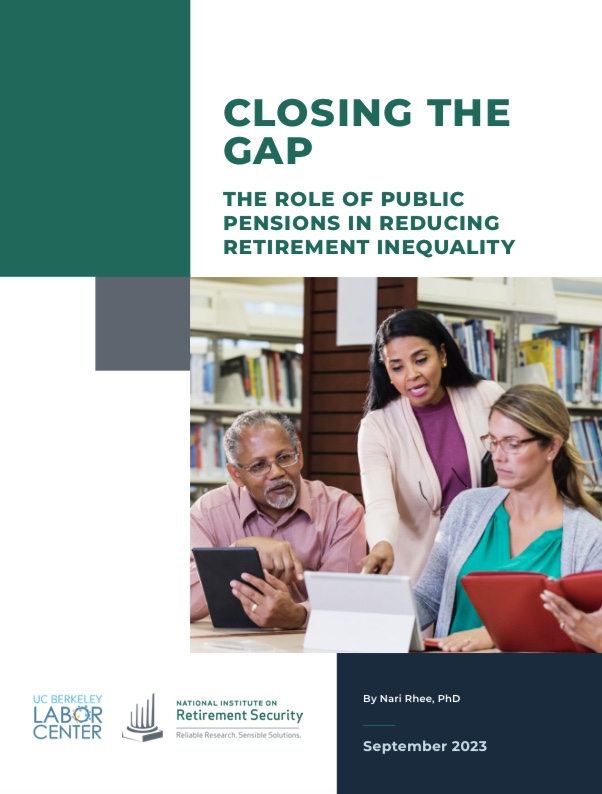
Closing the Gap: The Role of Public Pensions in Reducing Retirement Inequality

By Nari Rhee This study analyzes the impact of defined benefit pensions, especially public pensions, on retirement income security and wealth distribution by race, gender, and educational attainment in the U.S. It serves as a companion report to Closing the Gap fact sheets, which are designed to inform the public about the social equity impact of pensions in each state and the District of Columbia. Get the report here


Gender Inequality Over the Life Cycle, Information Provision and Policy Preferences

By Alessandra Casarico, Jana Schuetz & Silke Uebelmesser We conduct a survey experiment with four thousand German respondents and provide information on two measures of gender inequality, separately or jointly: the gender gap in earnings and the gender gap in pensions. We analyze the effect of information provision on respondents’ views on the importance of reducing gender inequality and on their agreement with the adoption of policies targeted at different stages of the life cycle and aimed at reducing the...

Home Equity and Retirement Funding: Challenges and Opportunities

By Vishaal Baulkaran & Pawan Jain We investigate the use of home equity to address the retirement saving crisis and funding shortfall. Using survey data from consumers and financial planners, we examine Canadian consumers’ views on equity release and gauge financial planners’ knowledge, attitudes, and perspectives toward recommending equity release products to their clients. Our findings indicate that a primary barrier for consumers is their lack of understanding about home equity release schemes. However, when these schemes are more cost-effective...

Gender Inequality Over the Life Cycle, Information Provision and Policy Preferences

By Alessandra Casarico, Jana Schuetz & Silke Uebelmesser We conduct a survey experiment with four thousand German respondents and provide information on two measures of gender inequality, separately or jointly: the gender gap in earnings and the gender gap in pensions. We analyze the effect of information provision on respondents’ views on the importance of reducing gender inequality and on their agreement with the adoption of policies targeted at different stages of the life cycle and aimed at reducing the...

January 2024

Inter-Generational Spillovers in Labor Supply: Evidence from a Danish Retirement Reform

By Malene C. F. Laczek In this paper, I study how the labor supply of one generation affects the next. Utilizing longitudinal Danish register data and a large retirement reform, I document that parents’ retirement significantly affects the labor supply of their adult children. This inter-generational link is driven solely by mothers. Concretely, mothers’ retirement permanently increases their adult children’s income rank by 7 income rank points, driven by increased hours worked, participation in the labor force, improved occupational rank,...

Social Security and Inequality in Belgium

By Giulia Klinges, Alain Jousten & Mathieu Lefebvre Over the years, the Belgian social security system has undergone substantial reform with a prime focus on increasing older worker labor force participation. The paper explores the effect of past reforms on inequality in old age. We distinguish two separate effects: The mechanical effect considers the change in inequality and expected benefit levels due to the reforms for a fixed retirement age distribution. The behavioral effect accounts for the endogenous change caused...

October 2023

Huge ethnicity pension gap revealed in UK figures

A UK individual from a minority ethnic background typically has a pension pot less than half the size of that belonging to the average white British saver, data reveal. The research from Legal & General’s investment arm claimed there was a sizeable “ethnicity pensions gap” in the UK that was being fuelled by “misconceptions” around pensions and a “significant distrust of employers”, as well as a lack of spare income. The average saver from a minority ethnic background has a pension pot of...

Understanding Financial Vulnerability Among Asians, Blacks, and Hispanics in the United States

By Andrea Hasler, Annamaria Lusardi, Olivia S. Mitchell & Alessia Sconti The COVID-19 crisis has brought to light the deeply rooted financial struggles that many people face in America, and it also exacerbated racial inequality. In particular, minority communities have been disproportionately impacted by the pandemic in many ways, making them ideal targets for efforts to promote financial well-being. This paper examines the financial vulnerability of Asians, Blacks, and Hispanics in the United States, along with potential drivers, using data...

US. The Racial Retirement Gap in 7 Facts

Building a financially secure retirement is an uphill climb for many Americans, but it’s especially steep if you are Black. The numbers paint a stark picture. Black workers ages 51 to 64 are the least likely among all racial and ethnic groups to have a retirement account, according to a July 2023 report from the U.S. Government Accountability Office. When they do have one, their median balance is far below that of similarly aged white adults across all income levels. The savings...

Understanding Trends in Hispanic and African American Retirement Preparedness in the US

By Edward Nathan Wolff  Retirement income security refers to households’ ability to provide an adequate income stream during the period of their retirement from the labor force. Expected retirement income is based on four components: standard wealth holdings, defined contribution pensions, defined benefit pensions, and social security benefits. Using the Survey of Consumer Finances, I find that Black and Hispanic households made remarkable progress in terms of retirement income, poverty reduction, and replacement rates over 1989-2007. This was followed by...