May 2023

Germany. Retirement Workers: The Solution To The Skills Shortage?

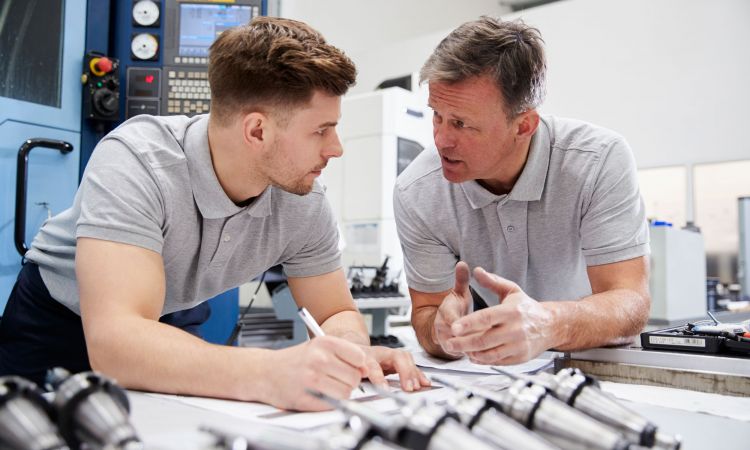
Kurt Marx repairs and maintains heating systems. He started as an apprentice almost 50 years ago. Actually, he could soon retire free of deductions. However, the service technician plans to continue working. Not for financial reasons: he likes the daily challenge of finding technical errors, he says. Above all, Marx wants to keep in touch with people. And he knows how difficult it is for his boss to find staff. “I’m probably not the exception, after all, specialists are...


Germany has a plan to tackle a rapidly aging workforce: recruiting robots

A robot takeover has long been the stuff of science fiction, but digitalization could be key in solving Germany’s labor shortage crisis, as its population ages. A record 45.9 million people were employed by Europe’s largest economy in the fourth quarter of 2022, the German Federal Statistical Office found. But, while more people than ever have jobs, over half of German companies reported that they were struggling to find skilled workers to fill vacancies, according to German Chambers of Commerce...

April 2023

Pension Reforms and Couples’ Labour Supply Decisions

By Hamed Markazi Moghadam, Patrick A. Puhani & Joanna Tyrowicz To determine how wives' and husbands' retirement options affect their spouses' (and their own) labour supply decisions, we exploit (early) retirement cutoffs by way of a regression discontinuity design. Several German pension reforms since the early 1990s have gradually raised women's retirement age from 60 to 65, but also increased ages for several early retirement pathways affecting both sexes. We use German Socio-Economic Panel data for a sample of couples...

February 2023

Social partner model spreads to small, medium-sized firms in Germany

Social partner model spreads to small, medium-sized firms in Germany The social partner model offering pure defined contribution (DC) plans is spreading mostly among small and medium-sized firms in the chemical sector in Germany, attracting employees who did not show interest in occupational pensions in the past. The German Federation of Chemical Employers’ Associations (BAVC), the social partner that started one of the first pure DC schemes in Germany, is currently seeing demand for social partner models for pensions in the...

January 2023

German government to set up foundation with up to €150bn for first-pillar pension reform

The German government plans to build a foundation under public law called Stiftung Generationenkapital to manage up to €150bn in assets in the long term for an equity fund to turn the first-pillar pension system into a partially funded platform based on the Aktienrente concept. The government will start to build the equity pension fund this year with starting capital worth €10bn, setting up a foundation that will “be anchored in law and independent from politics” to stabilise the first-pillar...

German Employers’ Associations call on government to act on pension reforms

The Confederation of German Employers’ Associations (BDA) is pressing the government to proceed swiftly towards reforming the country’s pension system this year, knocking down incentives to retire early. BDA president Rainer Dulger said that “2023 must be a year of action. Germany needs real and sustainable reforms. Now is the time to put the necessary reforms into practice, without any mental restrictions”. He also addressed labour market figures published on 3 January. According to the figures published by the federal employment...

December 2022

Germany. Companies Introduce Social Partner Model For Pensions

At first glance, the interest is extremely low: Of the 1,900 companies that the Federal Chemical Employers’ Association (BAVC) wrote to, only 50 had decided in favor of the new “Nahles pension” by the beginning of December. A rate of 2.6 percent. Nevertheless, Klaus-Peter Stiller, general manager of the association, is anything but disappointed. After all, the companies currently have other concerns in the energy crisis than adjusting their pension systems. “In this respect, the 50 companies that have...

Germany. Scholz wants to limit early retirement to weather German labour crisis

While Germany's chancellor Olaf Scholz has called for policies to discourage people from taking early retirement, the FDP is looking to Sweden for inspiration, considering the economic benefits of a more flexible retirement policy and how it may help plug the country’s labour shortage. Scholz calls for cutbacks in early retirements Germany’s chancellor Olaf Scholz has made an appeal to people over the age of 60, calling on them to delay their retirement. The SPD politician said that pension-age people delaying...

November 2022

Germany. Social partners move forward to implement pure DC plans

German employer and employee representatives are taking the first steps to implement the social partner models for pensions signed up recently, under a new legal framework, with other candidates planning to offer pure defined contribution (DC) schemes. The investment strategy under the social partner model set up by energy company Uniper with unions is taking shape, with a social partner advisory board – Sozialpartnerbeirat – constituted last week, that has decided on asset class allocation, and the upper limit of...

Germany prepares to reform all three pension system pillars

The German government is targeting a comprehensive reform of all the three pension system pillars during what it considers a turning point in history – Zeitwende – with high inflation, possible recession, changes in economic policies and demographic pressures. Speaking at the Handelsblatt occupational pension forum in Berlin today, Florian Toncar, parliamentary state secretary at the Ministry of Finance, said that the government will strengthen the capital funded components in all three pension system pillars, with the first pillar having...