May 2026

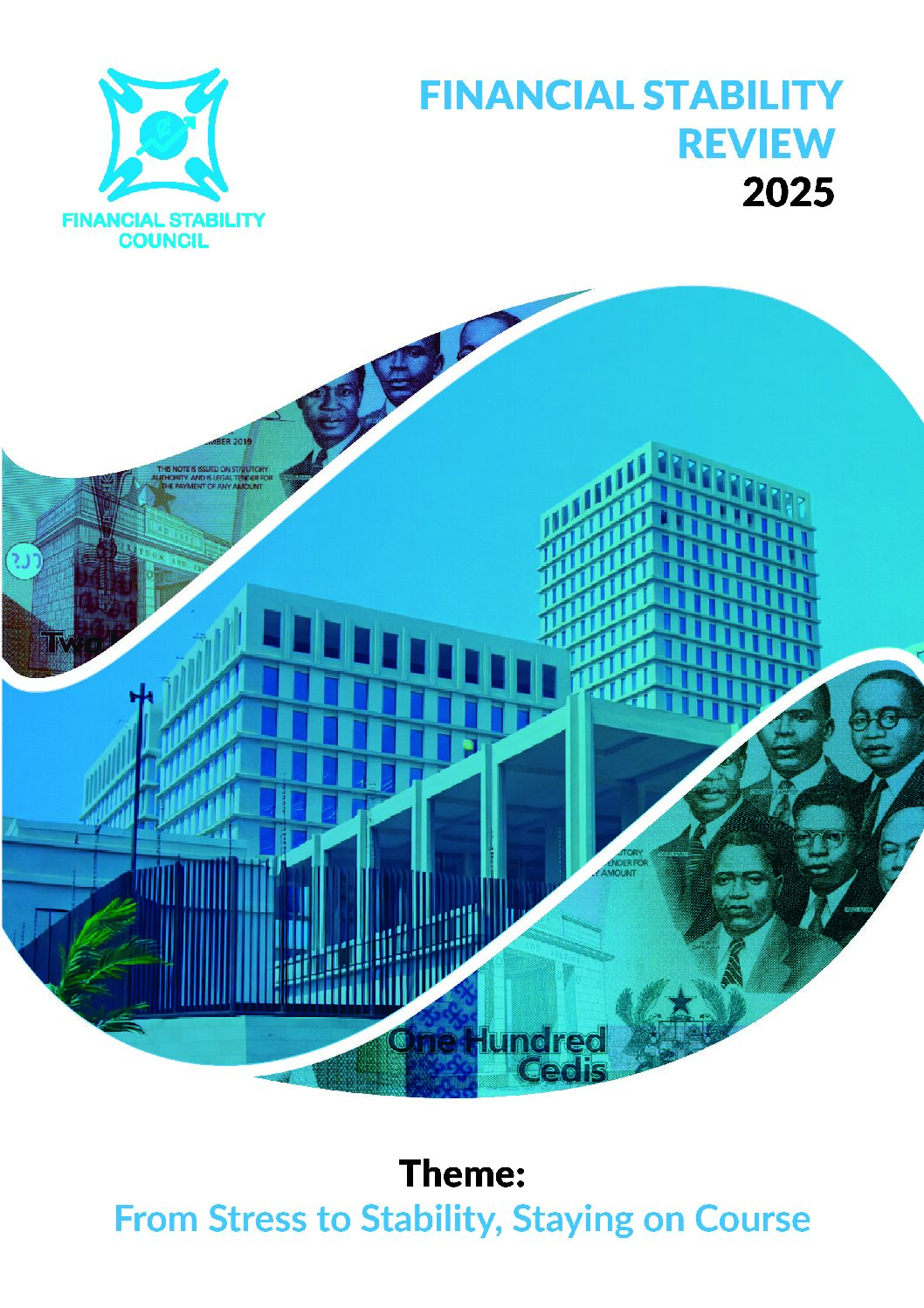
Financial Stability Review 2025

By Financial Stability Council The Financial Stability Review evaluates developments in Ghana’s financial system, with emphasis on policies implemented to mitigate emerging risks to financial stability. This report is organised into eight (8) chapters: macro-financial developments, developments in Ghana’s financial system, assessment of the Banking, Insurance, Securities, and Pensions Industries, financial sector resilience, and a special features section that highlights topical issues of relevance to financial stability. In this current edition, two new sections have been introduced – key Financial...

Ghana. Informal sector pension coverage rises to 16.7%

Pension coverage among informal sector workers in Ghana increased from 13.2 per cent in 2024 to 16.7 per cent in 2025, the Financial Stability Review 2025 has revealed. The Review attributed the increase to intensified public education campaigns, improved enrolment strategies, and the introduction of flexible pension products tailored to self-employed workers. The report said the growth formed part of broader reforms aimed at strengthening the sustainability of Ghana’s three-tier pension system and expanding access to retirement savings opportunities. It said the...

Ghana Financial Sector Assets Jump 23.3% in 2025

Ghana’s financial sector assets rose 23.3 per cent to GH¢647.25 billion in 2025, equal to 45.1 per cent of Gross Domestic Product (GDP), regulators said in their maiden stability review. The expansion was driven by steadier macroeconomic conditions, stronger capital buffers, and heavy bank holdings of government instruments, according to the Bank of Ghana (BoG). Profitability and solvency positions strengthened across all four supervised industries, namely banking, insurance, securities, and pensions. The figures were unveiled at the maiden launch of the...

NPRA deploys risk-based supervision to fortify Ghana’s pension industry

The National Pensions Regulatory Authority (NPRA) has taken a major step toward strengthening oversight and protecting contributors’ retirement funds with the full deployment of its Risk-Based Supervisory System (RBSS). According to the Chief Executive Officer of the Authority, Christopher Boadi Mensah, the reform marks a major institutional shift from traditional compliance-based supervision to a more targeted, intelligence-driven regulatory framework. Under the new system, NPRA can better monitor compliance and profile risks among industry players, identify early warning signs, and take preventive...

April 2026

Ghana: NPRA to Launch Digital Platform to Boost Informal Sector Pension Enrolment

THE National Pensions Regulatory Authority (NPRA) has announced plans to roll out a comprehensive pension digital platform aimed at significantly increasing pension coverage among informal sector workers across the country. The initiative forms part of a broader policy direction by the Authority to introduce targeted incentives that will encourage workers in the informal economy to enrol onto personal pension schemes and secure their retirement income. Speaking at a media engagement in Accra, the Deputy Chief Executive Officer of the NPRA, Mr...

Ghana. NPRA moves to prosecute over 11 employers for non-compliance

The National Pensions Regulatory Authority (NPRA) is tightening its grip on employers who fail to pay workers’ pension contributions, revealing that some 11 companies have already been taken to court over such violations. According to the Authority, these enforcement have led to the recovery of over GH¢27 million from defaulting employers' money that rightfully belongs to workers planning for life after retirement. But officials say this is only the beginning, warning that even stricter sanctions are on the way for those...

March 2026

Ghana. Unpaid Tier-2 Pensions: A Silent Crisis Demanding Urgent National Attention

In recent months, a troubling pattern has emerged across Ghana’s pension landscape. One that raises serious questions about accountability, transparency, and the welfare of retirees. Numerous complaints from pensioners, particularly those who retired in 2025, point to persistent non-payment of Tier-2 pension benefits. These are not isolated grievances; they reflect a systemic issue that demands urgent national scrutiny. At the center of these concerns are two key institutions: Social Security and National Insurance Trust (SSNIT) and the National Pensions...

Ghanaian pension funds to invest $11m in Atlantic Lithium as Ewoyaa Project gains momentum

A consortium of Ghanaian pension funds has committed millions of dollars to Atlantic Lithium, marking a landmark domestic investment in what is expected to become Ghana’s first lithium-producing mine and signalling growing local confidence in the country’s emerging critical minerals sector. The investment, valued at up to US$11 million, forms part of a broader funding package of about US$16.4 million secured by the company to advance its flagship Ewoyaa Lithium Project toward construction and production. The Ghanaian institutional investors, managed by...

Ghana. Informal sector employers who fail to pay employees’ pensions will be prosecuted – NPRA

The National Pensions Regulatory Authority (NPRA) in the Bono Region has cautioned employers in the informal sector to ensure the regular payment of their workers’ monthly pension contributions or face prosecution. Mr Enoch Okomfo Okonah, Assistant Manager in charge of Compliance at the Bono Regional Office of the NPRA, said employers who default could be fined up to 2,000 penalty units, pay the defaults, or be sentenced to two years imprisonment—or suffer both penalties. In an interview with the Ghana News...

February 2026

Ghana. SSNIT, Sustainability and the Transparency Question: Strengthening Pension Confidence

Ghana’s national pension scheme, established under the National Pensions Act, 2008 (Act 766), operates as a partially funded system. In such a structure, pensions are financed primarily from ongoing contributions by active workers, supplemented by returns on invested funds. Unlike a fully funded scheme, where benefits are paid strictly from accumulated savings for each contributor, a partially funded system relies on a mix of current inflows and accumulated assets. In this context, “reserves” do not function as a simple...