April 2025

Postponing Retirement Under Age Discrimination and Grandparenting

By Leqing Huang To tackle the population aging and improve the sustainability of the pension system, the Chinese government proposes to postpone the statutory retirement age gradually. However, when implementing this policy in China, age discrimination in the job market and grandchild care culture are two potential concerns. Therefore, this paper builds a multi-period OLG model with these two crucial factors to provide a quantitative evaluation of the potential policy impacts on population growth, labor supply, and pension funds. The...
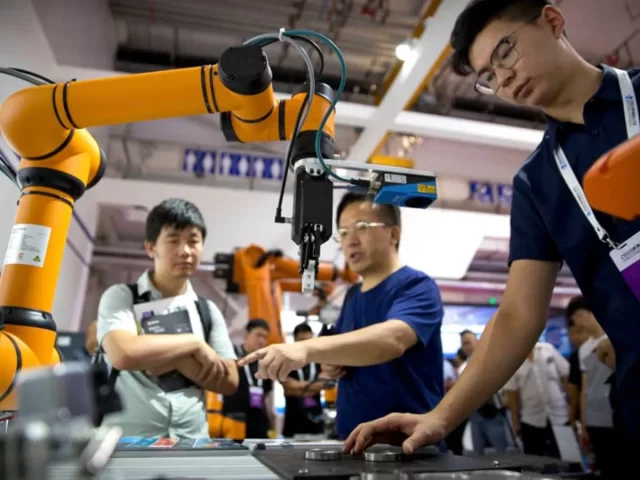

Robots and Informal Employment in China

By Haiyan Lin This paper examines labor adjustments between the informal and formal sectors in response to the adoption of industrial robots in China. Using a longitudinal household data from 2010 to 2018, I find that robotization increases informal employment. Quantitatively, one more robot per thousand workers increases the share of informal employment by 1.16 percentage points. The reallocation is not driven by new entrants or re-entrants, but by workers initially employed in the formal sector. Displaced formal workers tend...

Seven trends shaping UK employment, incentives and pensions in 2025

As these plans evolve, their ripple effects will be felt into 2025 and beyond. Global forces add further pressure. Regulatory developments in the EU, US and beyond will demand UK employers’ attention as they adapt to the shifting landscape. We’ve identified seven key trends that will define 2025. Employers can use these insights to prioritise their strategies and stay ahead. 1. Employee litigation on the rise—new rights, new risks: The Employment Rights Bill’s sweeping reforms could trigger a surge in claims,...

Italy’s fertility rate hits record low in 2024

Italy's fertility rate fell to the lowest level ever recorded in 2024, the country's main statistical entity said on Monday. According to Italy's National Statistics Institute, known as ISTAT, around 370,000 births were registered in Italy last year, a decrease of 2.6 percent from the previous year. The death rate also declined, ISTAT said, falling by 3.1 percent last year to 651,000. That means there were 281,000 more deaths than births in the country in 2024, pushing the country's average life...

March 2025

Parental Leave Policies, Fertility, and Labor Supply

By Daisoon Kim & Minchul Yum South Korea has been facing persistently low fertility rates and large gender gaps in labor supply. In response, the government has expanded parental leave benefits to address these challenges. To evaluate the effectiveness of these policies, we develop a quantitative, heterogeneous-household life-cycle model in which couples make joint decisions on careers, labor supply, savings, and child-related choices, including fertility, childcare, and parental leave take-up. The model is calibrated to recent Korean cohorts to replicate...

Future-Proofing the Longevity Economy: Innovations and Key Trends

By World Economic Forum The world is at a pivotal moment in its demographic transition, with more than one in four people now living in countries where the population has peaked. This shift, coupled with increasing life expectancy and declining birth rates, presents both urgent challenges and unprecedented opportunities. Building on the Longevity Economy Principles, this white paper synthesizes five key trends shaping the future of the longevity economy: building resilient public retirement systems; transitioning from savings accumulation to decumulation; enhancing the...

The End of Traditional Retirement: Building Financial Security in a Changing World

Have you ever seen your father leave for work every morning, heading to the same office, doing the same job, surrounded by the same colleagues for decades? It was a time when career paths were straightforward, stability was the norm, and retirement felt like a well-earned reward after years of dedication. Now, look at your own career—how many jobs have you switched already? Two? Three? Maybe more? And still, the future feels uncertain. Jobs that once lasted a lifetime are...

Gender pension gaps in a private retirement accounts system: A dynamic model of household labor supply and savings

By Clement Joubert & Petra E. Todd  This paper develops and estimates a dynamic model of individuals’ and couples’ labor supply, savings, and retirement decisions to analyze how the design of Chile’s privatized pension system and a reform undertaken in 2008 affect gender pension gaps and old-age poverty. Chile has one of the longest-running private retirements accounts systems in the world, which has served as a model for many countries. The paper estimates the dynamic model using pre-reform data...

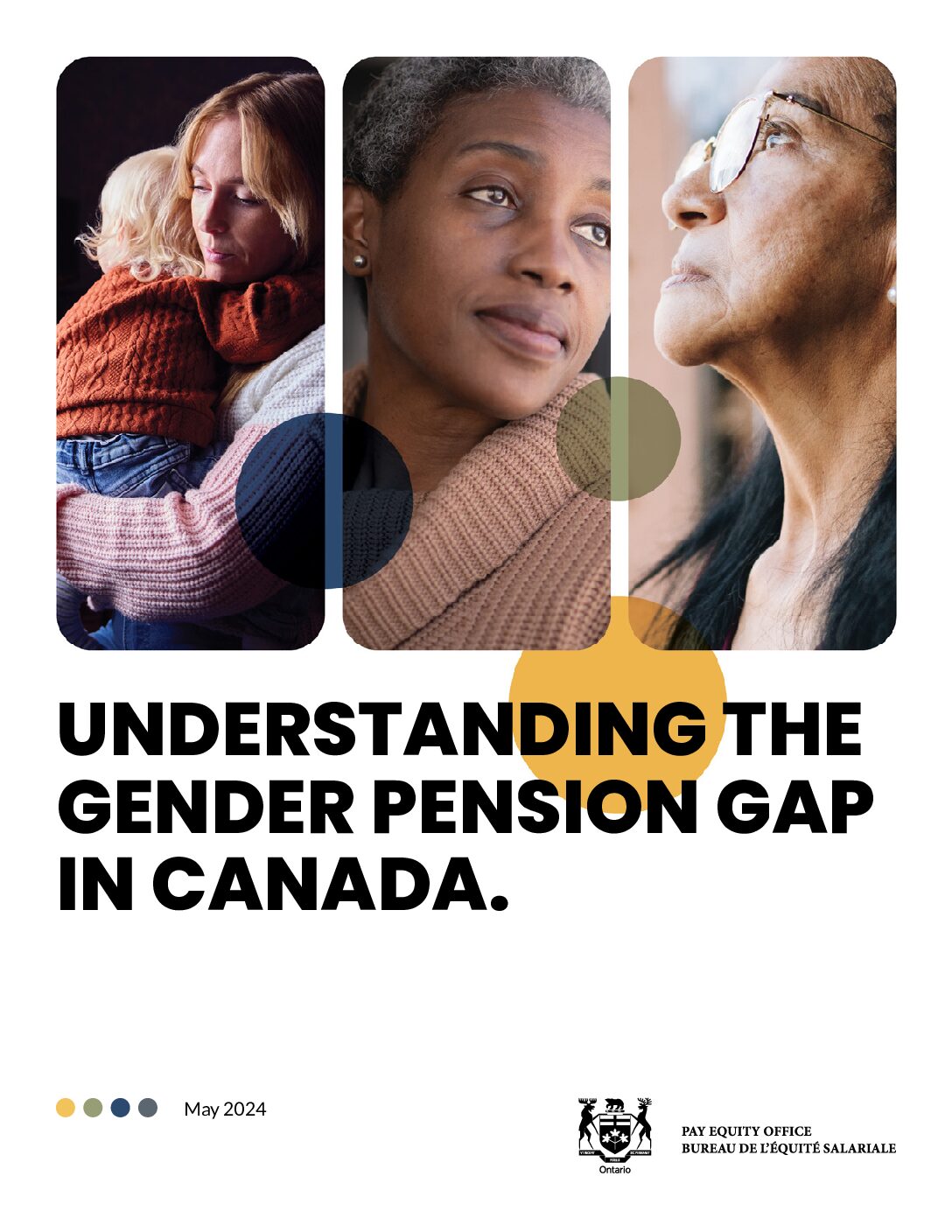
Understanding the Gender Pension Gap in Canada

By Elizabeth Shilton The gender pension gap in Canada measures the gender difference in combined income from Canada’s 3-pillar system of retirement income instruments: Old Age Security/Guaranteed Income Supplement, Canada Pension Plan/ Quebec Pension Plan and private pensions (including RRSP/RRIF income). In 1976 - the first year for which we have meaningful statistics – that gap stood at 15%, and it has stubbornly refused to close despite substantial increases in overall retirement income and massive advances in women’s labour market engagement...

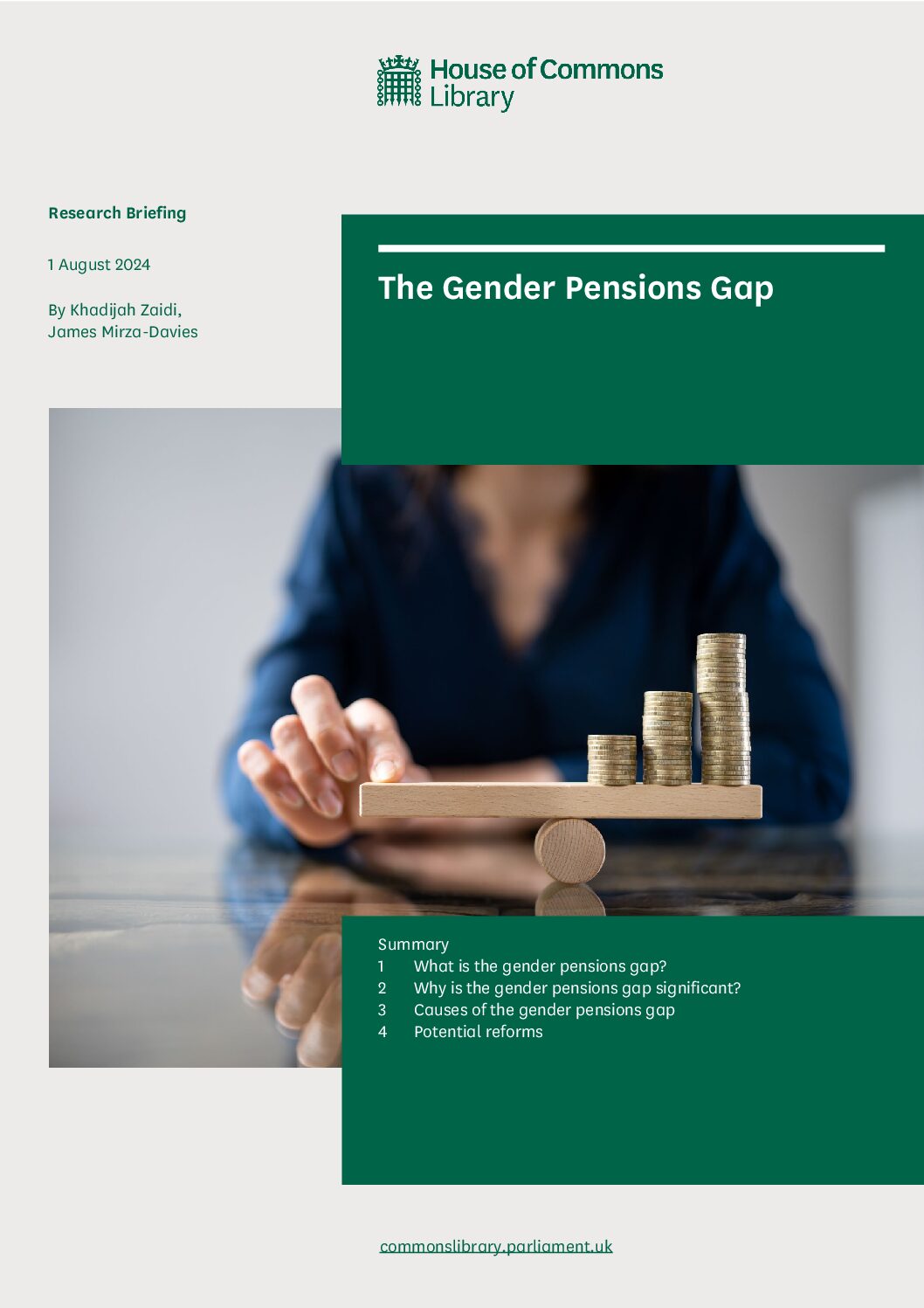
The Gender Pensions Gap

By Khadijah Zaidi & James Mirza-Davies The gender pensions gap refers to differences in retirement income or retirement wealth for men and women, and it can be measured in different ways. The gender pensions gap is mainly caused by the gender pay gap. There are however additional causal factors relating specifically to pensions, such as historic state pension rules, the impact of auto-enrolment rules on different types of workers, and how divorce settlements treat pensions. The Work and Pensions Committee...