June 2024

​Sweden eases rules on occupational pension payout phase, allowing pauses

Sweden’s government has decided to introduce more flexible rules for the payment of occupational pensions — following agreement on the issue by the cross-party pensions group last October. During the first five payment years, it will be possible for individuals to pause payments and extend the payment period, according to an announcement from the ministries of finance and social affairs last week. Elisabeth Svantesson, the Swedish finance minister, said: “Sweden’s pensioners should be able to choose how they want to set...


3M to transfer pension-payment obligations for 23,000 U.S. retirees

3M to book a charge of nearly $1 billion as it transfers some of its pension obligations to Met Tower Life 3M Co. said Thursday it will transfer about $2.5 billion of its pension-payment obligations to Metropolitan Tower Life Insurance Co. The consumer- and industrial-products company (MMM) said the transfer, which will affect the pension payments of about 23,000 U.S. retirees, won't change the amount of the monthly benefit payments. The only change is who is making the payments. 3M, which makes...

Funded Status of U.S. Corporate Pension Plans Continues to Improve in May

In May, the financial health of U.S. corporate pension plans experienced a marked improvement, continuing a positive trend seen over the past five months, according to a round-up of the country’s pension watchers. The main reasons for the positive funding trends in May across various corporate defined benefit plans included positive economic indicators, strategic investment approaches such as cash-flow-driven strategies and resilience in market performance despite lower interest rates. “May’s improvement is the fifth month in a row of funded ratio...

May 2024

The Incidence of Workplace Pensions: Evidence from the Uk’s Automatic Enrollment Mandate

By Rachel Scarfe, Daniel Schaefer & Tomasz Sulka We examine who bears the costs of mandated workplace pension programs, exploiting the quasi-experimental rollout of automatic enrollment in the UK. Total compensation (take-home pay plus employer contributions) increases, driven by employer contributions, while the amount of take-home pay decreases. These effects differ by employer size, with take-home pay declining to an extent in the largest firms that we can rule out a pass-through to employees of more than 47%, significantly less...

US Corporate Pension Funding Mixed on Stock Declines

Changes to the average funded status of the largest U.S. corporate defined benefit plans were mixed in April as lower stock returns weighed on the positive effect of higher interest rates, according to monthly pension trackers from some of the country’s largest pension consultancies. The mixed results come off all-time highs booked in March. Meanwhile, pension fund investors are on interest rate watch, with the Federal Reserve still expected to cut rates later this year depending on how inflation, employment and...

UK. Pension Protection Fund 7800 index shows April increase for surplus, funding ratio

The total surplus of U.K. corporate pension funds covered by the Pension Protection Fund 7800 index increased 0.6% to £458.3 billion ($570.5 billion) at the end of April, coupled with an increase in funding ratio. The funding ratio was 148.8% at the end of April, compared to 146.5% at the end of March this year. Of the 5,050 plans in the PPF 7800 Index, there were 505 plans in deficit and 4,545 in surplus. Shalin Bhagwan, chief actuary at the Pension...

US. Corporate pension funding surpluses remain high in April – 3 reports

U.S. corporate pension fund surpluses remained high in April despite negative market returns for the month, according to three new reports. Wilshire Advisors estimated the aggregate funding ratio of U.S. corporate plans reached 110.8% as of April 30, an increase of 1.1 percentage points above the 109.7% funding ratio estimated as of March 31. "April’s funded status increase resulted from the increase in Treasury yields, which led to the largest monthly decline in liability values since September 2022. Corporate bond yields,...

April 2024

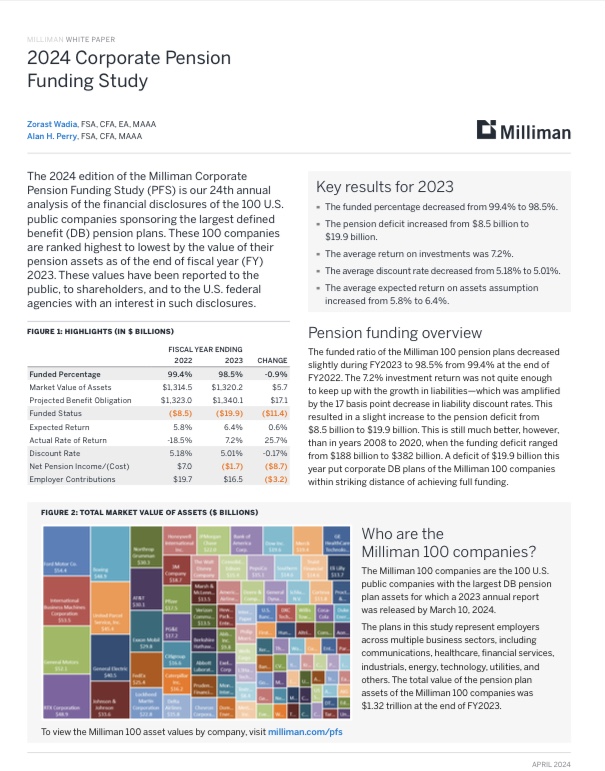
2024 Corporate Pension Funding Study

By Zorast Wadia & Alan Perry The 2024 edition of the Milliman Corporate Pension Funding Study (PFS) is our 24th annual analysis of the financial disclosures of the 100 U.S. public companies sponsoring the largest defined benefit (DB) pension plans. These 100 companies are ranked highest to lowest by the value of their pension assets as of the end of fiscal year (FY) 2023. These values have been reported to the public, to shareholders, and to the U.S. federal agencies...

U.S. corporate pension funding remains near 100% in 2023 — Milliman

U.S. corporate pension plan funding ratios fell slightly to 98.5% in 2023 due to falling discount rates, according to Milliman’s annual Corporate Pension Funding Study. The study of the 100 U.S. public companies with the largest defined benefit plans showed that the average funding ratio fell from 99.4% a year earlier due to a 17-basis-point decline in the average discount rate to 5.01% from 5.18% at the end of 2022. The study also showed that 48 of the top 100 plans...

Strength in Diversity: What We Can Learn from BC’s Target-benefit Plans

By Barry Gros With the significant decline in single-employer defined-benefit (DB) pension plans in the private sector, it’s important to understand other alternatives. One such alternative is the target-benefit plan. The regulation of target-benefit plans (TBPs) in all provinces across Canada can be made more straightforward and effective using lessons learned from real-life experiences. With target-benefit plans currently being more prominent in the province of British Columbia than any other province, it is useful to take a closer look at these...