August 2021

Pensions, Income Taxes and Homeownership: A Cross-Country Analysis

By Hans Fehr, Maurice Hofmann & George Kudrna This paper studies the role of pensions and income taxes in determining homeownership and household wealth. It provides a cross-country analysis, using tax and pension policy designs in Germany, the US and Australia. These developed nations have similar incomes per capita but very different homeownership rates, with the US and Australia having much higher homeownership compared to Germany. The question is to what extent the observed differences in homeownership are induced by...


June 2021

Germany plans pension taxation reform after election

Germany's Finance Ministry said on Monday it plans to reform the taxation of pensions after September's federal election, responding to the federal fiscal court's demand for an overhaul to avoid the double taxation of future retirement savings. "This is a proposed solution that we can imagine," State Secretary Rolf Boesinger said in Munich. He spoke after the court dismissed one couple's double taxation complaint but said future pensioners were at risk of having to pay taxes twice under existing transitional regulations. The...

May 2021

German court rejects complaints against double taxation of pensions

Germany's federal fiscal court on Monday rejected as unfounded a retired couple's objection to their retirement benefits being double taxed. The court case resulted from a 2005 change in the law that made pensions liable to tax. Until then, pensions had been essentially tax-exempt as the contributions were made from taxed salaries. Under the 2005 law, pension contribution payments gradually became essentially tax free while the taxable share of pension income was increased in a process set to conclude by 2040. The...

Social Security, Taxation Law, and Redistribution: Directions for Reform

By Alison McClelland, Richard Krever While it is now generally accepted that some redistribution of economic power is a legitimate goal of government, there is no consensus as to the type of redistribution that should be pursued. In the absence of a clear redistributive goal, it is impossible to evaluate critically current law, or make recommendations for change. In the first part of this article, we examine alternative models of redistribution and advocate a preferred model, namely, redistribution to promote...

A Game-Theoretic Analysis of Fiscal Policy Under Economic Growth From the Perspective of MMT

By Yasuhito Tanaka We present a game-theoretic analysis of fiscal policy under economic growth from the perspective of MMT using a simple two-periods overlapping generations (OLG) model with pay-as-you-go pensions. We show the following results. 1) Sustained budget deficit is necessary to maintain full-employment under economic growth driven by population growth or technological progress. 2) An excessive budget deficit triggers inflation, and after one period inflation full-employment is maintained by sustained budget deficit with constant price. 3) Insufficient government deficit...

April 2021

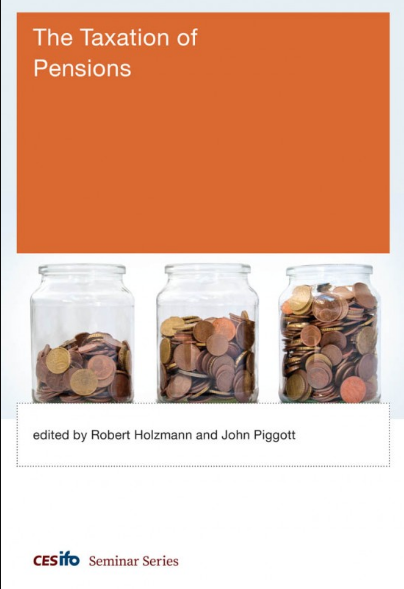
The Taxation of Pensions

By Robert Holzmann, John Piggott Policy makers and academic researchers have been preoccupied in recent decades with the design of pension schemes and effective pension system reform. Relatively little attention has been given to the taxation of pensions and, more broadly, the provision of retirement income. In this book, experts from a range of countries explore the interconnection. Their contributions are especially timely, given recent demographic and political developments including population aging that lengthens the time between contribution payment and...

Do Required Minimum Distribution 401(K) Rules Matter, and for Whom? Insights from a Lifecycle Model

By Vanya Horneff, Raimond Maurer, Olivia S. Mitchell Tax-qualified vehicles helped U.S. private-sector workers accumulate $25Tr in retirement assets. An often-overlooked important institutional feature shaping decumulations from these retirement plans is the “Required Minimum Distribution” (RMD) regulation, requiring retirees to withdraw a minimum fraction from their retirement accounts or pay excise taxes on withdrawal shortfalls. Our calibrated lifecycle model measures the impact of RMD rules on financial behavior of heterogeneous households during their worklives and retirement. We show that proposed...

March 2021

Retirees who pay the most in taxes make only $36,000 a year on average, study finds

Retirees who have the most money pay the most in taxes, according to a recent working paper, but they’re not necessarily rich. “Most of the tax burden is carried by the top quintile of households,” Anqi Chen, co-author and assistant director of savings research at the Center for Retirement Research at Boston College, told Yahoo Money. But “it's important to keep in mind that when we think about the top quintile of households — the top 20% — they're not...

How Much Taxes Will Retirees Owe on Their Retirement Income?

By Anqi Chen, Alicia H. Munnell To evaluate their retirement resources, households approaching retirement will examine their Social Security statements, defined benefit pensions, defined contribution balances, and other financial assets. However, many households may forget that not all of these resources belong to them; they will need to pay some portion to federal and state government in taxes. It is unclear, however, just how large the tax burden is for the typical retired household and for households with different income...

Sweden wants to tax pensioners in Portugal

Swedish Parliament is set to vote on unilaterally ending an agreement with Portugal to not tax citizens receiving their pensioners here Following in the footsteps of Finland in 2018, Stockholm now also wants to see its expat pensioners in Portugal taxed as they would be in their home countries. Portugal recently changed its non-habitual resident regime to enforce a blanket ten percent tax on foreign pensions, but Sweden argues this is inadequate and not in accordance with an agreement signed with...