June 2022

Do Retirees Want to Consume More, Less or the Same as they Age?

By Anqi Chen & Alicia H. Munnell Whether households prefer a constant, increasing, or decreasing path of consumption in retirement has important implications for our understanding of retirement adequacy. Financial planners and researchers often assume that retirees would like to maintain a constant standard of living. Similarly, Social Security benefits are based on the premise that people want steady inflation-adjusted benefits. However, several studies suggest that retired households actually decrease their consumption over time. This brief, which reports the results of...
The Missing Middle. How Tax Incentives for Retirement Savings Leave Middle-Class Families Behind

By Tyler Bond and & Doonan Saving for retirement is one of the biggest financial challenges most working Americans will face. While the vast majority will participate in Social Security, most will have less than half of their income replaced by Social Security in retirement. Therefore, many workers also will need to save for retirement through other plans, such as an employer-provided defined benefit pension plan or 401(k) plan, or on their own through an Individual Retirement Account (IRA). Congress...

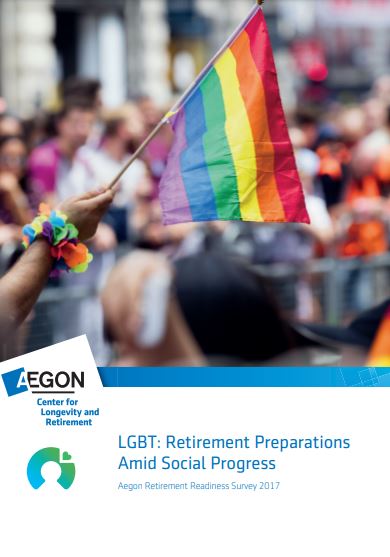
LGBT: Retirement Preparations Amid Social Progress

By AEGON LGBT: Retirement Preparations Amid Social Progress is a collaboration between Aegon Center for Longevity and Retirement, and nonprofits Transamerica Center for Retirement Studies® (US), and Instituto de Longevidade Mongeral Aegon (Brazil). The report focuses on the retirement aspirations and plans among the LGBT community, and highlights findings from LGBT survey respondents from nine of the 15 surveyed countries comprising the 6th Annual Aegon Retirement Readiness Survey. Many of the traditional patterns of family and working life, including the way...

The Gender Pensions Gap Report 2022 … and how to close it

By Joanne Segars OBE & Samantha Gould  Lower incomes throughout a woman’s working life will invariably impact their pension savings, creating an obvious pension gap. Furthermore, women who take time away from work to have children or for other caring responsibilities contribute to the widening gulf that we see between men and women’s pension wealth. Three million women are effectively “locked out” of workplace pension saving because they do not meet the £10,000 auto enrolment eligibility criteria. We are on a mission...

LGBTQ and Finance

By Sanjukta Brahma, Konstantinos Gavriilidis, Vasileios Kallinterakis, Thanos Verousis & Mengyu Zhang Recent changes in workplace and corporate board diversity policies and a series of court rulings have signalled a fundamental change in the treatment of lesbian, gay, bisexual, transgender and queer (henceforth LGBTQ) people in the corporate world. In this paper, we survey the burgeoning literature on the role of sexual orientation in finance. We show that LGBTQ-friendly policies affect organizational outcomes and enhance the quality of corporate governance....

Gay, gray, black, and blue: An examination of some of the challenges faced by older LGBTQ people of color

By Seon Kum Few studies exist that highlight the life experiences of the older LGBTQ person of color. This cohort faces unique challenges in life that have not been explored or investigated extensively, if at all. Older LGBTQ people of color have experienced discrimination based on race, gender, and sexuality in all phases of their lives, often bearing witness to and helping to start various equal rights and social justice movements. In addition to the unique challenges that come with...

May 2022

The National Landscape of State Retirement Benefits. How Good Are Public Retirement Systems at Putting Employees on a Path to Retirement Income Security?

By Jonathan Moody & Anthony Randazzo  Retirement security is ultimately about retirement income. Families and individuals want to know that during their retirement years they will have enough weekly, monthly, or annual income to live comfortably and meet their basic needs. Of course, many people aspire to more than just the basics. Ask even a handful of individuals about how they want to live in retirement, and you’ll hear a wide range of preferences. Expenses can vary from family-to-family, too,...

Progressing Towards Efficiency: The Role for Labor Tax Progression in Reforming Social Security

Progressing Towards Efficiency: The Role for Labor Tax Progression in Reforming Social Security

By Krzysztof Makarski, Joanna Tyrowicz & Oliwia Komada We study interactions between progressive labor taxation and social security reform. Increasing longevity puts fiscal strain that necessitates the social security reform. The current social security is redistributive, thus providing (at least partial) insurance against idiosyncratic income shocks, but at the expense of labor supply distortions. A reform which links pensions to individual incomes reduces distortions associated with social security contributions, but incurs insurance loss. We show that the progressive labor tax...

Top-Income Adjustments and Official Statistics on Income Distribution: The Case of the UK

Top-Income Adjustments and Official Statistics on Income Distribution: The Case of the UK

By Stephen P. Jenkins UK official statistics on income distribution have incorporated top-income adjustments to household survey data since 1992. This article reviews the work undertaken by the Department for Work and Pensions and the Office for National Statistics, and the academic research that influenced them, and reflects on the lessons to learn from the UK experience. Source: SSRN 403 views

The Economic Well-Being of LGBT Adults in the U.S. in 2019

By CLEAR The Federal Reserve Board has conducted the Survey of Household Economic Decisionmaking (SHED) since 2013. In 2019, the survey included LGBTQ people by asking U.S. adults about their sexual orientation and gender identity (SOGI), enabling for the first time the creation of a picture of the economic well-being of LGBT households using the SHED data. Analysis of the data shows that in 2019: • LGBT adults were more often struggling to get by. Fewer than two-thirds of LGBT adults reported...