October 2025

Mental exercise can reverse a brain change linked to aging, study finds

Scientists are reporting the first compelling evidence in people that cognitive training can boost levels of a brain chemical that typically declines with age. A 10-week study of people 65 or older found that doing rigorous mental exercises for 30 minutes a day increased levels of the chemical messenger acetylcholine by 2.3% in a brain area involved in attention and memory. The increase "is not huge," says Étienne de Villers-Sidani, a neurologist at McGill University in Montreal. "But it's significant, considering that you get a...


Mercer CFA Institute Global Pension Index 2025 released.

The retirement systems of the Netherlands, Iceland and Denmark once again are the top three systems worldwide, according to the 2025 Mercer CFA Institute Global Pension Index. The same three topped Mercer’s 2024 report. For the first time in the 17-year history of the index, Singapore’s retirement system also received an A, the only country in Asia to achieve a rating at that level and the No. 5 system overall. Israel ranked fourth for the second consecutive year. A-grade countries offer...

Australian fertility rate falls to new record-low

Australia's fertility rate fell to a new record-low for the second straight year in 2024, official data published on Wednesday revealed. According to the data from the Australian Bureau of Statistics (ABS), the total fertility rate in Australia was a record-low 1.481 births per woman in 2024. It marks the second consecutive year that the fertility rate has been the lowest since records began in 1924, after the figure was 1.499 births per woman in 2023. The ABS said that the total...

2025 Global Retirement Index

By Dave Goodsell Norway has regained the top position in the 2025 Natixis Global Retirement Index, driven by its strong performance in health outcomes, low unemployment and high-income equality. Ireland surges to second place, thanks to improvements in inflation and an economic environment that supports retirement security. Since its launch in 2012, the Natixis Global Retirement Index has offered a comparative assessment of retirement security in 44 developed countries. The index evaluated 18 key indicators grouped into four subindexes: Finances in...

Europe’s aging burden far less than US or China

Graying Europe has long been considered an outlier in global demographics – but the rising cost to its governments in terms of bills for pensions and health care are more manageable than assumed and less than in rival economies in the United States and China. In a detailed report on the rising cost to the public purse from Europe's aging population, Brussels-based think Breugel this week outlined the trajectory through 2070 using the latest country-by-country data from the European Commission. Familiar...

Bad Sleep Makes Your Brain Age Faster, Study Finds

People who struggle with poor sleep tend to have brains that look older than their actual age, according to an extensive brain imaging study conducted by Karolinska Institutet and published in eBioMedicine. The researchers suggest that increased inflammation in the body could help explain this connection. Although poor sleep has long been associated with dementia, scientists still debate whether unhealthy sleep patterns contribute to cognitive decline or if they are early signs of the disease. In this new investigation, the Karolinska...

The impacts of different dietary restriction regimens on aging and longevity: from yeast to humans

By Tsui-Ting Ching & Ao-Lin Hsu Dietary restriction (DR) refers to a broad set of interventions that limit the intake of specific nutrients or overall food consumption, either in quantity or timing, without causing malnutrition. DR has long been considered the most robust intervention for increasing healthspan and lifespan. This includes, not exhaustively, caloric restriction (CR), protein restriction (PR), amino acid restriction (AAR), intermittent fasting (IF), and time-restricted fasting (TRF), each with overlapping but distinct metabolic and physiological effects. This...

The U.S.-Born labor force will shrink over the next decade

By Josh Bivens It is often underrecognized how much population aging is currently reducing the growth rate of the U.S. labor force and will continue to pull it down in coming decades. The share of the population that is over the age of 65 (when labor force participation tends to take a steep fall on average) is rising rapidly. This share was 12.4% in 2007, 17.9% in 2024, and will hit 21.2% by 2035 (CBO 2025b). A recent EPI report...

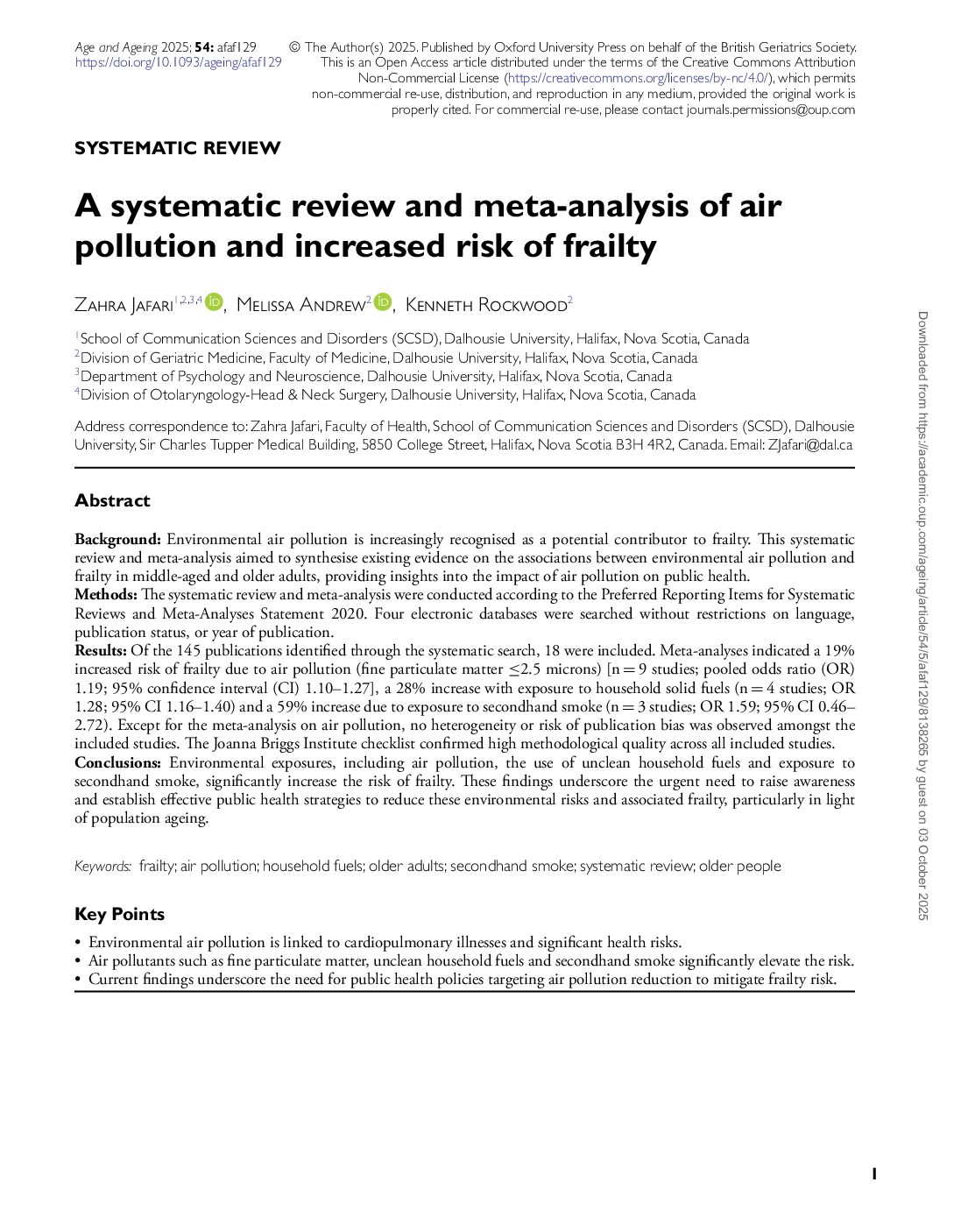
A systematic review and meta-analysis of air pollution and increased risk of frailty

By Zahra Jafari, Melissa Andrew & Kenneth Rockwood Background Environmental air pollution is increasingly recognised as a potential contributor to frailty. This systematic review and meta-analysis aimed to synthesise existing evidence on the associations between environmental air pollution and frailty in middle-aged and older adults, providing insights into the impact of air pollution on public health. Methods The systematic review and meta-analysis were conducted according to the Preferred Reporting Items for Systematic Reviews and Meta-Analyses Statement 2020. Four electronic databases were searched without...

Part-Time Penalties and Heterogeneous Retirement Decisions

By Kanta Ogawa Older male workers exhibit diverse retirement behaviors across occupations and respond differently to policy changes, influenced significantly by the part-time penalty—wage reduction faced by part-time workers compared to their full-time counterparts. Many older individuals reduce their working hours, and in occupations with high part-time penalties, they tend to retire earlier, as observed in data from Japan and the United States. This study develops a general equilibrium model that incorporates occupational choices, endogenous labor supply, highlighting that the...