May 2026

Retirement without guaranteed income streams may mean near-total asset wipeout

Retirement may not unfold the way most people (or planners) expect, and new research from the suggests that without a reliable income floor, the consequences can be severe. The Employee Benefit Research Institute study tracked how household net non-housing assets shifted across a roughly three-decade window using longitudinal data from the 1992–2022 Health and Retirement Study. What it found challenges the conventional image of retirement as a steady, predictable spend-down of accumulated wealth. Asset drawdown varied dramatically depending on how much a retiree...

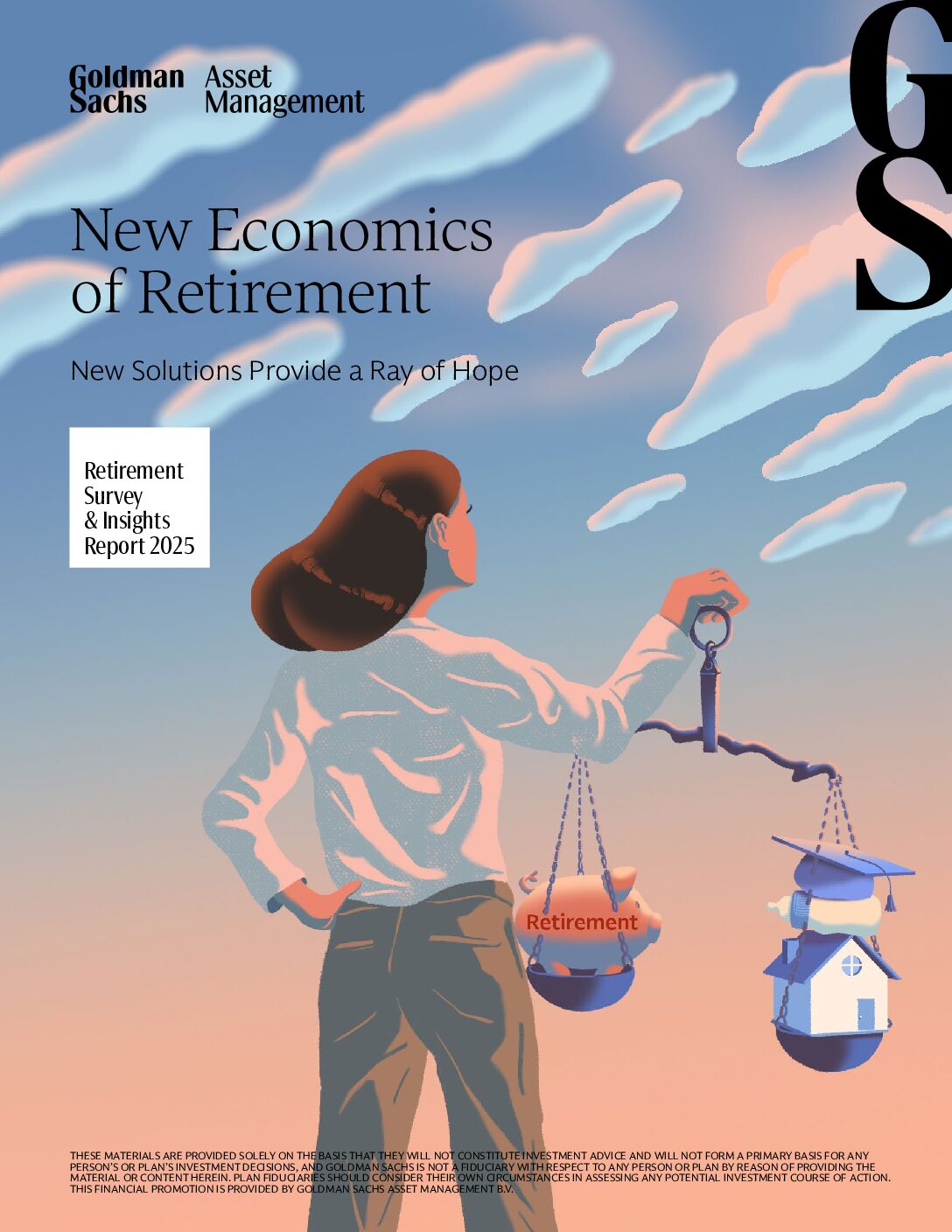
New Economics of Retirement: New Solutions Provide a Ray of Hope

By Goldman Sachs In our annual Retirement Survey & Insights Report, we are pleased to present findings that may challenge conventional wisdom about retirement preparedness in America. While many acknowledge the looming retirement crisis, the traditional advice to simply save more may fail to account for the complex and evolving realities faced by millions of Americans. This year’s report introduces the "new economics of retirement,” as we grapple with the question “does the retirement math still work?” The report illustrates how rising costs...

Europe’s demographic challenge: how to guarantee intergenerational fairness in pensions and beyond

Engaging younger generations earlier  The core challenge is timing. Pension planning often begins too late, even though early contributions are crucial. Yet for many young people, retirement feels too distant to prioritise.  Speakers highlighted financial literacy and pension awareness as key tools but stressed that education must go hand in hand with practical solutions. Well-designed systems, such as automatic enrolment, can significantly increase participation, while pension tracking tools can help individuals keep oversight in increasingly mobile careers.  Addressing persistent inequalities   Fairness between generations...

US. Pension income in 2026 reshapes safe withdrawal strategies

Pension changes withdrawal: Guaranteed income covering 40%+ of expenses can justify higher withdrawal rates than the 3.9% baseline. COLA protects income: Inflation-adjusted pensions help maintain purchasing power, supporting more confident portfolio draws. Advanced strategies rise: Dynamic Spending or Guardrails can exceed 5% withdrawals when backed by a strong income floor. Why 2026's economic conditions change the retirement math Morningstar’s 2026 guidance starts retirees at a 3.9% withdrawal rate due to current market valuations. Research from Wade Pfau and the Journal of Financial Planning indicates that when...

The Impact of Corporate Employment: Minimum Wage or Social Insurance Policy? — Evidence from China

By Junpeng di, Wanhe li & Mingyuan zhang China's minimum wage standards and enforcement have been on the rise, and the academic community generally believes that minimum wage increases enterprise labor costs and has an important impact on employment. However, less attention has been paid to social insurance, which is also a cost for Chinese companies. This paper considers both minimum wage and social insurance policy at the same time, and firstly analyzes the influence mechanism of the two on...

April 2026

Threats of AI? Workers’ perceptions of technological change and precautionary saving behaviour

By Kun Lee, Ludivine Martin & Thuc-Uyen Nguyen-Thi Despite the extensive literature on the labour market impacts of technological change, workers’ behavioural adaptation to augmented technological risks remains relatively underexplored. In this study, we investigate workers’ perceptions of future risks posed by AI and advanced technologies and how these perceptions are causally linked with their precautionary saving behaviour. Using a novel survey of workers in Luxembourg – a country characterised by rapid technological change and dynamic labour markets – we...

Immigrants at the Margin: Labor Market Effects of the Minimum Wage

By Mark Borgschulte, Heepyung Cho & Darren Lubotsky We examine the differential effects of minimum wages on immigrant and native workers in the United States. We find that minimum wage increases lead to reduced hours of work among immigrants with no effect on their employment. The effects are concentrated among recently arrived, likely-undocumented workers in high turnover industries. Native workers show no such response, even when examining native subgroups with similar characteristics to the most affected immigrants. We conclude that...

March 2026

US. How to Recession-Proof Your Retirement Income Before 2026 Ends

Will a recession hit in 2026? At this point, that's anyone's guess. But between the oversees conflict, tariff policies, and general uncertainty, it's easy to see why some people may be worried about the economy taking a serious turn for the worse. Recessions can hit workers harder than retirees because they often lead to an uptick in lost jobs. If you're retired and aren't working, you at least don't have to worry about losing your job. And even if you're working...

Venezuela protesters demand end to ‘hunger’ level wages

Hundreds of Venezuelan workers and pensioners marched Monday for an increase in “hunger” wages as well as pensions frozen for four years and eroded by galloping inflation. The monthly minimum wage currently equates to around 28 US cents, while annual price hikes surpass 600 percent. The last wage increase came in 2022 when then-president Nicolas Maduro, ousted in a US military operation on January 3, passed a decree lifting the monthly level to $28. But the value of Venezuela’s currency has...

Closing the gender income gap: from paycheck to pension

By Allianz Research Women have made measurable progress over recent decades in narrowing gender pay gaps and increasing labor-force participation – but structural gaps persist. Across the OECD, the unadjusted gender pay gap – the percentage difference between the average earnings of all men and all women without accounting for differences in job type, hours worked, experience or seniority – has declined from 21% in the early 2000s to 13.7% in 2024, and female labor-force participation has risen steadily to 71%, compared with 81% of men. However, single metrics do not capture the full economic impact...