January 2026

Decoding Pension Funds: Sustainability Indicators for Annual Report Analysis

By Leticia Martins Medeiros, Clea Beatriz Macagnan & Rosane Maria Seibert Pension funds’ growth highlights the need to emphasize fiduciary duty and investment sustainability, considering the current and future participants’ interests (priority stakeholders) and systemic risk reduction (environmental, social, economic, and governance effects). Therefore, this study builds sustainability indicators based on the interests of pension fund stakeholders. The methodology comprised five stages: the first consisted of analyzing Annual Information Reports to create a preliminary list of indicators; the second involved...

Global Pension Assets Study – 2025

By Thinking Ahead Institute The Global Pension Assets Study estimates global pension fund assets across 22 major pension markets (the P22). These geographies now stand at US$58.5 trillion in pension assets and account for 68% of the GDP of these economies. The study, conducted by WTW and the Thinking Ahead Institute since the 1990s, includes an analysis of the seven largest markets (the P7): Australia, Canada, Japan, Netherlands, Switzerland, UK and the US, which comprise 91% of total pension assets. Pension...

Population Aging and Corporate Leverage

By Xingshen Li, Kexin Jiang, Wei Li & Xiaofen Tan This study examines the relationship between corporate leverage and population aging. Based on a panel dataset of global listed firms from 2000 to 2021, we find that population aging at the country level reduces a firm’s leverage. This effect is mediated through mechanisms that influence operational pressures and asset prices. Further analysis reveals that the adverse impact of population aging on corporate leverage is more pronounced among firms with higher financial...

Social Protection for Informal Workers

By Abhijeet U Pai The modern working relationships require the law to recognise non-standard forms of employment and address the lack of traditional employment benefits like social protection for them. Informal employment is seen as a job-based (based on nature of job rather than status of the enterprise) concept that cuts across different sectors of economic activity and thus is defined as ‘informal economy’ rather than ‘informal sector’, in terms of employment relationship and protections associated with the job of the...

Artificial Intelligence and Retirement Planning

By John Cutler, J.D Any views and ideas expressed in the essay are the author’s alone and may not reflect the views and ideas of the Society of Actuaries, the Society of Actuaries Research Institute, Society of Actuaries members, nor the author’s employer. The premise for this essay is that retirees (and pre-retirees) are unlikely to have had experience with artificial intelligence (AI) to any great degree. If you think about most advanced technologies, individuals learn about them in the workplace...

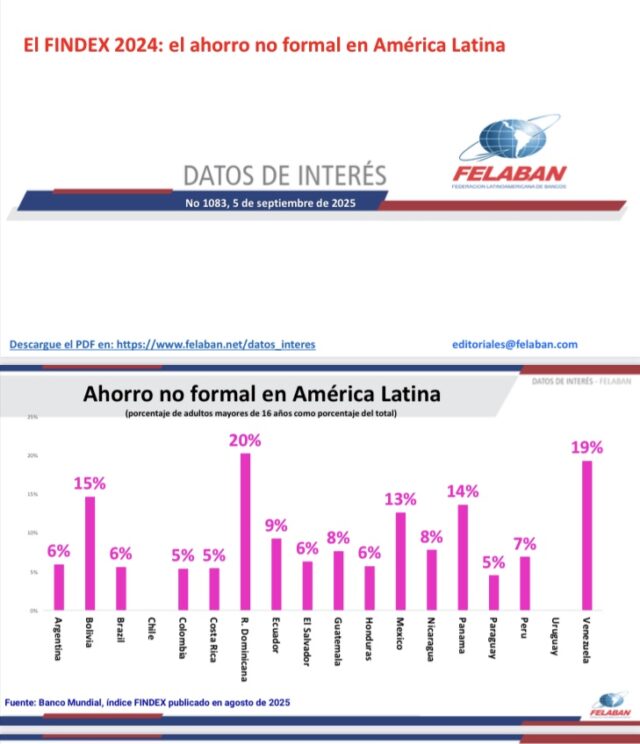
El FINDEX 2024: el ahorro no formal en América Latina

Por Felaban El índice FINDEX del Banco Mundial explícita la importancia que tiene el ahorro no formal entre la población de América Latina. Si bien existen múltiples alternativas formales de ahorro, una parte de la población adulta de la región ahorra en cadenas, grupos no formales, “natilleras”, grupos familiares y de amigos entre muchos otros. Esto si bien es un factor que desde alguna mirada puede considerarse como idiosincrático, también refleja lo que los trabajos CAF ha determinado con la...

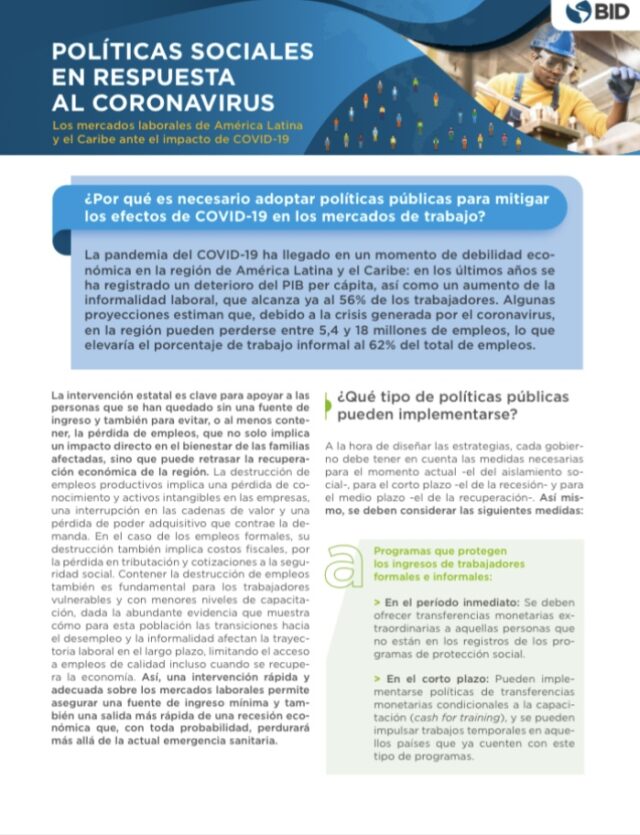
Los mercados laborales de América Latina y el Caribe ante el impacto de COVID-19

Por Oscar Arboleda, Dulce Baptista, Carolina González-Velosa, Rafael Novella, David Rosas-Shady, María Teresa Silva Porto & Nicolás Soler La pandemia de COVID-19 ha llegado en un momento de debilidad económica en la región de América Latina y el Caribe: en los últimos años se ha registrado un deterioro del PIB per cápita, así como un aumento de la informalidad laboral, que alcanza ya al 56% de los trabajadores. Algunas proyecciones estiman que, debido a la crisis generada por el coronavirus,...

Las cifras de empleo mejoran de América Latina, pero persisten la informalidad y las desigualdades

Por Naciones Unidas La situación del mercado laboral en América Latina y el Caribe registra avances, pero aún enfrenta barreras estructurales importantes, informó este jueves la Organización Internacional del Trabajo (OIT). En su publicación anual Panorama Laboral, la OIT enfatizó la recuperación del empleo tras la pandemia de COVID-19, pero advirtió que muchos de los problemas históricos siguen sin resolverse. El informe señala que la primera mitad de este año estuvo marcada por una recuperación moderada del empleo en la región, cuya...

Pensiones, edad de retiro y desigualdad de género

Por Alejandra Macías Sánchez  Hablar de pensiones en México es fundamental porque representan uno de los componentes más relevantes y dinámicos del gasto público, y su peso seguirá aumentando en las próximas décadas. Los datos del Presupuesto de Egresos de la Federación (PEF) 2026 muestran que el gasto público en pensiones rebasará el 6 % del PIB y casi un cuarto del gasto neto total (CIEP, 2025). Esto confirma que las pensiones no son un tema marginal ni de largo...

Bridging Skill Gaps for the Future: New Jobs Creation in the AI Age

By Florence Jaumotte, Jaden Kim, David Koll, Elmer Z. Li, Longji Li, Giovanni Melina, Alina Song & Marina M. Tavares The demand and supply of new skills—especially in IT and AI—are reshaping labor markets, impacting wages and hiring. About 1 in 10 job vacancies in advanced economies demands at least one new skill, often appearing first in the United States. The incidence is about half of that in emerging market economies. These skills boost average wages and employment but deepen...