May 2023

The Effects of Non-Contributory Pensions on Material and Subjective Well Being

By Rosangela Bando, Sebastian Galiani & Paul Gertler Public expenditures on non-contributory pensions are equivalent to at least 1 percent of GDP in several countries in Latin America and is expected to increase. We explore the effect of non-contributory pensions on the well-being of the beneficiary population by studying the Pension 65 program in Peru, which uses a poverty eligibility threshold. We find that the program reduced the average score of beneficiaries on the Geriatric Depression Scale by nine percent...
April 2023

Reforming against the demographic clock

By Allianz Research  The Covid-19 pandemic erased life-expectancy gains of almost a decade, pushing population aging and pension reform into the background. In fact, to alleviate the financial burden on private households and companies, governments not only put together aid packages worth billions of euros that drove up national debt, but also postponed already agreed upon reform measures, lowered contribution rates and allowed early withdrawals from retirement plans. As a result, the build-up of future pension entitlements and retirement savings slowed,...

March 2023

The gender gap in pension saving

By Jonathan Cribb, Heidi Karjalainen & Laurence O’Brien This report is an output from a programme of research on ‘Pension saving over the lifecycle’ (WEL /FR-000000374) that is funded by the Nuffield Foundation. Co-funding from the ESRCfunded Centre for the Microeconomic Analysis of Public Policy (ES/T014334/1) is also gratefully acknowledged. We are grateful to Alex Beer, Carl Emmerson and Paul Johnson for useful comments, and to Rowena Crawford for discussion and advice on this work. This work was produced using data from...

Pay-as-They-Get-In: Attitudes Towards Migrants and Pension Systems

By Tito Boeri, Matteo Gamalerio, Massimo Morelli & Margherita Negri We study whether a better knowledge of the functioning of pay-as-you-go pension systems and recent demographic trends in the hosting country affects natives' attitudes towards immigration. In two online experiments in Italy and Spain, we randomly treated participants with a video explaining how, in pay-as-you-go pension systems, the payment of current pensions depends on the contributions paid by current workers. The video also explains that the ratio between the number of...

A Leveraged Gender Gap: The Combined Effect of Longevity Risk (Mis)-Perception and Financial Risk-Taking

By Giovanna Apicella & Enrico G. De Giorgi Financial risk and longevity risk are the main risks affecting pension income. This paper analyses gender differences related to how financial risk taking and survival expectations are correlated. We analyse data from the “Survey of Health, Ageing and Retirement in Europe” (SHARE) database and find a significant gender gap in self-assessed risk tolerance, consistently with previous literature. Moreover, we show that individuals with realistic survival expectations (i.e., survival expectations that are close...

Pension Provision in Thailand

By Robert Palacios & Himanshi Jain This report documents the current state of pension provision in Thailand and options for reform that would increase the adequacy and sustainability of the pension system. While the focus here is on income support, the welfare of the elderly depends on many other government policies ranging from labor market policies to aged care and health services. It is also important to assess the pension system in terms of its broader impact on fiscal sustainability...

African Pension Funds – Environmental, Social & Governance Factors Benchmarking Exercise

By Dr Rory Sullivan and Robert Black, Matthew Sullivan & Fiona Stewart African Pension Supervisors Forum, representing pension supervisory authorities from across the African region, invited the team to review the approach to incorporation of ESG factors into decision making by pension funds across the región This project assessed a sample of Africa’s pension funds on their sustainable investment related disclosure Strengths in disclosure were: 1.All of the funds provide good disclosure about their organisation, including their history, ownership, mission, governance structure...

Government spending in Spain from a European perspective

By Mario Alloza, Julia Brunet, Victor Forte-Campos, Enrique Moral-Benito & Javier J. Pérez This document presents a detailed analysis of the structure of general government spending in Spain and its recent evolution in comparison to the rest of the European countries. The weight of Spanish public spending is similar to that of neighbouring countries, although below the average for a reference group of European countries (EU-15). Thus, in 2019 the level of public spending stood at 42% of GDP compared to...

February 2023

Financial Inclusion: Annual Monitoring Report 2022

By Stephen McKay, Karen Rowlingson & Adele Atkinson  This report is the tenth, and final, in a series of annual monitoring reports supported by the Friends Provident Foundation and Barrow Cadbury Trust to monitor progress towards, or indeed, away from, financial inclusion in Britain. To aid comparisons and provide a comprehensive picture, it uses the same framework as the previous reports and updates figures, where available, to give the most recent data and trends. Read book "here"

January 2023

Pension Fund Statistics – Q3 2022

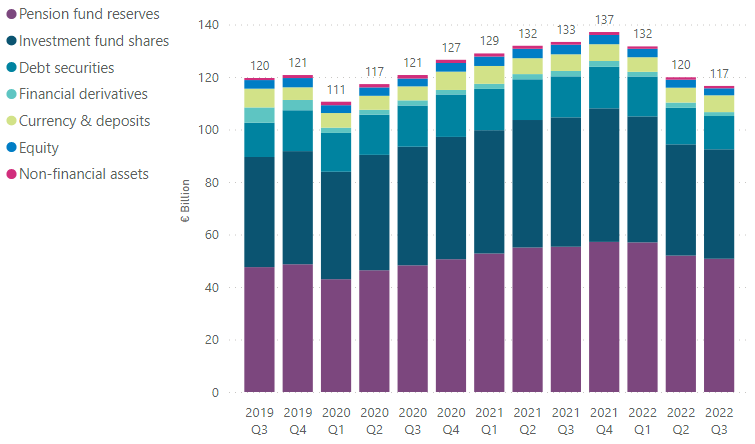
By Central Bank of Ireland Total assets of the Irish pension fund sector fell by 2.5 per cent (€3 billion) over Q3 2022 to stand at €117 billion. This continues a trend across the year to date with assets down 14.9 percent on the series high of €137 billion at end-2021. Technical reserves relating to pension entitlements of Irish pension funds decreased in Q3 2022. 1 Defined contribution (DC) technical reserves fell as a result of falls in corresponding asset values. Defined benefit...