
Panorama General del SAR
Por Comisión Nacional del Sistema de Ahorro para el Retiro El Panorama General del SAR te brinda una visión del Sistema de Ahorro para el Retiro en cifras a través de sus principales indicadores. Libro completo aquí
Por Comisión Nacional del Sistema de Ahorro para el Retiro El Panorama General del SAR te brinda una visión del Sistema de Ahorro para el Retiro en cifras a través de sus principales indicadores. Libro completo aquí
When designing a product, understanding the customers’ needs and preferences is essential. A case in point of the importance of tailoring product designs to customers is the “sachet revolution” in India. In the 1970s and 80s, some brands that sold daily essential products such as shampoos sought to target a large customer base who, at the time, could not afford these products: lower-income households and the rural market. To cater to the needs of low-income and rural households, these...

By Denise Laroze, Gabriela Fajardo, Charles Noussair, Ximena Quintanilla, Paulina Granados, Pedro Vallette, Mauricio López-Tapia Deciding what to do with one's pension funds is a high-stakes, one-shot decision. Retirement schemes are often described in technical jargon that few people understand. We consider whether the learning process can be eased by providing information in video format (vs. the standard textual format) and by changes to the user interface of the websites on which individuals learn about their pension options. The results...

By Yunxiao Wang, Katja Hanewald, Zilin (Scott) Shao, Hazel Bateman Reverse mortgage markets remain relatively small internationally, with one frequently cited reason being bequest motives. We study the role of reverse mortgages in intergenerational financial planning as a tool for families to bring forward bequests. We develop a new two-generation lifecycle model with parental altruism to compare the welfare gains of bequests and early bequests (inter vivos gifts) for homeowning parents and adult children seeking to purchase their first home....

By Aili Chen, CFA As pension systems adapt to changing economics and demographics, there is growing interest in collective defined contribution (CDC) schemes as they offer a different approach to retirement savings compared to defined benefit (DB) schemes. Instead of providing a guaranteed pension payment, CDC schemes provide workers with a pot of money to use in retirement, alleviating corporate sponsors of the responsibility and cost associated with providing lifetime guaranteed benefit payments. The size of the pension pot can...

By Denise Laroze, Gabriela Fajardo, Charles Noussair, Ximena Quintanilla, Paulina Granados, Pedro Valette & Mauricio López-Tapia Deciding what to do with one's pension funds is a high-stakes, one-shot decision. Retirement schemes are often described in technical jargon that few people understand. We consider whether the learning process can be eased by providing information in video format (vs. the standard textual format) and by changes to the user interface of the websites on which individuals learn about their pension options. The...

By Yunxiao Wang, Katja Hanewald, Zilin (Scott) Shao & Hazel Bateman Reverse mortgage markets remain relatively small internationally, with one frequently cited reason being bequest motives. We study the role of reverse mortgages in intergenerational financial planning as a tool for families to bring forward bequests. We develop a new two-generation lifecycle model with parental altruism to compare the welfare gains of bequests and early bequests (inter vivos gifts) for homeowning parents and adult children seeking to purchase their first...

By Aili Chen, CFA As pension systems adapt to changing economics and demographics, there is growing interest in collective defined contribution (CDC) schemes as they offer a different approach to retirement savings compared to defined benefit (DB) schemes. Instead of providing a guaranteed pension payment, CDC schemes provide workers with a pot of money to use in retirement, alleviating corporate sponsors of the responsibility and cost associated with providing lifetime guaranteed benefit payments. The size of the pension pot can...

Por Viviana García, Nicolás López Andrea Silva, Miguel Bustamante, Soraya León, Luzmarina Silva, Mauricio Baeza, Carol Chandía & Jorge Gamonal El artículo revisa políticas públicas sobre el envejecimiento en Chile desde 1990 hasta 2022, basándose en los cuatro ejes de la Política Integral de Envejecimiento Positivo: saludable, seguro, institucional y participativo. Para ello, se analizaron, según cada eje, diferentes ámbitos de intervención, tales como alimentación, establecimientos de larga estadía, reforma de pensiones, ley de envejecimiento activo, sexualidad, transporte público y...
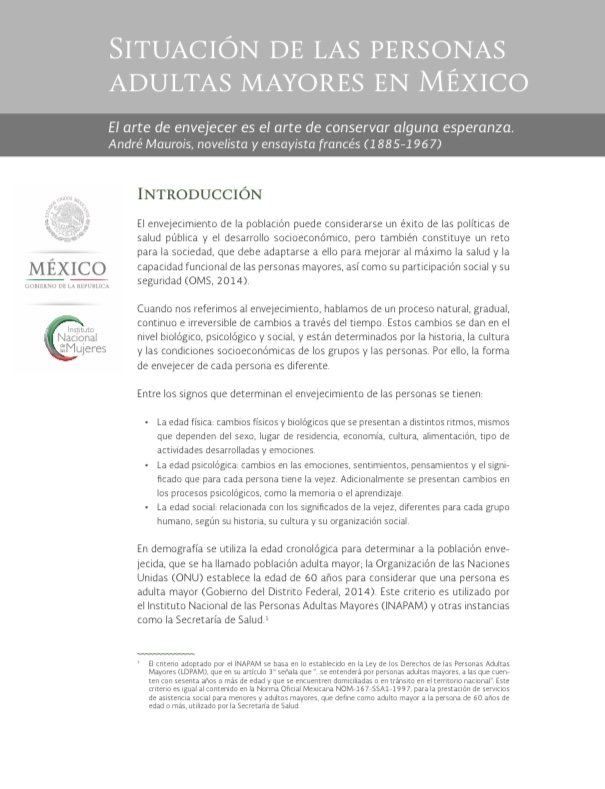
Por Instituto Nacional de las Mujeres El envejecimiento de la población puede considerarse un éxito de las políticas de salud pública y el desarrollo socioeconómico, pero también constituye un reto para la sociedad, que debe adaptarse a ello para mejorar al máximo la salud y la capacidad funcional de las personas mayores, así como su participación social y su seguridad (OMS, 2014). Cuando nos referimos al envejecimiento, hablamos de un proceso natural, gradual, continuo e irreversible de cambios a través del...