
March 2023

Frames, Incentives, and Education: Effectiveness of Interventions to Delay Public Pension Claiming

By Franca Glenzer, Pierre-Carl Michaud & Stefan Staubli Many people forgo a higher stream of public pension income by claiming early. We provide both quasi-experimental and survey-experimental evidence that the timing of public pension claiming is relatively inelastic to changes in financial incentives in Canada. Using the survey experiment, we evaluate the effect of two different educational interventions and different ways of framing the incentive to delay claiming. While all three types of interventions induce delays, these interventions have heterogeneous...

Pay-as-They-Get-In: Attitudes Towards Migrants and Pension Systems

By Tito Boeri, Matteo Gamalerio, Massimo Morelli & Margherita Negri We study whether a better knowledge of the functioning of pay-as-you-go pension systems and recent demographic trends in the hosting country affects natives' attitudes towards immigration. In two online experiments in Italy and Spain, we randomly treated participants with a video explaining how, in pay-as-you-go pension systems, the payment of current pensions depends on the contributions paid by current workers. The video also explains that the ratio between the number of...

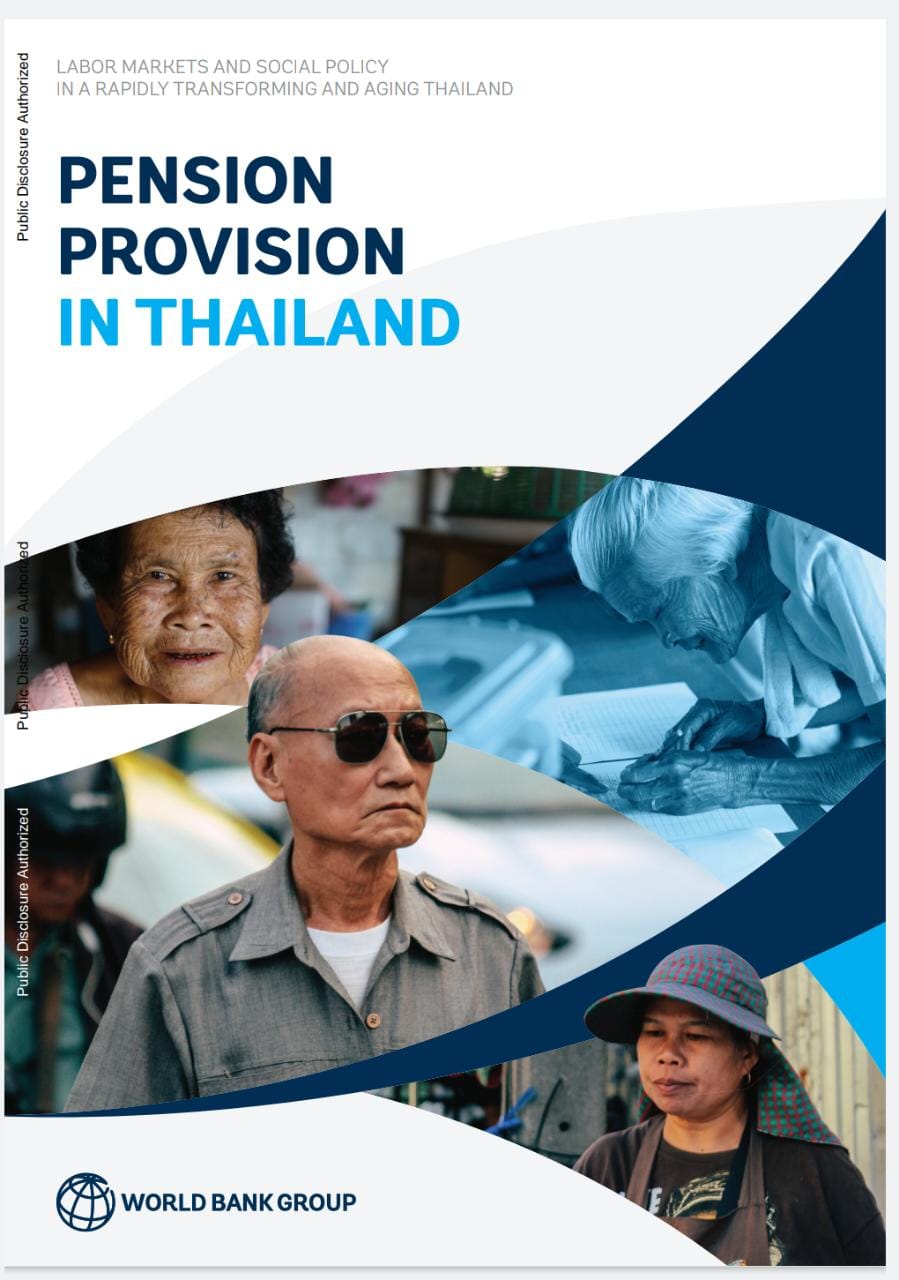
Pension Provision in Thailand

By Robert Palacios & Himanshi Jain This report documents the current state of pension provision in Thailand and options for reform that would increase the adequacy and sustainability of the pension system. While the focus here is on income support, the welfare of the elderly depends on many other government policies ranging from labor market policies to aged care and health services. It is also important to assess the pension system in terms of its broader impact on fiscal sustainability...

February 2023

The rise of elderly workers: The Europeans defying retirement norms and working past the age of 70

While trade unions are mobilising in France to defend retirement at 62, throughout the European Union, men and women are working beyond the age of 65 or even 75. Who are they? The official statistics draw the average picture of a self-employed man aged between 65 and 69, working rather part-time in the health or social sector. But this average situation obviously overlooks the nuances from country to country. In which EU countries do people work beyond the age of 65? Firstly, it’s...

Gustavo Petro, Colombia’s president, wants to smother the gig economy

On february 22nd fleets of taxi drivers went on strike and tried to block roads in over two dozen cities in Colombia. Their beef was with Gustavo Petro, the country’s recently elected left-wing president. They cheered when Mr Petro’s administration said that it was going to regulate transport apps, such as Didi and Uber, which are illegal in the country. But his government’s proposals, which were leaked in January, created uproar among ordinary Colombians: one draft suggested they would...

UK urged to curb pension freedoms to boost workforce

Ministers seeking to boost the UK’s workforce should crack down on pension freedoms and tax breaks that encourage wealthy people to retire early, according to an influential think-tank.   In a report on Tuesday, the Resolution Foundation set out a series of measures aimed at tackling the post-coronavirus pandemic rise in economic inactivity. That is now a crucial focus for Chancellor Jeremy Hunt, as he looks for ways to improve the UK’s growth prospects in his Budget on March 15.   Hunt has...

Asia’s population is shrinking faster than any other continent’s.

Asia faces a problem: Its population is aging faster than any other continent’s. A growing percentage of people in Japan, South Korea and China are over 65, and those countries’ economies are suffering because of a lack of available workers. Governments are struggling to find the money to support retirees. The problem is pronounced in Japan. I spoke to Motoko Rich, The Times’s Tokyo bureau chief, about what it means when a society ages this quickly. Claire: You’ve reported on the...

What matters for annuity demand: Objective life expectancy or subjective survival pessimism?

By Karolos Arapakis & Gal Wettstein Objective life expectancy and subjective survival pessimism (defined as the difference between objective and subjective life expectancy) may both affect the demand for annuities. The question this project answers is: how do these two explanations contribute to annuitization decisions in practice? To explore this question, the analysis estimates regression models that include objective life expectancy, subjective survival pessimism, and other characteristics that are linked to annuitization decisions. The results show that, as one would...

Flexibility And Earning Potential, Two Lures Of The Gig Economy

We’ve been talking about the gig economy in the United States, which, by the end of 2022, had 70 million gig workers—the most in the world—and how this mode of working might tie in with inclusive capitalism. The choice to work freelance comes with pluses, as we found, and some minuses too. Most of the deficits take the form of the loss of financial security nets. Despite some isolated efforts on the part of U.S. lawmakers to give gig...

US. Are Pensions the Answer to the Public-Sector Worker Shortage?

It’s widely known that state and local governments are struggling to recruit and retain workers. In Maryland, there are about 6,000 job postings available. And in Wayne County, Michigan, another approximately 1,000 jobs are available. These mounting vacancies can threaten the continuity of vital public services in public safety, education and transportation.   But as the number of layoff announcements in the private sector increase and a record number of Americans withdraw funds from their 401(k)s as a result of financial...