March 2022

Pensions and the green transition: policy and political issues at stake

Pensions and the green transition: policy and political issues at stake

By David Natali, Michele Raitano & Giulia Valenti Pension policy has gone through an intense period of reform over the past few decades. However, further changes are likely to take place in the near future. Major global trends, not only population ageing but also globalisation, technological innovation and climate change, are going to shape socioeconomic and labour organisation and influence macroeconomic trends and will thus have an impact on the adequacy and long-term sustainability of pension policy. This paper focuses...

War and Pensions

War and Pensions

By John A. Turner, David M. Rajnes & Gerard Hughes Although war has had substantial effects, both positive and negative, on pension systems, the topic has received relatively little attention. War has played a role in the development of pension systems in many countries. Yet, no previous analysis has examined the full range of its effects. Source: Actuaries.org 829 views

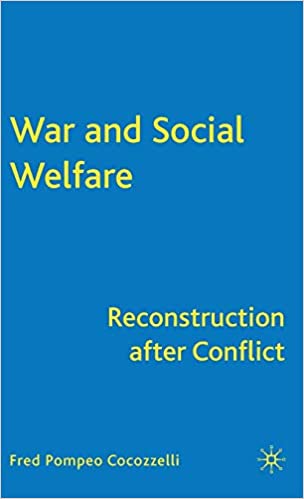
War and Social Welfare: Reconstruction after Conflict 2009th Edición

By F. Cocozzelli & Paul S. Chung War and Social Welfare: Reconstruction after Conflict addresses the issues of rebuilding social assistance and pension programs in the wake of war. Arguing that post-conflict reconstruction missions need to pay greater attention to comprehensive social policy formation, the book makes normative and functional claims that social welfare programs articulate the core aspects of citizenship. War and Social Welfare uses the case of Kosovo to examine the interaction of international and local political actors...

February 2022

AI for social protection: Mind the people

The technology that allowed passengers to ride elevators without an operator was tested and ready for deployment in the 1890s. But it was only after the elevator operators’ strike of 1946—which cost New York City $100 million—that automated elevators started to get installed. It took more than 50 years to persuade people that they were as safe and as convenient as those operated by humans. The promise of radical changes from new technologies has often overshadowed the human factor...

The Informal Economy Revisited: Examining the Past, Envisioning the Future

By Martha Che & Françoise Carré This landmark volume brings together leading scholars in the field to investigate recent conceptual shifts, research findings and policy debates on the informal economy as well as future challenges and directions for research and policy. Well over half of the global workforce and the vast majority of the workforce in developing countries work in the informal economy, and in countries around the world new forms of informal employment are emerging. Yet the informal workforce...

The Silver Economy Gets a Covid Reality Check

French care-home operator Orpea was once a bet on better retirement. In an aging society, demand for long-term care would only rise — and so would demand for long-term returns, hence why Canada’s top pension fund bought a 15% stake in 2013. It was going to be the virtuous circle of the “silver economy” in action — retirement as an asset class. The virtuous circle now looks like a vicious one. After years of growth, some 3.4 billion euros ($3.9 billion) has been wiped...

January 2022

Pandemics: Insurance and Social Protection

By María del Carmen Boado-Penas, Julia Eisenberg & Şule Şahin This open access book collects expert contributions on actuarial modelling and related topics, from machine learning to legal aspects, and reflects on possible insurance designs during an epidemic/pandemic. Starting by considering the impulse given by COVID-19 to the insurance industry and to actuarial research, the text covers compartment models, mortality changes during a pandemic, risk-sharing in the presence of low probability events, group testing, compositional data analysis for detecting data...

Fostering Inclusion in Mexico

Mexico has long suffered from high poverty and social exclusion. Although the COVID-19 pandemic has likely exacerbated these problems, an increase in social program spending helped lessen the negative impact on employment, retail sales, and poverty. Our recent staff paper argues that higher and more efficient spending on social programs, education, and health would reduce socioeconomic gaps, mitigate economic scarring from the pandemic, and foster an inclusive recovery. Longstanding social vulnerabilities According to the National Council for the Evaluation of Social...

Did Pandemic Unemployment Benefits Reduce Employment? Evidence from Early State-Level Expirations in June 2021

By Harry J. Holzer, R. Glenn Hubbard & Michael R. Strain The generosity of Unemployment Insurance (UI) benefits was expanded during the pandemic (FPUC), along with the groups of workers eligible for benefits (PUA). These two programs were set to expire in September 2021, but 18 states opted out of both in June 2021. Using Current Population Survey data, we present difference-in-difference and event study estimates that the flow of unemployed workers into employment increased by around two-thirds following early...

December 2021

Leveraging identification to extend social insurance to the informal sector

Leveraging identification to extend social insurance to the informal sector

Providing pensions and other forms of social insurance to people requires keeping track of large numbers of individuals over long periods of time. There is little margin for error. Allocating contributions of one individual to the pension of another not only affects individual fates. It also risks undermining the trust in the entire system and without trust social insurance cannot work. In the formal economy with contractual employer-employee relationships, the identification of an individual over a long period can (at...