January 2026

Artificial Intelligence and Retirement Planning

By John Cutler, J.D Any views and ideas expressed in the essay are the author’s alone and may not reflect the views and ideas of the Society of Actuaries, the Society of Actuaries Research Institute, Society of Actuaries members, nor the author’s employer. The premise for this essay is that retirees (and pre-retirees) are unlikely to have had experience with artificial intelligence (AI) to any great degree. If you think about most advanced technologies, individuals learn about them in the workplace...
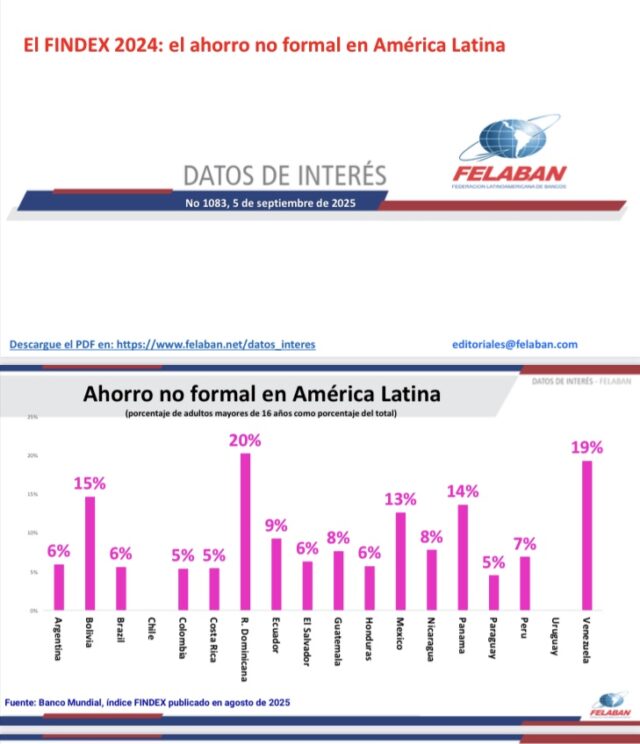
El FINDEX 2024: el ahorro no formal en América Latina

Por Felaban El índice FINDEX del Banco Mundial explícita la importancia que tiene el ahorro no formal entre la población de América Latina. Si bien existen múltiples alternativas formales de ahorro, una parte de la población adulta de la región ahorra en cadenas, grupos no formales, “natilleras”, grupos familiares y de amigos entre muchos otros. Esto si bien es un factor que desde alguna mirada puede considerarse como idiosincrático, también refleja lo que los trabajos CAF ha determinado con la...

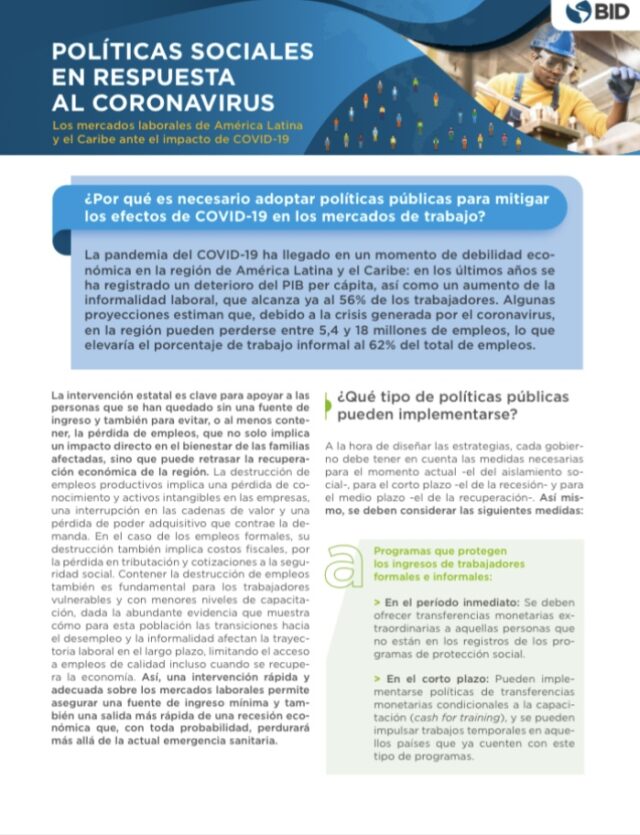
Los mercados laborales de América Latina y el Caribe ante el impacto de COVID-19

Por Oscar Arboleda, Dulce Baptista, Carolina González-Velosa, Rafael Novella, David Rosas-Shady, María Teresa Silva Porto & Nicolás Soler La pandemia de COVID-19 ha llegado en un momento de debilidad económica en la región de América Latina y el Caribe: en los últimos años se ha registrado un deterioro del PIB per cápita, así como un aumento de la informalidad laboral, que alcanza ya al 56% de los trabajadores. Algunas proyecciones estiman que, debido a la crisis generada por el coronavirus,...

Las cifras de empleo mejoran de América Latina, pero persisten la informalidad y las desigualdades

Por Naciones Unidas La situación del mercado laboral en América Latina y el Caribe registra avances, pero aún enfrenta barreras estructurales importantes, informó este jueves la Organización Internacional del Trabajo (OIT). En su publicación anual Panorama Laboral, la OIT enfatizó la recuperación del empleo tras la pandemia de COVID-19, pero advirtió que muchos de los problemas históricos siguen sin resolverse. El informe señala que la primera mitad de este año estuvo marcada por una recuperación moderada del empleo en la región, cuya...

Pensiones, edad de retiro y desigualdad de género

Por Alejandra Macías Sánchez  Hablar de pensiones en México es fundamental porque representan uno de los componentes más relevantes y dinámicos del gasto público, y su peso seguirá aumentando en las próximas décadas. Los datos del Presupuesto de Egresos de la Federación (PEF) 2026 muestran que el gasto público en pensiones rebasará el 6 % del PIB y casi un cuarto del gasto neto total (CIEP, 2025). Esto confirma que las pensiones no son un tema marginal ni de largo...

Bridging Skill Gaps for the Future: New Jobs Creation in the AI Age

By Florence Jaumotte, Jaden Kim, David Koll, Elmer Z. Li, Longji Li, Giovanni Melina, Alina Song & Marina M. Tavares The demand and supply of new skills—especially in IT and AI—are reshaping labor markets, impacting wages and hiring. About 1 in 10 job vacancies in advanced economies demands at least one new skill, often appearing first in the United States. The incidence is about half of that in emerging market economies. These skills boost average wages and employment but deepen...

Underpensioned: Analysis of Pensions Wealth data

By Pensions Policy Institute This Technical Report provides details of analysis undertaken for now:pensions as part of the Underpensioned Series of reports. John Adams, Senior Policy Analyst, at the Pensions Policy Institute (PPI), carried out the modelling and produced this report published in November 2025. The PPI is grateful for the input from Samantha Gould of now: pensions, in the production of this paper. Editing decisions remains with the author, who takes responsibility for any remaining errors or omissions. Sponsorship...

Pension Wealth and the Timing of Retirement

By Jonas Maibom, Torben M. Andersen & Anne Katrine Borgbjerg We analyze how pension wealth influences retirement timing using 25 years of Danish administrative panel data on wealth and labor market status. Exploiting early-career variation in firm-specific mandatory pension contribution rates, we study labor supply decisions from age 55 onward. Greater pension wealth accelerates labor market exit: at age 63, the elasticity is about 0.3 — an additional 100,000 DKK (15,000 USD) at age 55 reduces earnings by 1% at...

Explaining Digital Payments Adoption with Econometrics and Explainable Machine Learning: Cross-Country Evidence from a Global Household Survey

By Saida Hajjaji This paper studies the determinants of individual adoption of digital payments using the Global Findex Database 2025, released by the World Bank and based on nationally representative household surveys conducted in 2024 across 141 economies. We combine a standard econometric approach with explainable machine learning (ML) methods in order to provide both transparent global benchmarks and granular, policy-relevant insights into digital payment behaviours. We first estimate a parsimonious logistic regression model on a broad multi-country sample of 5,189...

Cash Transfers and Socioeconomic Behavior among Older Adults:,Evidence from a Regression Discontinuity Design

By Anh Tuyet Nguyen & Hiroyuki Yamada The rapid aging of populations has prompted the introduction of social pension programs aimed at preserving the welfare of the elderly. However, adverse socioeconomic behaviors may dampen the intended policy effects. Using a fuzzy regression discontinuity design, this study examines the impact of social pension receipt on expenditure patterns and material hardship among older adults aged 80 year or older in Vietnam. We find that social pension increases the risk of material hardship...