June 2020

Returning to the Core: Rediscovering a Role for Real Estate in Defined Contribution Pension Schemes

By Debbie Harrison, David P. Blake, Tony Key The objective of the research was to analyse and evaluate the role of real estate in the UK’s defined contribution (DC) pensions market in relation to auto-enrollment – the new system of pension scheme provision for private sector employees in the UK, which is being phased in by all employers between October 2012 and 2018. The most important feature of auto-enrollment schemes is the ‘default fund’, which is the multi-asset investment strategy...

Building better retirement systems in the wake of the global pandemic

By Olivia S. Mitchell In the wake of the global pandemic known as COVID-19, retirees, along with those hoping to retire someday, have been shocked into a new awareness of the need for better risk management tools to handle longevity and aging. This paper offers an assessment of the status quo prior to the spread of the coronavirus, evaluates how retirement systems are faring in the wake of the shock. Next we examine insurance and financial market products that...

An Introduction to Pensionomics

By Mario Arturo Ruiz Estrada, Evangelos Koutronas Purpose – The purpose of this paper is to explore the concept of pensionomics as a prospective tool for pension evaluation. This paper suggests a paradigm shift – a multi-disciplinary synthesis of differing perspectives in evaluating pension’s overall performance based on past work on pension evaluation – incorporating non-economic variables with significant impact on economic growth and social development. Design/methodology/approach – This paper suggests a new analytical tool called “Pensions Consistency (PC)...

Can Low Retirement Savings Be Rationalized?

By John B. Shoven, Sita Slavov, John G. Watson Simple presentations of the life cycle model often suggest a constant level of real consumption in retirement. Similarly, financial planners commonly suggest that people save for retirement in such a way as to enable them to maintain a level retirement standard of living equal to their standard of living while working. However, constant consumption with age is only optimal under the precise and unlikely condition that the subjective rate of...

May 2020

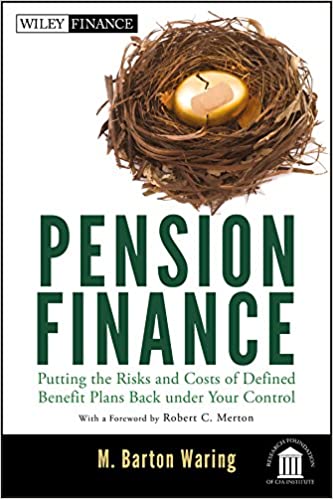
Pension Finance

By M Barton Waring, Robert C Merton Pension plans around the world are in a state of crisis. U.S. plans alone are facing a total accrued liability funding deficit of almost $4 trillion (of the same order of magnitude as the federal debt), a potential financial catastrophe that ranks among the largest ever seen. It has become clear that many government, corporate, and multi-employer pension sponsors will not be able to cope with this crippling debt and may default...

Allianz pension report 2020 the silver swan

By Allianz Even before the Covid-19 outbreak, societies were becoming more and more fragmented over several social fault lines: culture, education, wealth, place of residence. Many of these overlap: The cosmopolitan, well-educated, wealthy people live in (big) cities, whereas more conservative, low-skilled workers tend to live in the periphery. There is, however, one important social fault line that cuts through all these identities: the generation gap. With demographic and climate change (and now the coronavirus pandemic), the generational...

The Effect of Workplace Pensions on Household Saving: Evidence from a Natural Experiment in Taiwan

By Tzu‐Ting Yang Population aging causes financial imbalances in pay‐as‐you‐go public pension programs. To remedy this problem, while ensuring the adequacy of retirement savings for employees, many countries complement or substitute public pensions by regulating their workplace pensions. This article exploits a pension reform in Taiwan that has mandated, since 2005, that all private‐sector employers contribute at least 6 percent of an employee's monthly wage to an individual pension account. I use workers in the unaffected sectors as a...

Selfies can help Brazil create a super supplementary pension

By Arun Muralidhar, Robert C. Merton, Alexandre Vitorino Brazilian policy makers and researchers have discussed the introduction of a complementary pension system to complement the Regime Geral de Previdência Social (RGPS), specially for those that want a retirement income above the RGPS ceiling. This article first recommends that the complementary system must be SUPER (Simple, Universal, Portable, Efficient with low cost and Robust Regulatation). It then proposes the adoption of a financial innovation called SeLFIES (Standard-of-Living, Forward-starting, Income-only Securities),...

Pareto-improving transition to fully funded pensions under myopia

By Torben M. Andersen, Joydeep Bhattacharya, joydeep Bhattachary, Marias H. Gestsson Under dynamic efficiency, a pay-as-you-go (PAYG) pension scheme is often described as an “original sin”: It helps the current generation of retirees but hurts future generations because they are forced to save via a return-dominated scheme. Abandoning it is deemed welfare-improving but typically not for all generations. But what if agents are present-biased (hence, undersave for retirement) and the “paternalistically motivated forced savings” component of a PAYG scheme...

Reference-Dependent Preferences, Time Inconsistency, and Unfunded Pensions

By Torben M. Andersen In the real world, public pay-as-you-go pension (PAYG) schemes are popular and co-exist with private, retirement-saving schemes. This is true even in dynamically efficient economies where such pensions offer a lower return. The classic Aaron-Samuelson result argues that, in theory, this is impossible. Later work has shown that it may be possible if agents, left on their own, undersave due to myopia or time-inconsistency. In that case, if the government is paternalistic, a welfare rationale...