February 2026

Population Aging and Pension Reforms in China

By Boele Bonthuis, Yongquan Cao & Christoph Freudenberg China is experiencing rapid population aging and a declining workforce, posing significant economic and fiscal challenges, especially to the pension system. This paper examines the evolution of China’s pension system, assesses its gaps relative to international peers, and evaluates the macro-fiscal implications of population aging and various pension reforms. Using a calibrated overlapping generations model that explicitly incorporates the rural–urban disparities, we project that population aging alone can slow annual GDP growth by...

January 2026

Cash Transfers and Socioeconomic Behavior among Older Adults:,Evidence from a Regression Discontinuity Design

By Anh Tuyet Nguyen & Hiroyuki Yamada The rapid aging of populations has prompted the introduction of social pension programs aimed at preserving the welfare of the elderly. However, adverse socioeconomic behaviors may dampen the intended policy effects. Using a fuzzy regression discontinuity design, this study examines the impact of social pension receipt on expenditure patterns and material hardship among older adults aged 80 year or older in Vietnam. We find that social pension increases the risk of material hardship...

December 2025

State of OECD Pension Funds’ Climate Transition: Insights and recommendations from the Net Zero Finance Tracker

By Frederick Fabian, Claris Parenti, Maddy Taylor & Valerio Micale Unlike other institutional investors, which often focus on short-term performance, pension providers have a fiduciary duty to address long-term systemic issues and act in their beneficiaries’ best interests. In many jurisdictions, this obligation includes setting credible climate targets, implementing internal changes to strategy, governance, and process, and actively supporting the decarbonization of the real economy. Pension funds’ role in financing the climate transition is drawing sharper focus as the limits of...

November 2025

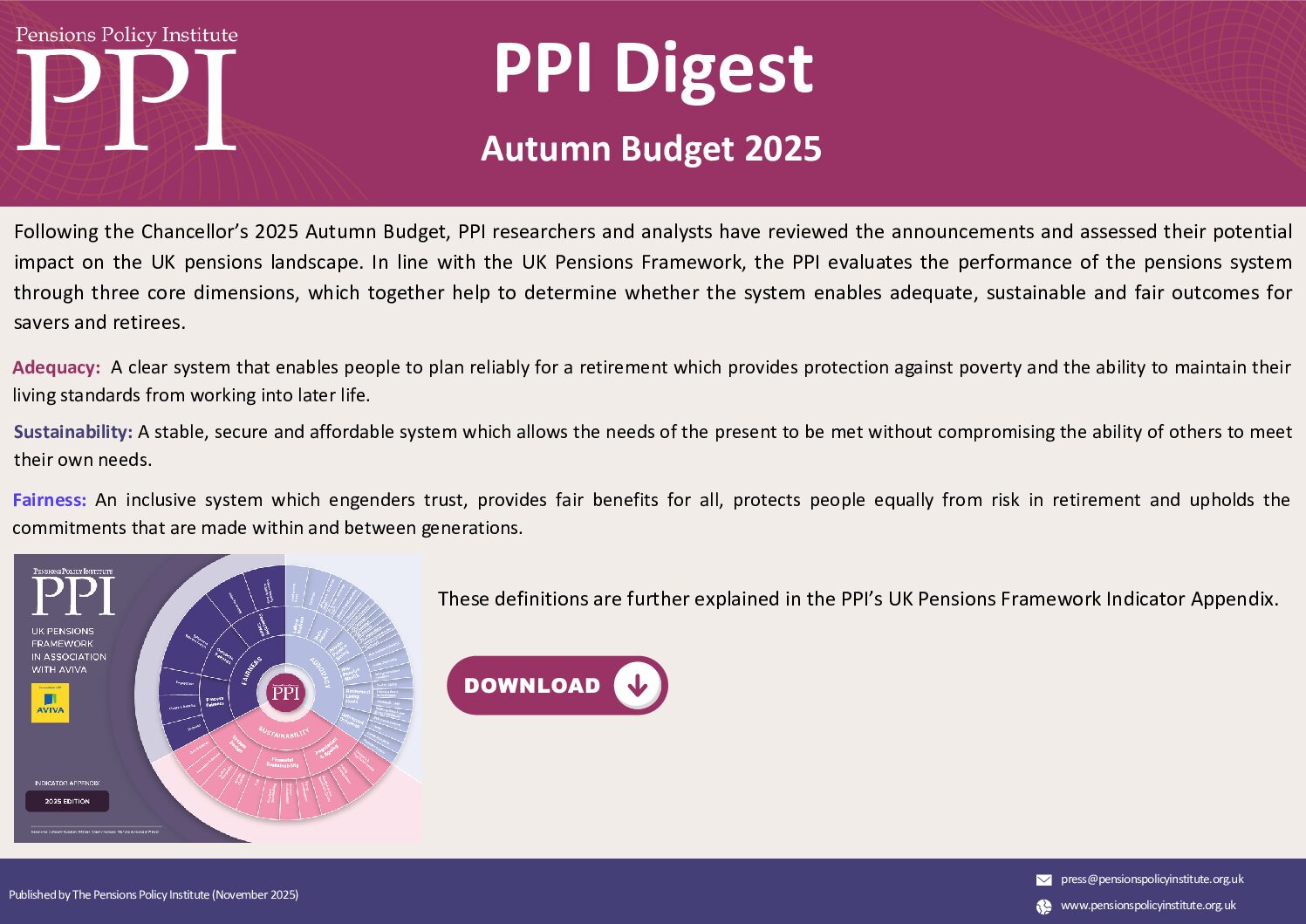
PPI Digest: Autumn Budget 2025

By Pensions Policy Institute Clearly, very difficult choices have had to be made in the Budget today. It was always unlikely that pensions would escape completely from this, even though both the Pensions Schemes Bill and the new Pensions Commission are seeking ways to increase the amount of money that future generations will have to support themselves in retirement. The introduction of a contributions cap of £2,000 on salary sacrificed pension contributions from 2029 will not affect many of those who...

Financial sustainability for the expansion of non-contributory pension systems and the eradication of old-age poverty

By Alberto Arenas de Mesa, Ernesto Espíndola & Juan Ignacio Vila Income protection is a substantive factor and a priority of social protection systems in Latin America and the Caribbean, in particular at either end of the life cycle (i.e. childhood and old age). This is due to the greater vulnerability and lower earning capacity of these population segments compared with other age groups, among other factors (Santos Garcia, Farías and Robles, 2023). In these circumstances, pension systems, in particular...

July 2025

Pensions in Spain: A Reform that Backfires

By Julián Díaz Saavedra & Javier Díaz-Giménez After the pension policy reversal that took place at the end of the past decade, the Spanish government approved a pack of new parametric changes to its public pension system, to cope with the present and future Spanish pension system imbalance. To study these changes, we use a large-scale overlapping generations model calibrated to the Spanish Economy, and show that this pension reform backfires. This is because these changes bring no significant variation...

Retirement Then, Now, and Next

By Teresa Ghilarducci & The SCEPA Team  Late Baby Boomers (age 59-67), Generation X (age 43-58) and Millennials (age 27-42) are retiring under much worse conditions than Early Baby Boomers (between age 68-76 in 2022). This fact gets obscured by research that paints an optimistic picture of retirement security that only really existed for Early Baby Boomers. Later generations have been impacted by changes to the conditions of retirement that Early Baby Boomers did not experience. This includes: the shift...

May 2025

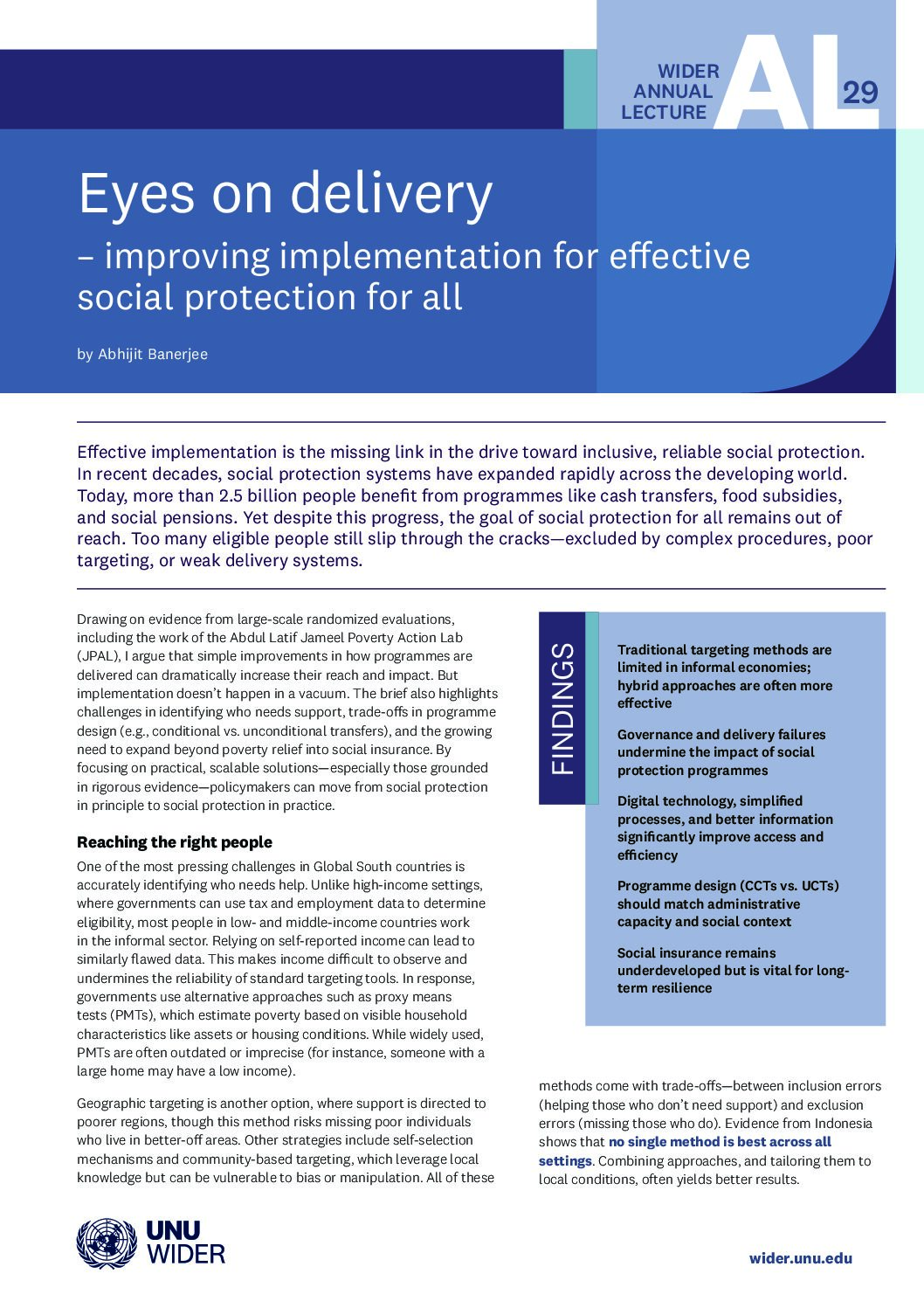
Eyes on delivery – improving implementation for effective social protection for all

By Abhijit V. Banerjee Effective implementation is the missing link in the drive toward inclusive, reliable social protection. In recent decades, social protection systems have expanded rapidly across the developing world. Today, more than 2.5 billion people benefit from programmes like cash transfers, food subsidies, and social pensions. Yet despite this progress, the goal of social protection for all remains out of reach. Too many eligible people still slip through the cracks—excluded by complex procedures, poor targeting, or weak delivery...

European semester thematic factsheet adequacy and sustainability of pensions

Pensions are the main source of income for older people in Europe, coming mostly from 'pay-as-you-go' public schemes. Retired people drawing a pension are a significant and — due to demographic ageing — a growing part of the EU population (about 124 million, or a quarter of the total population1). European pension systems are facing the dual challenge of remaining financially sustainable and being able to provide Europeans with an adequate income in retirement. The key purpose of pension...

Decoding Pension Funds: Sustainability Indicators for Annual Report Analysis

By Leticia Martins Medeiros, Clea Beatriz Macagnan & Rosane Seibert Pension funds' growth highlights the need to emphasize fiduciary duty and investment sustainability, considering the current and future participants' interests (priority stakeholders) and systemic risk reduction (environmental, social, economic, and governance effects). Therefore, this study builds sustainability indicators based on the interests of pension fund stakeholders. The methodology comprised five stages: the first consisted of analyzing Annual Information Reports to create a preliminary list of indicators; the second involved examining...