March 2024

Final report: Engaging with Pensions at timely moments

By Department for Work & Pensions The research achieves this by exploring people’s attitudes and behaviour with regards to pensions, saving, and retirement planning; identifying whether specific life events might be useful prompts to help people engage with their pensions; and looking at how the government and the pensions industry could best support people at these times. Get the report here

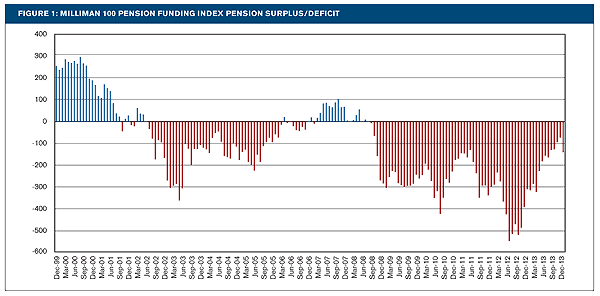
Pension Funding Index February 2024

By Zorast Wadia The funded status of the 100 largest U.S. corporate defined benefit pension plans increased by $12 billion during January as measured by the Milliman 100 Pension Funding Index (PFI). The funding surplus improved to $40 billion as a result of liability decreases that outweighed asset losses during the month. Pension liabilities fell due to an increase in the benchmark corporate bond interest rates used to value those liabilities. As of January 31, the plans’ funded ratio climbed...

Lessons from the Pan-European Personal Pension product (PEPP)

By Hans van Meerten Europe has come up with legislation for a new individual pension product: the PEPP. This introduces an individual retirement account that can be rolled out in the entire European Union (EU). And can be offered to citizens worldwide. Europe – like most continents - is ageing at a rapid pace. In 2060, there will be two people at a working age for every pensioner, in comparison with four people at a working age at the present time....

Financial Fragility, Financial Resilience, and Pension Distributions

By Robert L. Clark & Olivia S. Mitchell We evaluate Americans’ financial robustness during the Covid-19 pandemic, using measures of financial resilience and financial fragility derived from US surveys of persons age 45-75 from 2020 to 2022. We analyze which factors were associated with resilience and fragility, discuss how these measures changed during the pandemic, and assess whether pre-pandemic resilience led to better outcomes during the period. Results show that stronger resilience was protective in terms of financial fragility, and financial literacy...

February 2024

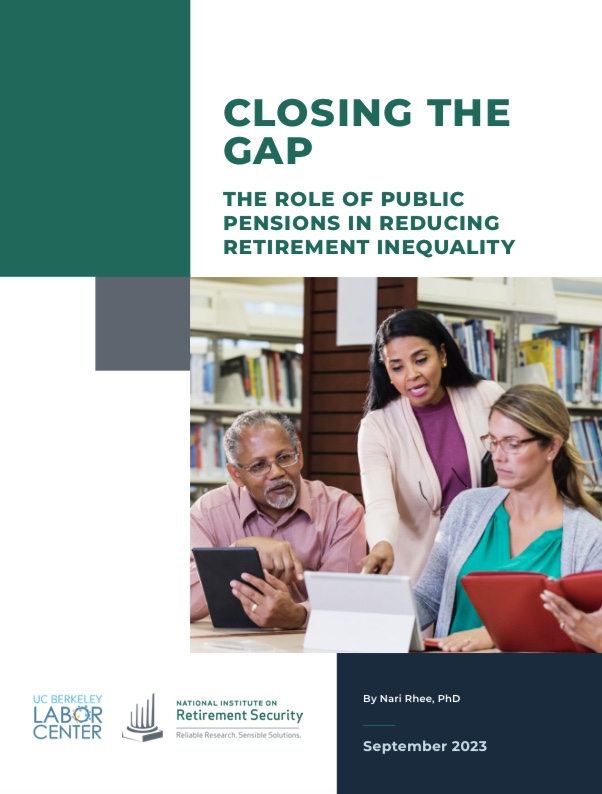
Closing the Gap: The Role of Public Pensions in Reducing Retirement Inequality

By Nari Rhee This study analyzes the impact of defined benefit pensions, especially public pensions, on retirement income security and wealth distribution by race, gender, and educational attainment in the U.S. It serves as a companion report to Closing the Gap fact sheets, which are designed to inform the public about the social equity impact of pensions in each state and the District of Columbia. Get the report here

The Government Pension Identity Crisis

By T. Leigh Anenson, J.D., LL.M., Ph.D. & Hannah R. Weiser, J.D., M.B.A. The Contract Clause once dominated the docket of the Supreme Court. But now the clause belongs to the museum of constitutional law. This artifact, however, is gaining new life in ongoing litigation over public pension reform that significantly impacts the financial benefits of government workers such as teachers, firefighters, and even judges. And, unlike private sector workers, for public servants there is no federal safety net in...

Can ChatGPT Plan Your Retirement?: Generative AI and Financial Advice

By Andrew W. Lo & Jillian Ross We identify some of the most pressing issues facing the adoption of large language models (LLMs) in practical settings, and propose a research agenda to reach the next technological inflection point in generative AI. We focus on four challenges facing most LLM applications: domain-specific expertise, an ability to tailor that expertise to a user’s unique situation, trustworthiness and adherence to the user’s moral and ethical standards, and conformity to regulatory guidelines and...

Aging Europe

By Eurostat In this interactive report, Eurostat presents us with the most relevant statistics on the aging population of the European Union, covering aspects such as working life, living conditions, access to health and income. All these statistics are accessible at the regional level and by country in the European Union. Get the report here

What could effective pensions engagement look like?

By Pensions Policy Institute This report, kindly sponsored by Standard Life, builds on the findings of the Briefing Note 136 - What is the role of engagement in pensions?, sets out the broad range of factors that can impact the level of engagement that can feasibly be achieved, the benefits and risks associated with engagement and the ways in which engagement strategies could be strengthened, including what other support may be needed for those who are less likely to become...

Does Pension Automatic Enrollment Increase Debt? Evidence from a Large-Scale Natural Experiment

By John Beshears, Matthew Blakstad, James J. Choi, Christopher Firth, John Gathergood, David Laibson, Richard Notley, Jesal D. Sheth, Will Sandbrook & Neil Stewart Does automatic enrollment into retirement saving increase household debt? We study the randomized roll-out of automatic enrollment pensions to ~160,000 employers in the United Kingdom with 2-29 employees. We find that the additional savings generated through automatic enrollment are partially offset by increases in unsecured debt. Over the first 41 months after enrollment, each additional month...