August 2021

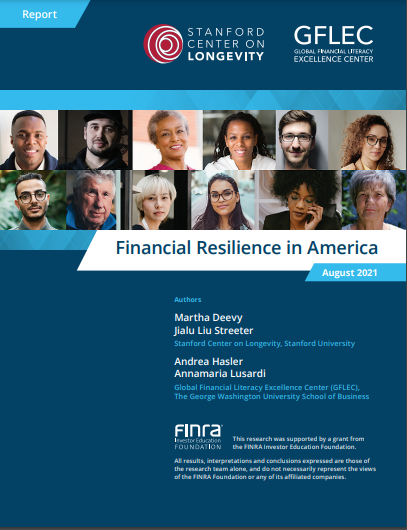
Financial Resilience in America August 2021

By Martha Deevy, Jialu Liu Streetern, Andrea Hasler & Annamaria Lusardi Data collected right before COVID-19 hit the United States in 2020 indicated deeply rooted financial insecurity: one in three American families wasn’t ready to cope with a mid-sized financial shock; about 27% couldn’t come up with $2,000 within a month if an unexpected need were to arise; and 33% found it difficult to make ends meet in a typical month (2020 TIAA Institute-GFLEC Personal Finance Index [P-Fin Index], Yakoboski...

Death and Taxes: Why Longer Lives Cost Money

By Christopher Snowdon The British population is getting older. In 1948, life expectancy was 68. Thanks to healthier lifestyles and medical advances, it is now 81 and is expected to rise to 87 by the end of the next decade. The rapid growth of the elderly population will put a strain on healthcare, social care and welfare provision. The Office for Budget Responsibility predicts that health spending in the UK will rise from 6.2 per cent of GDP in 2019/20 to...

July 2021

Fair Pension Policies with Occupation-Specific Aging

By Volker Grossmann, Johannes Schünemann & Holger Strulik We discuss public pension systems in a multi-period overlapping generations model with gerontologically founded human aging and a special focus on occupation-specific morbidity and mortality. We examine how distinct replacement rates for white-collar and blue-collar workers and early retirement policies could be designed to provide a fair and aggregate welfare-enhancing public pension system. Calibrating the model to Germany, we find that a pension system that equalizes relative pension contributions and the relative...

Delay the Pension Age or Adjust the Pension Benefit? Implications for Labor Supply and Individual Welfare in China

By Yuanyuan Deng, Hanming Fang, Katja Hanewald, Shang Wu We develop and calibrate a life-cycle model of labor supply and consumption to quantify the implications of alternative pension reforms on labor supply, individual welfare, and government budget for China’s basic old-age insurance program. We focus on urban males and distinguish low-skilled and high-skilled individuals, who differ in their preferences, health and labor income dynamics, and medical expense processes. We use the calibrated model to evaluate three potential pension reforms: (i)...

Towards equity and sustainability? China’s pension system reform moves center stage

By Li Yang In this paper I review the latest development of China’s public pension system. Last several decades saw China’s tremendous achievement in various public pension reforms. Especially since the 11th Five-Year Plan (2006-2010), reform has accelerated. By 2019, the public pension system in China has covered almost one billion adults, which makes it the biggest pension system in the world. Together with the expansion of Dibao (Basic living allowance) and the eradication of poverty, the development of pension...

The Economics of Ageing and the Political Economy of Old Age

By William A. Jackson Economic discussion of ageing has been largely neoclassical in approach. Ageing has become a specialism within population economics, which is itself a specialism within the neoclassical mainstream. An alternative view has come from authors in sociology and social policy, who have produced their own 'political economy of old age'. In contrast with neoclassical individualism, sociological depictions of aging have stressed the social construction of old age and the structured dependency of the elderly. Non-neoclassical economists have...

May 2021

World Population Ageing 2019

By United Nations 1. Population ageing is a global phenomenon: Virtually every country in the world is experiencing growth in the size and proportion of older persons in their population. There were 703 million persons aged 65 years or over in the world in 2019. The number of older persons is projected to double to 1.5 billion in 2050. Globally, the share of the population aged 65 years or over increased from 6 per cent in 1990 to 9 per...

Trends in Labor Supply of Older Men and the Role of Social Security

By Zhixiu Yu The labor supply of older men increased from the 1930s to the 1950s cohort. I estimate a structural model that fits the participation and hours worked by the 1930s cohort well. The observed policy changes in normal retirement age, the earnings test, and delayed retirement credits explain 73.4% and 88.7% of the observed rises in labor force participation and hours worked by the 1950s cohort. Additional policy experiments suggest that postponing retirement age have little effect on...

Differences and Similarities in Patterns of Society Ageing in the European Union

By Denisa Kočanová, Viliam Kováč, Jan Buleca Population ageing is a demographic problem, which emphasises the need to be interested in the lives of the most vulnerable group–the elderly. The paper investigates the ageing process and similarity of selected countries in the European Union. The EU Member States were assessed and assigned to appropriate clusters according to several indicators related to the areas that affect the lives of the elderlies, namely health status, labour market conditions, and financial security. We...

Prospective Longevity

By Warren C. Sanderson, Sergei Scherbov From two leading experts, a revolutionary new way to think about and measure aging. Aging is a complex phenomenon. We usually think of chronological age as a benchmark, but it is actually a backward way of defining lifespan. It tells us how long we’ve lived so far, but what about the rest of our lives? In this pathbreaking book, Warren C. Sanderson and Sergei Scherbov provide a new way to measure individual and population aging. Instead...