
February 2025

Politics Before Pensions: How New ESG Rules Expose Public Pension System Vulnerabilities

By Danilo Risteski As some of the largest institutional investors in the United States, public pension funds wield considerable power over investment decisions. A recent trend highlights this extraordinary power: state pension funds have started exploiting their retirees’ pensions to force investment companies to invest in accordance with their respective states’ political priorities. Nowhere is this trend more obvious than in the environmental, social, and governance field. On one hand, states like Maine have passed legislation prohibiting public pension funds...

Place-Based Policies of the European Union: Contrasts and Similarities to the US Experience

By Peter R. Berkowitz, Michael Storper & Max Herbertson The European place-based policy framework was established in the European Treaties and has a current budget of $60-70 billion per year. This paper identifies key features and directions for its future development with respect to three place-based problems: traditionally lagging regions; contemporary distressed (or left-behind regions), including those facing the structural challenges of the energy transition; the challenge of spreading prosperity faced with the uneven geography of technological clusters and routine technology-based manufacturing. We...

The effect of Covid pension withdrawals and the Universal Guaranteed Pension on the income of future retirees in Chile

By Carlos Madeira Chile implemented large pension withdrawals during the Covid pandemic. Afterwards, Chile increased non contributory beneÖts in a quasi-universal scheme. Simulating future pensions, I show that the average loss in contributory pension income is 27.9%, with losses of 23.9% and 31.4% for men and women, respectively. After accounting for public transfers, the average loss in total pension income is just 6.2%, with losses of 7.5% and 5.2% for men and women, respectively. Current retirees lost just 1.1% of...

El futuro del envejecimiento en América Latina y el Caribe: nuevas perspectivas metodológicas

Por Jeroen Spijker Este artículo proporciona una visión general de varios indicadores alternativos al instrumento más tradicional para medir el envejecimiento para el pasado, presente y futuro en los países de América Latina y el Caribe. Los resultados muestran que cuando pensamos en la vejez no tan solo en términos de los años vividos, sino también, en términos de los años que quedan por vivir, casi todas las poblaciones actuales de América Latina y el Caribe están rejuveneciendo en vez de...

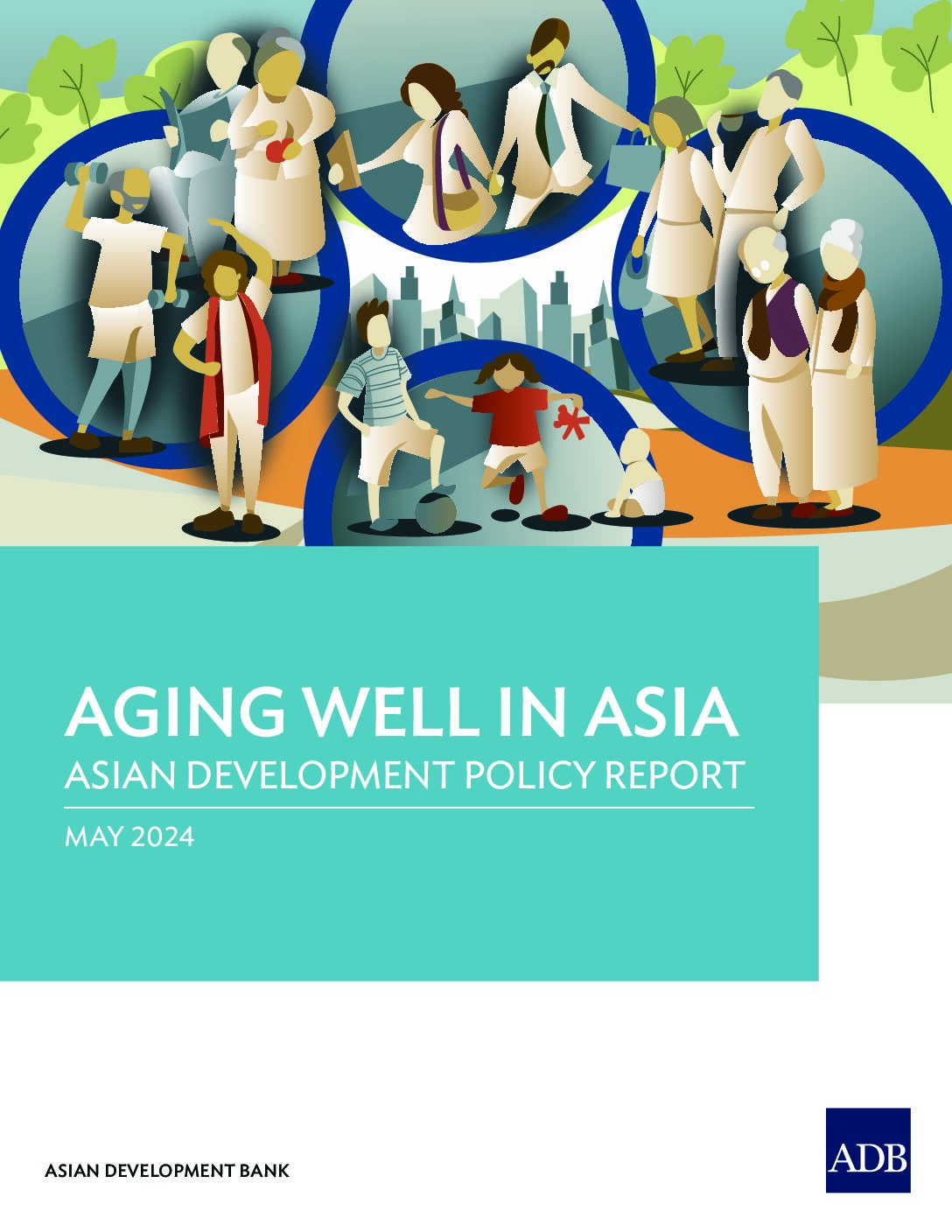
Aging Well in Asia: Asian Development Policy Report

By Asian Development Bank The report explores four linked dimensions of well-being: health, productive work, economic security, and social engagement. It highlights the need for lifelong investment in human capital, a life-cycle approach to intervention for age-specific needs, and population-wide outreach to people of all ages. It provides concrete recommendations in the policy domains of health, employment and retirement, pensions, long-term care, and community-level support. Get the report here 

Challenges and concerns surrounding China’s retirement age reform

By China Labour Bulletin China is currently grappling with a pressing demographic challenge, marked by record-low birth rates and low retirement ages, leading to a continuous decline in the working-age population. According to the National Bureau of Statistics, the working-age population dropped to 61.3% in 2023, down from 62% the previous year. The shrinking workforce and ageing population are increasingly straining China’s pension system. Current projections indicate that, without intervention, the social security system’s resources will be depleted by 2035. In response to...

Smaller than We Thought? The Effect of Automatic Savings Policies

By James J. Choi, David Laibson, Jordan Cammarota, Richard Lombardo & John Beshears Medium- and long-run dynamics undermine the effect of automatic enrollment and default savings-rate auto-escalation on retirement savings. Our analysis of nine 401(k) plans incorporates the facts that employees frequently leave firms (often before matching contributions from their employer have fully vested), a large percentage of 401(k) balances are withdrawn upon employment separation, and many employees opt out of auto-escalation. Steady-state saving rates increase by 0.6% of income due to automatic enrollment and...

January 2025

Household Saving in Japan: The Past, Present, and Future

By Charles Yuji Horioka This paper explores the determinants of the level of, and trends over time in, Japan’s household saving rate, with emphasis on the impact of the age structure of the population, and makes projections about future trends therein. The paper finds that Japan’s household saving rate has not always been high either absolutely or relative to other countries and that it was only during the 1961-86 period that it exceeded 15%. Past and future trends in Japan’s...

Financial Inclusion Across the United States

By Motohiro Yogo, Andrew Whitten & Natalie Cox We study retirement and bank account participation for the universe of U.S. households with a member aged 50 to 59 in the administrative tax data. ZCTA-level average income, income inequality, and racial composition predict retirement account participation for low-income households, conditional on household income and regional price parities. Income inequality also predicts bank account participation for low-income households. We estimate the causal effect of access to an employer retirement plan on participation. Recent policy proposals...

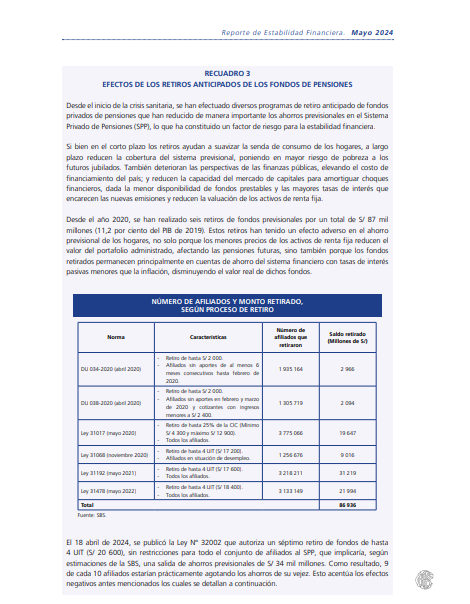
Efectos de los Retiros Anticipados de los Fondos de Pensiones

Por Banco Central de Reserva del Perú Desde el inicio de la crisis sanitaria, se han efectuado diversos programas de retiro anticipado de fondos privados de pensiones que han reducido de manera importante los ahorros previsionales en el Sistema Privado de Pensiones (SPP), lo que ha constituido un factor de riesgo para la estabilidad financiera. Si bien en el corto plazo los retiros ayudan a suavizar la senda de consumo de los hogares, a largo plazo reducen la cobertura del sistema previsional, poniendo en...