
November 2025

Household financial literacy and retirement planning in rural China

By Yuting Qian, Weiqiang Tan & Jingbo Wu Amid the prevailing importance of discussing rural villagers' retirement in China, this study analyzes the relationship between the financial literacy of rural residents and their plans for retirement. Using in-depth survey data from the Greater Bay Area, this work examines the region's demographic structures and presents the different levels of rural residents' financial literacy. The findings are robust and indicate a positive correlation between financial literacy and retirement planning. The examination also reveals the moderating...

UK. Almost two thirds of mid-retirees have not had essential conversations about finances

Research by Aviva, a leading pension provider, and Age UK, the UK’s expert voice on ageing, has found that mid-retirees are navigating retirement without the financial support or guidance they may need as they get older. The report by Aviva and Age UK (published May 2025), Retirement Reality: Managing Money in Mid-Retirement, highlights the challenges faced by mid-retirees navigating the retirement landscape. The research surveyed 1,000 mid-retirees (aged 65-75) who have a private pension, are on a moderate retirement...

October 2025

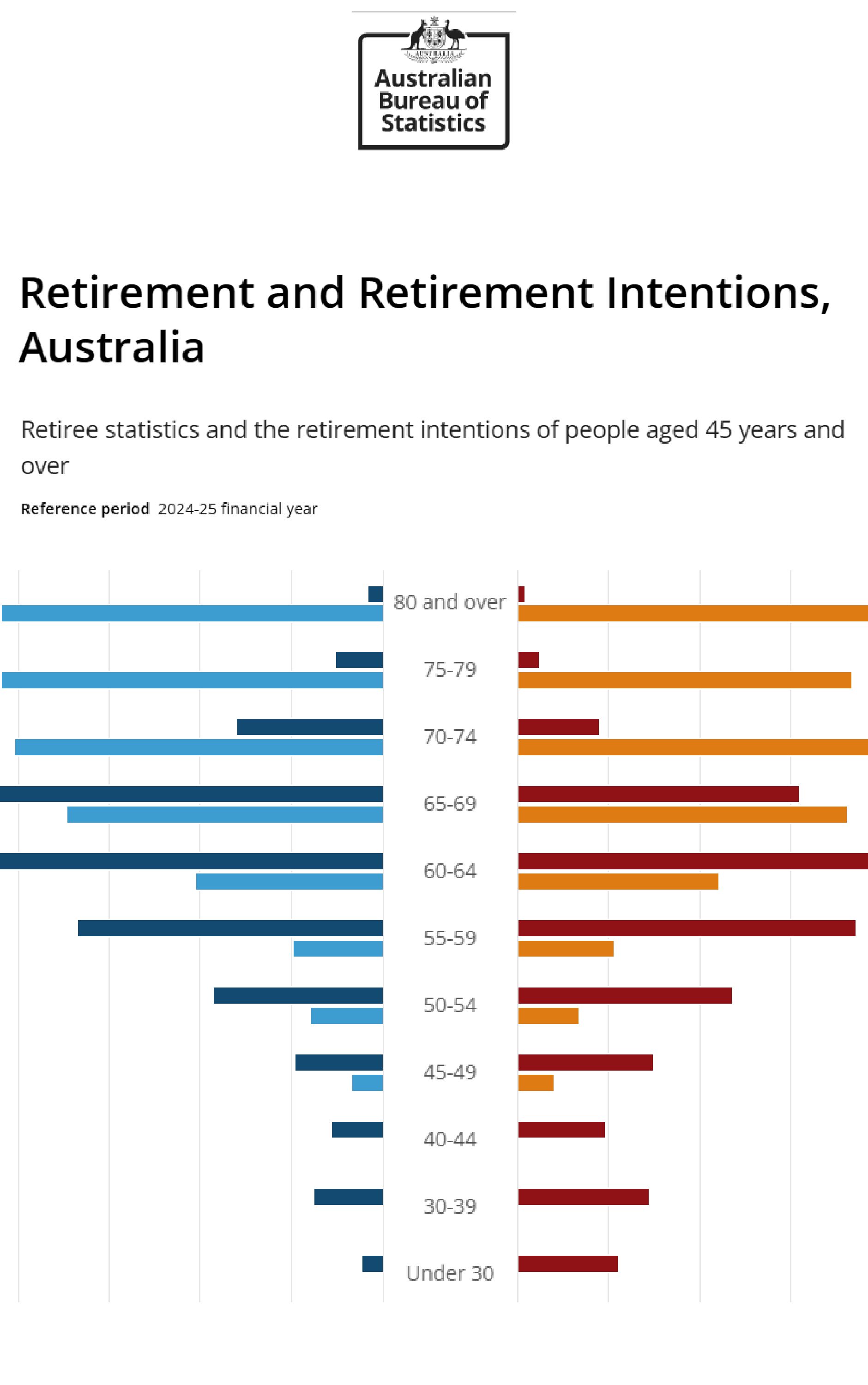
Retirement and Retirement Intentions, Australia: Retiree statistics and the retirement intentions of people aged 45 years and over

By Australian Bureau of Statistics In 2024-25, 156,000 people aged 45 and over retired. Of these, 55% were women. On average, women retire at an earlier age than men. The average age both men and women are retiring is continuing to increase. The average age at retirement for people aged 45 years and over who retired in 2024-25 was 63.8 years. For men, the average age was 64.9 years and for women the average age was 62.7 years. The average age at retirement...

Behavioral Biases of Financial Planners: The Case of Retirement Funding Recommendations

By Vishaal Baulkaran & Pawan Jain We examine whether financial planners display common behavioral biases and whether these biases affect their recommendations for various home equity release options to fund retirement income. First, we show that different factors explain different behavioral biases. Second, we show that different behavioral biases affect financial planners’ comfort level and recommendations for various options to fund extra income during retirement. For instance, female planners, planners with advanced degrees and those from non-bank institutions display less...

A Closer Look at the Retirement Prospects of the Middle Class

Representing more than half of the U.S. population, people in the middle class embody the American dream by working hard, caring for their families, and saving for the future while navigating an ever-changing economy and society. So how are they addressing these complexities? In “Retirement Throughout the Ages: The American Middle Class,” the Transamerica Center for Retirement Studies (TCRS) in collaboration with Transamerica Institute examines the road to retirement for people in the middle class across age ranges, their life...

US. Gig economy helps power economy, but its workers can’t retire

America is fast approaching a historic milestone. By 2027, freelancers will make up more than 50 percent of the workforce, marking a fundamental shift in the U.S. labor market. Yet many of these workers will have no retirement plan. According to the Pew Research Center, only 13 percent of single-person business owners are saving for retirement compared to almost three-fourths of Americans in traditional jobs. That leaves tens of millions of freelancers and independent workers at risk, just as other...

September 2025

US. Strength in numbers: Why scale is reshaping the future of retirement plans

For CFOs and finance team leaders, the pressure to deliver more value with fewer resources is relentless. Retirement plan management—often a top-three employee benefit—has become a focal point, as organizations navigate rising costs, complex compliance, and growing expectations from employees and regulators alike. Many employers still manage their 401(k) plans in isolation, bearing the full weight of administration and risk without the advantages of scale. Today, as regulatory scrutiny and litigation intensify, and employees demand stronger retirement security, the...

US. Rethinking Retirement A Four-Pillar Framework for Security and Sustainability

America’s retirement system needs an overhaul. Many retirees face inadequate income and persistent uncertainty. On the bright side, however, most Americans do have more money than ever before to finance their retirement. Thus, reforming our retirement system will not require significant government resources. But it will require a fundamentally new approach that considers all potential sources of retirement income. One key feature of our retirement system, the 401(k), was designed to generate wealth that supplements income from Social Security and...

2025 Read on Retirement survey

By BlackRock Workplace savers are feeling more confident about retirement—but plan sponsors aren’t on the same page. As the gap in outlook widens, advisors have a critical role to play. Uncover the insights shaping this divide. Navigating uncertainty and a growing divide Saver confidence is up but fragile. This year’s dip underscores how closely confidence tracks with market volatility. And while savers feel increasingly sure, only 38% of employers believe the majority of their employees are truly on track—a record low. The...

US. Worker Optimism About Retirement Rises, Actual Savings Contributions Fall

Nearly two-thirds (64%) of workers feel on track with their retirement savings, but there is a record gap between their confidence level and that of their employers, according to BlackRock’s 2025 Read on Retirement survey, published Monday. Only 38% of employers surveyed reported they believe at least 60% of their employees are on track with their retirement savings, a record low since BlackRock began its survey in 2016. Meanwhile, savers’ confidence is up 23% over the same period. “A decade of...