August 2023

Retirement Security: Income and Wealth Disparities Continue through Old Age

By GAO Income and wealth inequality in the United States have increased over the last several decades. We looked at whether these trends continue for older Americans as they age. We compared income and wealth for all older households from 1989 through 2016 and found households in the top 20% saw disproportionately greater gains than other households. We also looked at income and wealth for a group of older Americans as they aged. We found disparities in income decreased, possibly due to...
July 2023

The 2021 Ageing Report: Underlying Assumptions and Projection Methodologies

By Directorate-General for Economic and Financial Affairs & Economic Policy Committee With a view to ensuring the sustainability of public finances in the EU, the ECOFIN Council charged the Economic Policy Committee (EPC) with producing a new set of long-term budgetary projections by 2021, on the basis of new population projections to be provided by Eurostat. Safeguarding the sustainability of public finances requires that the analysis is based on reliable, comparable information on possible challenges to fiscal sustainability, including strains...

June 2023

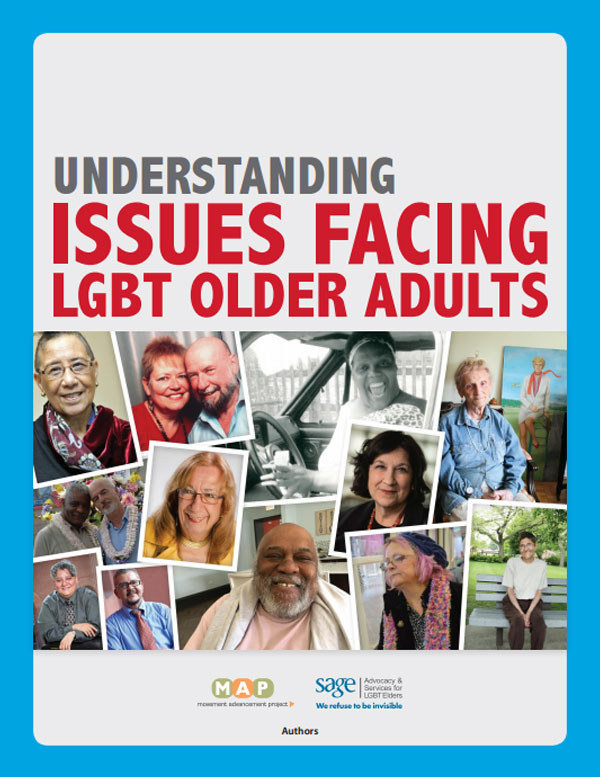
Understanding issues facing LGBT older adults

By Movement Advancement Project & Sage It is estimated that there are approximately 2.7 million LGBT adults aged 50 and older in the United States, 1.1 million of whom are 65 and older. Understanding Issues Facing LGBT Older Adults provides an overview of their unique needs and experiences so that service providers, advocates, the aging network, and policymakers can consider these factors when serving this population or passing laws that impact older adults and the LGBT community. Read book “here”

Long-Term Care Equality Index 2023

By Kelley Robinson & Michael Adams The Long-Term Care Equality Index (LEI) is a program of SAGE and the Human Rights Campaign Foundation (HRCF). The goal of the LEI is to create a network of LTCCs across the country that are providing a welcoming home for older LGBTQ+ people. The Long-Term Care Equality Index 2023 represents the first validated survey on LGBTQ+ inclusion in long-term care and senior housing communities. The Human Rights Campaign Foundation and SAGE are excited to present...

Pioneering Safe & Inclusive LGBT Specific Retirement Accommodation. Exploring Models in the USA, UK, & Spain

By Liam Concannon With significant advances in equal rights for lesbians, gay men, bisexual and transgender (LGBT) citizens, achieved across the western world during the past few decades, one group that continues to be overlooked is LGBT elders. This article examines the unique discrimination and homophobia faced by older LGBT people living in nursing and residential care homes. It investigates ways in which these environments construct and perpetuate heteronormativity by addressing the needs of heterosexual residents, while at the same...

Projections of the Size and Composition of the U.S. Population: 2014 to 2060

By Sandra L. Colby & Jennifer M. Ortman  Between 2014 and 2060, the U.S. population is projected to increase from 319 million to 417 million, reaching 400 million in 2051. The U.S. population is projected to grow more slowly in future decades than in the recent past, as these projections assume that fertility rates will continue to decline and that there will be a modest decline in the overall rate of net international migration. By 2030, one in five Americans...

May 2023

The Future of AI and Older Adults

By Laurie M. Orlov  Advances in AI got the full attention of the technology industry, which is undergoing its first major disruption since the arrival of smart speakers and voice in 2014. Multiple industries see compelling opportunities, including healthcare providers, senior living, customer service providers, training and remote monitoring service offerings. Government organizations are investing in AI and aging startups and programs. Although there are a number of barriers to adoption, in the not-so-distant future, machine learning, chatbots, and AI in the home...

Can the Australian Judicial System Meet the Structural Challenges of Future Population Change?

By Brian Opeskin  This article examines the impact of population change on the evolution of the Australian judicial system. Through four case studies, it argues that demography is an important but overlooked lens through which to understand pressures on the judicial system over coming decades. The case studies examine the impact of increasing life expectancy on judicial tenure; of population ageing on judicial pensions; of international migration on judicial diversity; and of population redistribution on the spatial delivery of justice...

Developments in the Economics of Aging (National Bureau of Economic Research Conference Report)

By David A. Wise  The number of Americans eligible to receive Social Security benefits will increase from forty-five million to nearly eighty million in the next twenty years. Retirement systems must therefore adapt to meet the demands of the largest aging population in our nation’s history. In Developments in the Economics of Aging, David A. Wise and a distinguished group of analysts examine the economic issues that will confront policy makers as they seek to design policies to protect the...

April 2023

Aging, Inadequacy, and Fiscal Constraint: The Case of Thailand

By Phitawat Poonpolkul, Ponpoje Porapakkarm & Nada Wasi We use an overlapping generations model to study the challenge in developing countries with a large informal sector and aging populations. We use Thailand as a case study and incorporate its labor market structure and its public pension system into the calibrated model. Unlike developed countries, workers in developing countries commonly transit from the formal sector to the informal sector, which can be in the early stage of their working life. This...