October 2025

The Paradox of Demographic Dividend: Ageing Population and the Gig Economy

As I travel from my office in Dal Gate towards Jawahar Nagar, in Srinagar, a 24-year-old food delivery rider parks his scooter in front of a coaching centre. He has just completed his third order of the morning and is checking his phone for the next one. His father, meanwhile, spent three decades as a government schoolteacher, drawing a steady salary and retiring with a pension that still sustains the family. The contrast could not be sharper: the father’s...


The U.S.-Born labor force will shrink over the next decade

By Josh Bivens It is often underrecognized how much population aging is currently reducing the growth rate of the U.S. labor force and will continue to pull it down in coming decades. The share of the population that is over the age of 65 (when labor force participation tends to take a steep fall on average) is rising rapidly. This share was 12.4% in 2007, 17.9% in 2024, and will hit 21.2% by 2035 (CBO 2025b). A recent EPI report...

Part-Time Penalties and Heterogeneous Retirement Decisions

By Kanta Ogawa Older male workers exhibit diverse retirement behaviors across occupations and respond differently to policy changes, influenced significantly by the part-time penalty—wage reduction faced by part-time workers compared to their full-time counterparts. Many older individuals reduce their working hours, and in occupations with high part-time penalties, they tend to retire earlier, as observed in data from Japan and the United States. This study develops a general equilibrium model that incorporates occupational choices, endogenous labor supply, highlighting that the...

Population Aging in ASEAN+3: But is 60 the New 40?

By Aruhan Rui Shi & Hongyan Zhao Population aging is becoming a significant concern, particularly as its pace accelerates, especially in emerging market economies. However, labeling all individuals aged 65 and above as elderly can be misleading and inaccurate when life expectancy is increasing. Therefore, using the prospective old-age dependency ratio to define what is elderly would allow for more precise measurements and facilitate research into the impact of aging on economic growth. Our findings suggest that while a negative...

Healthy ageing: Are we on track?

The world is ageing at an unprecedented pace. The change in global demography caused by population ageing has been a notable phenomenon in recent times. The global population of people aged 60 and above is expected to increase from 1.1 billion in 2023 to 1.4 billion in 2030. Moreover, the pace of population ageing has been significantly faster than in the past, with an estimated increase in the proportion of older people in the global population from 12% to 22% between 2015 and 2050. Between 1974...

September 2025

The global imperative of investing in healthy aging

Observed on October 1 of each year, International Day of Older Persons recognizes the contributions of older adults and raises awareness of the challenges they may face. As the world undergoes a profound demographic shift with increasing life expectancies, many communities lack the structures or opportunities that allow the older population to thrive. Societies are confronted with a once-in-a-generation choice: reimagine systems to support longevity for all or risk stagnation with outdated structures. “Improving the quality of life for older individuals and...

US. New Government Research Finds Strong Private Sector Retirement Plan Coverage

The Bureau of Labor Statistics has released its latest monthly report on employee benefits in the United States, and retirement benefit coverage for workers specifically. As of March 2025, the latest month for which measurable results are available, the Bureau found that retirement benefits were available to 72 percent of private industry workers. Notably, 70 percent of private sector workers had access to defined contribution plans, and 14 percent had access to defined benefit plans. Among private sector workers, the research found that 59...

Has Population Aging Led to Strategic Shifts in Enterprises?

By Hanteng Li, Yun Qin & Yuhang Wang  This paper uses Chinese listed companies from 2009 to 2023 as a sample to systematically examine the impact pathways and mechanisms through which population aging influences corporate strategic transformation. The study finds a significant positive relationship between population aging and corporate strategic transformation, and this conclusion remains robust under multiple sensitivity tests. Further analysis of moderating effects indicates that a firm’s innovation capability plays an important moderating role in the relationship between...

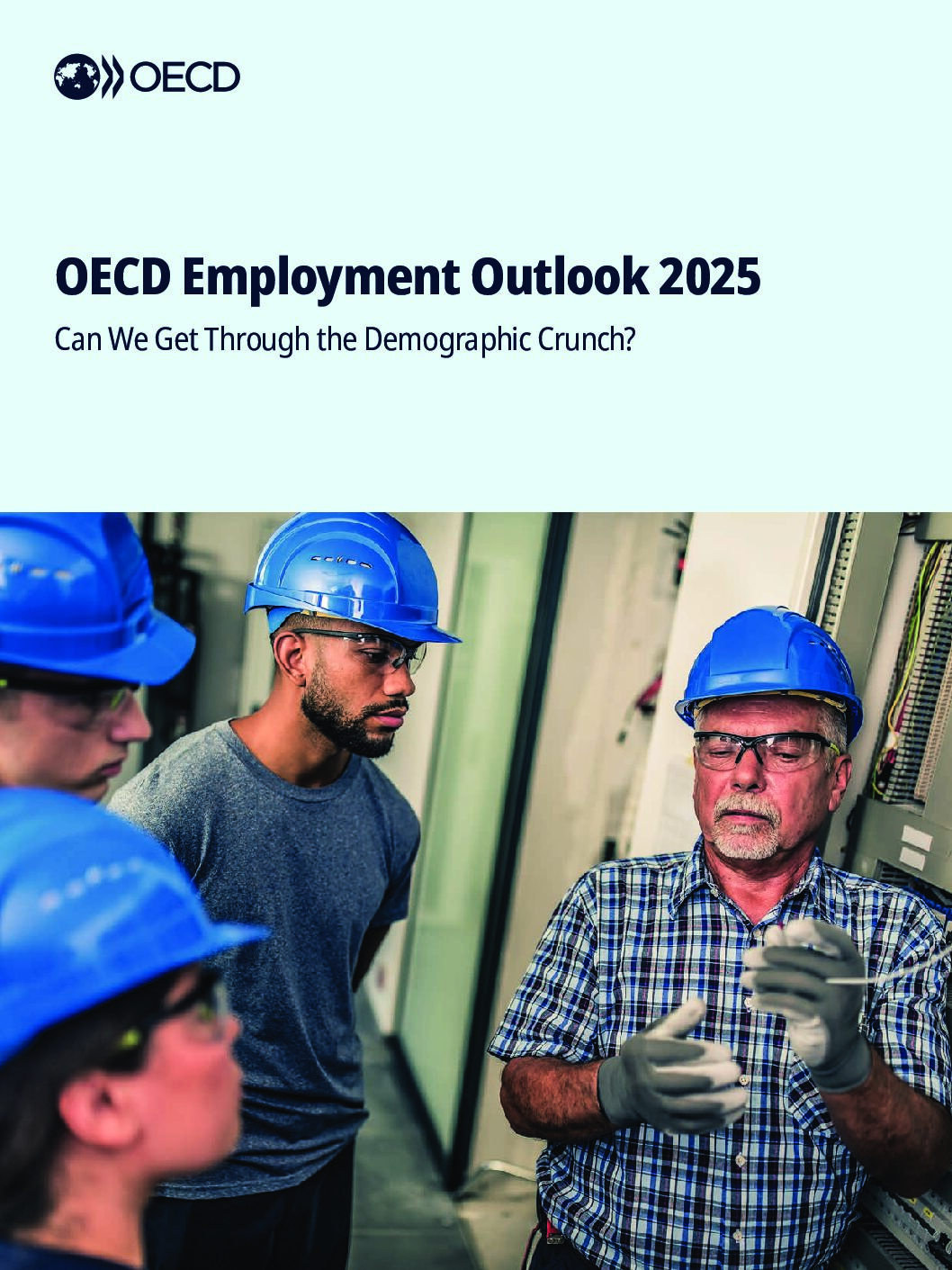
OECD Employment Outlook 2025: Can We Get Through the Demographic Crunch?

By Organisation for Economic Co-operation and Development Over the past two decades, population ageing, increasing statutory retirement ages and rising education levels have led to higher employment rates among workers aged 55 and above in OECD countries. However, progress across countries remain uneven, and employment rates decline rapidly from age 60, such that many workers are leaving employment well before reaching the eligibility age for a pension. To sustain living standards and address structural labour shortages, many countries will need...

The Impact of Job Exposure to Artificial Intelligence on the Korean Labor Market in 2020

By Yeseul Lee & Hyeonjun Hwang This study examines the impact of artificial intelligence exposure on wage and employment outcomes in the Korean labor market in 2020. We propose the Artificial Intelligence Exposure Score (AIES) by integrating 27,921 Korean AI patents from 2011 and 2020 with O*NET task descriptions through Sentence-BERT natural language processing techniques. This approach creates occupation-level exposure measures that reflect Korea-specific innovation patterns. Using data from the Korean Labor and Income Panel Study (KLIPS), we estimate log-linear...