November 2023

Unionization of Retired Workers in Europe

By Vinzenz Pyka & Claus Schnabel We shed light on an understudied group: retirees in unions. Using representative individual-level data of 19 European countries, we find that the share of retirees in unions and the union density of retirees increased between 2008 and 2020. Econometric analyses indicate that on average retired workers' probability of union membership is 17 percentage points lower than that of active workers. This finding is consistent with social custom models and cost-benefit considerations. We further find that...

October 2023

The Role of Disability Insurance on the Labour Market Trajectories of Europeans

By Agar Brugiavini & Petru Crudu  This work documents the role played by disability insurance, typically part of a wider public pension provision package, on the labour market trajectories and retirement decisions. We will first employ a machine learning approach to estimate a Transition Probability Model able to uncover the most likely labour market histories and then evaluate the effects of policy reforms, including reforms to the eligibility for disability insurance benefits. The main contribution is the introduction of disability...

September 2023

The Labor Market Effects of Facilitating Social Security Contributions Under Part-Time Employment Contracts: Evidence from Colombia

By Brenda Samaniego de la Parra, Andrea Otero-Cortés & Leonardo Morales  We examine the impact of reducing rigidities caused by regulation on labor demand in a context with high informality. Using employer–employee matched administrative records and household survey data, we estimate the effects of a reform that eliminated a wedge in firms' regulatory costs of employing workers on different work schedules in Colombia, reducing the relative costs of formal parttime employment. We find that the reform increased the probability of entering...

August 2023

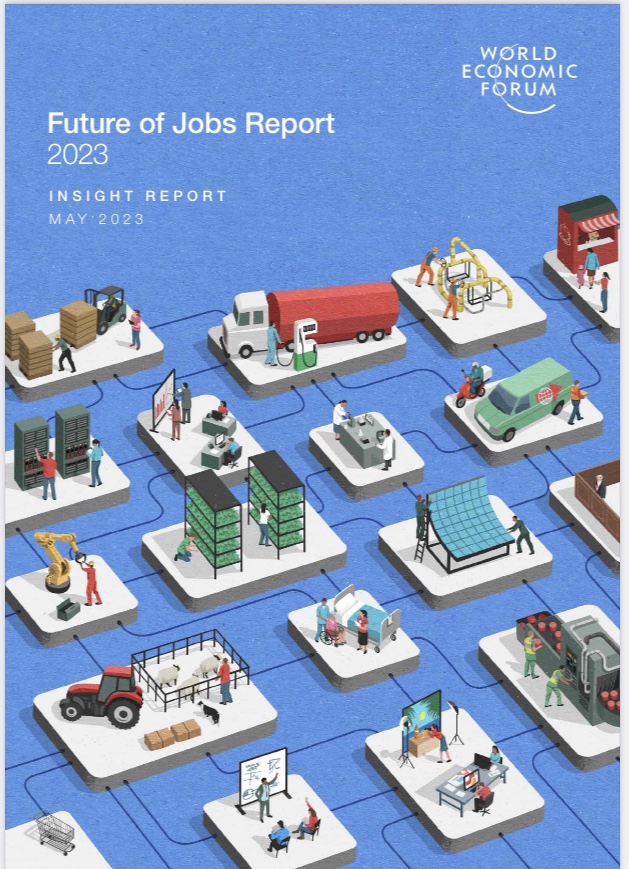
Future of Jobs Report 2023

By World Economy Forum  The past three years have been shaped by a challenging combination of health, economic and geopolitical volatility combined with growing social and environmental pressures. These accelerating transformations have and continue to reconfigure the world's labour markets and shape the demand for jobs and skills of tomorrow, driving divergent economic trajectories within and across countries, in developing and developed economies alike. The Fourth Industrial Revolution, changing worker and consumer expectations, and the urgent need for a green...

Annual report on intra-EU labour mobility 2022 published

By European Commission  Irrespective of the pandemic, the number of working age EU citizens living in another Member State remained stable, at 10.2 million in 2020. The number of persons moving, however, declined in line with the restrictions imposed because of the pandemic. With the pandemic phasing out, we expect that these figures will return to pre-Covid-levels. The labour market performance of mobile workers has, following a Covid-induced dip in 2020, again reached 74%, i.e. the same level as for nationals....

July 2023

Relationship between Social Security Programs and Elderly Employment in Japan

By Takashi Oshio, Satoshi Shimizutani & Akiko S. Oishi  This study examines how elderly employment is associated with social security programs and how it responds to recent reforms in Japan. To this end, we employed a rich and longitudinal dataset of middle-aged and older individuals collected between 2005 and 2018. By incorporating various factors related to social security incentives into a single index of implicit tax (ITAX), we confirmed that the index successfully captured the incentives and their changes incorporated...

Early Retirement Provision for Elderly Displaced Workers

By Herman Kruse & Andreas Steinvall Myhre This paper studies the economic effects on re-employment and program substitution behavior among elderly displaced workers who exogenously lose eligibility for their early retirement option. We use detailed Norwegian matched employer-employee data containing information on bankruptcy dates and individual income, wealth, pensions and social security benefits. As job displacement before a certain age cut-off results in the loss of eligibility for early retirement benefits between ages 62–67 years in Norway, we are able...

How the 1963 Equal Pay Act and 1964 Civil Rights Act Shaped the Gender Gap in Pay

By Martha J. Bailey, Thomas E. Helgerman & Bryan A. Stuart In the 1960s, two landmark statutes—the Equal Pay and Civil Rights Acts—targeted the long-standing practice of employment discrimination against U.S. women. For the next 15 years, the gender gap in median earnings among full-time, full-year workers changed little, leading many scholars and advocates to conclude the legislation was ineffectual. This paper uses two different research designs to show that women’s relative wages grew rapidly in the aftermath of this...

National survey of gig workers paints a picture of poor working conditions, low pay

By Ben Zipperer, Celine McNicholas, Margaret Poydock, Daniel Schneider & Kristen Harknett  While the concept of nontraditional, short-term, and contract work has been around since well before the digital age, it wasn’t until the 2010s that digital platform companies like Uber, DoorDash, Instacart, and TaskRabbit began to rise to prominence and shape the way we define gig work today. In the most basic terms, gig work can be defined as work done by individuals who are classified as self-employed, freelancers,...

Trapped in the platform: Migration and precarity in China’s platform-based gig economy

By Yang Zhou Recent studies on precarity among gig workers has turned away from labour process factors to explore the role of the wider social, cultural and institutional environment. Existing westerncentred studies in this aspect argue that platforms reproduce racialised and gendered hierarchies to leverage control over vulnerable populations. This study extends this literature by focusing on the migration factor in a non-western context. Using the case of Didi, drawing on ethnographic and interview data, it is argued that migrant...