May 2024

Older Adult Employment: 2021 Annual Report

By SeniorLiving.org Workers over the age of 55 represent a huge and essential segment of the American economy, and their influence is growing. In fact, by 2030, one in four U.S. workers will be 55 or older. In part because they account for such a large share of the workforce, older adults have been hit hard by the Covid-19 pandemic, and many states had a decline in the number of workers over 55 remaining in the workforce. But overall, the 55-and-older...

The growth of the older workforce

By Richard Fry & Dana Braga The share of older adults holding a job today is much greater than in the mid-1980s. Some 19% of adults ages 65 and older are employed today. In 1987, only 11% of older adults were working. Today’s share is similar to that of the early 1960s, when 18% of older Americans worked. As the employment rate among older adults has gradually risen since the 1990s, employment among younger workers has followed a different pattern. Jobholding...

April 2024

Latent Cumulative Disadvantage: US Immigrants’ Reversed Economic Assimilation in Later Life

By Leafia Z Ye One of the most salient findings in research on immigration has been that immigrants experience substantial economic mobility as they accumulate more years in the host-society labor force and eventually approach earnings parity with their native-born counterparts. However, we do not know whether this progress is sustained in retirement. In this paper, I develop a framework of Latent Cumulative (Dis)advantage and hypothesize that even as immigrants are approaching parity with the native-born in terms of current...

The future of life expectancy

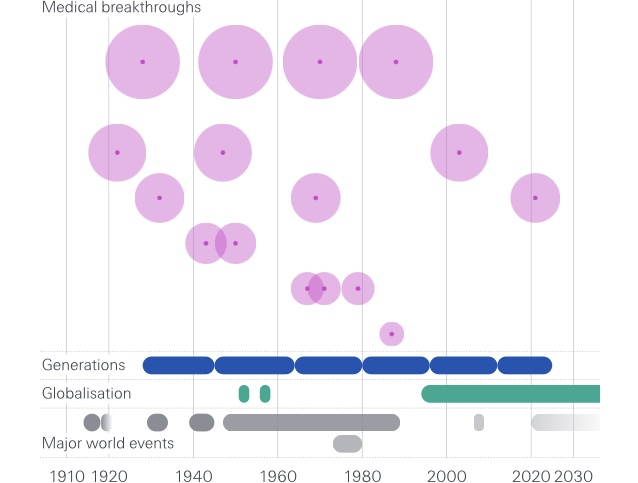
By Prachi Patkee & Adam Strange Human longevity is one of the great success stories of the past century, and there is broad consensus that there are further gains to come. Mortality improvement forecasts underpin the insurance industry's long-term mortality and longevity lines of business. To generate long term forecasts, defined as beyond 20 years, a holistic view of the factors that influence mortality, which combine analyses of historic trends with a forward-looking view of medical advances, societal changes and...

The Effects of Environmental Distress on Labor Markets: Evidence from Brazil

By Danae Hernandez-Cortes & Sophie Mathes This article documents how environmental distress affects individual-level labor market outcomes in Latin America’s largest economy. We collect data on a broad range of environmental distress events namely heat waves, floods, fires, and droughts, and combine these with uniquely rich administrative information covering the universe of formal employment in Brazil from 2003 to 2017. We find heterogeneous labor effects in response to environmental distress. We find that heat waves disrupt employment, increasing retirement rates...

March 2024

The gender pensions gap report 2024

By Joanne Segars, Lizzy Holliday & Laura Wilkinson The gender pensions gap- the difference in pension savings wealth between men and women at retirement age - is substantial. Allowing for typical working patterns, women's pension wealth is a third (33%) less, relative to men. These figures are the result of a lifetime of reduced earnings potential, increased time out of the workforce and other contributory factors. To bridge this gap themselves, women would need to work an extra 19 years in...

January 2024

Inter-Generational Spillovers in Labor Supply: Evidence from a Danish Retirement Reform

By Malene C. F. Laczek In this paper, I study how the labor supply of one generation affects the next. Utilizing longitudinal Danish register data and a large retirement reform, I document that parents’ retirement significantly affects the labor supply of their adult children. This inter-generational link is driven solely by mothers. Concretely, mothers’ retirement permanently increases their adult children’s income rank by 7 income rank points, driven by increased hours worked, participation in the labor force, improved occupational rank,...

Occupations Shape Retirement Across Countries

By Philip Sauré, Arthur Seibold, Elizaveta Smorodenkova & Hosny Zoabi We study how occupations shape individual and aggregate retirement behavior. First, we document large differences in individual retirement ages across occupations in U.S. data. We then show that retirement behavior among European workers is strongly correlated with U.S. occupational retirement ages, indicating an inherent association between occupations and retirement that is present across institutional settings. Finally, we find that occupational composition is an important determinant of aggregate retirement behavior across...

December 2023

Working Without Borders: The Promise and Peril of Online Gig Work

By Datta Namita,Rong Chen, Singh Sunamika, Stinshoff Clara, Iacob Nadina, Nigatu Natnael Simachew, Nxumalo Mpumelelo & Klimaviciute Luka Online gig work poses both opportunities and challenges for governments and workers. On the upside, it offers prospects for income generation, especially in developing countries, where most people work in low-productivity, low-quality, often informal jobs. The virtual and often temporary nature of gig work also provides flexibility for often neglected groups such as women, youth, migrants, and people with disabilities. These jobs...

The Employment Landscape of Older Migrant Workers in China’s Aging Society: The Role of City-Level and Industry Specialization

By Haobin Fan & Ting Zhang As China’s population ages, more older workers are participating in the labor market, including a significant number of older migrant workers moving to urban areas. However, surprisingly little research has been done on their destination city and employment patterns. This paper addresses this gap by investigating the impact of city-level and industry specialization on the employment prospects of older migrant workers. Using both individual- and city-level data, we find that unlike prime-age migrant workers, older migrant workers have higher...