October 2022

Older Workers’ Employment and Social Security Spillovers through the Second Year of the COVID-19 Pandemic

By Gopi Shah Goda, Emilie Jackson, Lauren Hersch Nicholas & Sarah Stith The COVID-19 pandemic triggered a large and immediate drop in employment among US workers, along with major expansions of unemployment insurance and work from home. We use Current Population Survey and Social Security application data to study employment among older adults and their participation in disability and retirement insurance programs through the second year of the pandemic. We find ongoing improvements in employment outcomes among older workers in...


Bounded Rationality and Optimal Retirement Age

By Hyeon Park This paper explores a lifecycle model of labor supply and endogenous retirement behavior for households whose planning window is truncated and who will reoptimize as extra information on productivity is revealed over time. This short horizon model internalizes the restriction on rationality for temporal resource allocation and the labor supply is closely dependent on the degree of productivity changes in view. With the model, the endogenous retirement timing---the moment at which the marginal utility from the intended...

September 2022

How Gloomy is the Retirement Outlook for Millennials?

By Karen Smith, Richard W. Johnson Social, economic, demographic, and public policy shifts have made Millennial retirement security a pressing concern. Many recent trends threaten financial security for future generations of retirees. Male labor force participation pre-age 55 has slumped, men’s median earnings have stagnated, marriage and homeownership rates are falling, debt levels remain high, and out-of-pocket spending on medical and long-term services and supports are rising. Other trends are more encouraging, such as women’s higher earnings, the rise in...

August 2022

State and Local Government Employees Without Social Security Coverage: What Percentage Will Earn Pension Benefits that Fall Short of Social Security Equivalence?

By Jean-Pierre Aubry, Siyan Liu, Alicia H. Munnell, Laura Quinby & Glenn Springstead Social Security is designed to provide a base of retirement income, to be supplemented in part by employer-sponsored retirement plans. However, approximately one-quarter of state and local government employees are not covered by Social Security, which federal law allows if their employer-provided plans provide comparable benefits. Yet many public pensions are less generous for recent hires, raising questions of whether those plans will still provide Social Security–equivalent benefits....

Recessions and Retirement: New Evidence from the COVID-19 Pandemic

By Courtney Coile & Haiyi Zhang The COVID-19 pandemic disrupted the US labor market, leading to an unprecedented loss of 22 million jobs in March and April 2020. Evidence from past recessions indicates that economic downturns are typically associated with an increase in retirements. In this study, we revisit the relationship between recessions and retirement in the COVID-19 era, using data from the Current Population Survey (CPS) supplemented by other data on economic and COVID conditions. We find that higher...

No Country for Old Men (or Women): The Impact of Migration on Pension Funding Adequacy and Sustainability

By Thomas Poufinas, James Ming Chen, Charalampos Agiropoulos & George Galanos Retirement security is of paramount importance to working people. Adequate retirement income is also a leading concern for private and public pension systems. Pension funding adequacy measures the ability of pension scheme assets to meet a system’s liabilities. Pension managers accumulate assets primarily from employee contributions. Assets then grow through investment returns. Liabilities consist mainly of benefits promised and paid to pensioners. In several countries, even within the European Union,...

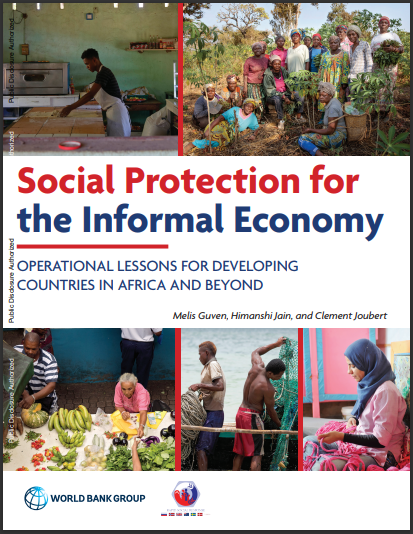
Social Protection for the Informal Economy. Operational Lessons for Developing Countries in Africa and Beyond

By Melis Guven, Himanshi Jain, & Clement Joubert The informal economy in Africa is large and diverse, and it is the main source of employment in the region. It is projected to grow and create more jobs. The informal economy is well established in the region, but it also faces a host of development challenges. It is characterized by low human capital and productivity compared with the formal economy and is typically associated with limited access to resources such as electricity, finance,...

Labor Supply Flexibility and Portfolio Selection with Early Retirement Option

By Junkee Jeon & Jehan Oh In this paper, we study an optimal consumption and investment problem of an economic agent who can choose flexible labor supply and an option to early retire in the existence of mandatory retirement date. We model the agent's preference as the Cobb-Douglas utility, which is a function of consumption and leisure, and consider the agent's unit wage rate as a stochastic process. The optimization problem has a feature of combining both stochastic control and...

July 2022

Gender Pay Gap Report 2021: Reporting our progress

By Legal and General In 2021, we have once again seen a continued, progressive narrowing of our pay gap, from 26.6% to 24.1%. This progress reflects the focus we have applied over the past year to creating a more diverse workforce and a more inclusive workplace where everyone can succeed. In this report, we share our latest gender pay gap data and update stakeholders on the steps we’re taking to narrow the gap further. Monitoring and reporting the gap over...

Wait Your Turn: Pension Incentives, Workplace Rules and Labor Supply Among Philadelphia Municipal Workers

By David McCarthy & Po Lin Wang Little academic work has examined the labor supply response to pension incentives at the intensive margin. We explore this issue using individual-level administrative and pension data for Philadelphia city employees, where workers have some choice about whether or not to perform overtime, which is pensionable. We document large variation across workers in the incentives to do overtime provided by pension rules. Although standard regressions show that worker overtime is positively associated with own...