June 2025

Milliman Pension Buyout Index May 2025

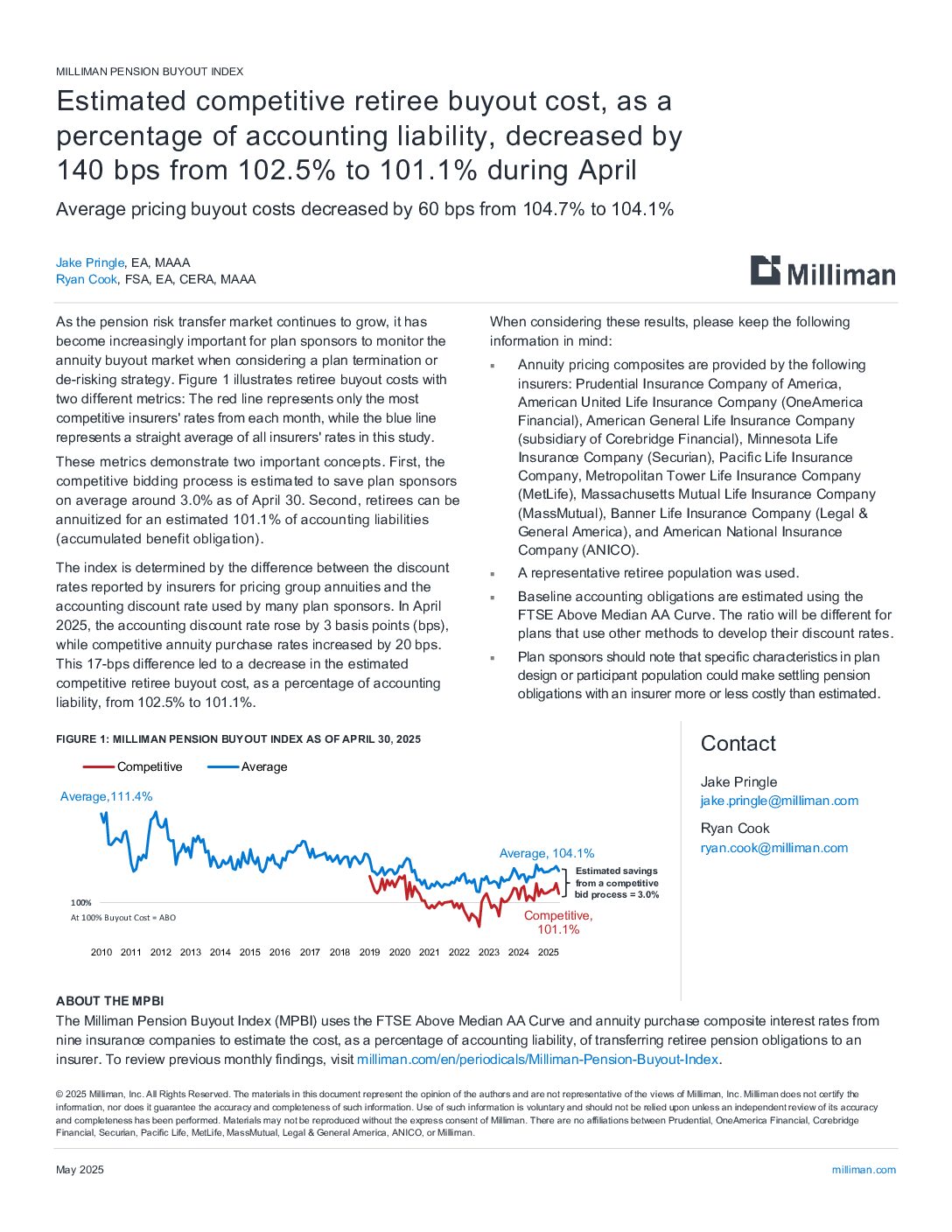
By Jake Pringle & Ryan Cook Estimated competitive retiree buyout cost, as a percentage of accounting liability, decreased by 140 bps from 102.5% to 101.1% during April As the pension risk transfer market continues to grow, it has become increasingly important for plan sponsors to monitor the annuity buyout market when considering a plan termination or de-risking strategy. Figure 1 illustrates retiree buyout costs with two different metrics: The red line represents only the most competitive insurers' rates from each month,...

PensionsEurope’s Position Paper on the European Commission’s Omnibus Simplification Proposal

By Pension Europe PensionsEurope welcomes the European Commission (EC) initiative which aims to align crucial EU legislation concerning Sustainable Finance. PensionsEurope firmly believes that the competitiveness of the EU economy is vital, it is possible to reduce the administrative burden without undermining the EU's policy objectives regarding the green transition. However, any simplification should be carefully balanced to ensure that material sustainability information on risks, opportunities, and impacts-critical to informed investor decision-making-is preserved. Accordingly, the Omnibus package should aim to streamline...

Optimal Income Redistribution

By Pavel Brendler, Eva Carceles-Poveda & Arpad Abraham We study whether a redesign of the social security and income tax-and-transfer systems can deliver significant welfare gains. Our rich quantitative model features both realistic inequality over the life-cycle and the key main channels through which redistributive policies can distort aggregate allocations. We find that there are two distinct ways to achieve significant welfare gains with joint policy reforms. The first prioritizes reducing distortions through a regressive pension system, resulting in higher...

Flexible Retirement and Optimal Taxation

By Abdoulaye Ndiaye & Zhixiu Yu Raising the retirement age is a common policy response when social security schemes face fiscal pressures. We develop and estimate a dynamic life cycle model to study optimal retirement and tax policy when individuals face health shocks and income risk and make endogenous retirement decisions. The model incorporates key features of Social Security, Medicare, income taxation, and savings incentives and distinguishes three channels through which health affects retirement: nonconvexities in labor supply due to...

The Future of Financial Inclusion: Fintech, Microfinance, and Alternative Banking Models

By Selina Zhan Financial literacy refers to the ability to make informed financial decisions through acquiring relevant knowledge and skills such as investing, budgeting, and asset management. Individual financial literacy is crucial as many governments around the world are unreliable when it comes to providing adequate and stable financial support to their civilians. Additionally, as institutions become more and more exclusive with their increasingly complex products, the need for financial literacy grows, especially as the cost of retirement rises each...

Rising Discount Rates Push Pension Risk Transfer Costs Lower in April

Offloading retiree pension risk to an insurance company became less expensive in April, according to consulting and actuary firm Milliman, which tracks the cost of de–risking pension funds with its Milliman Pension Buyout Index. The firm estimated that in a competitive bidding process, average costs of a pension risk transfer declined to 101.1% of a plan’s accounting liabilities in April from 102.5% in March. At the same time, average annuity purchase costs among all insurers in Milliman’s index decreased to...

May 2025

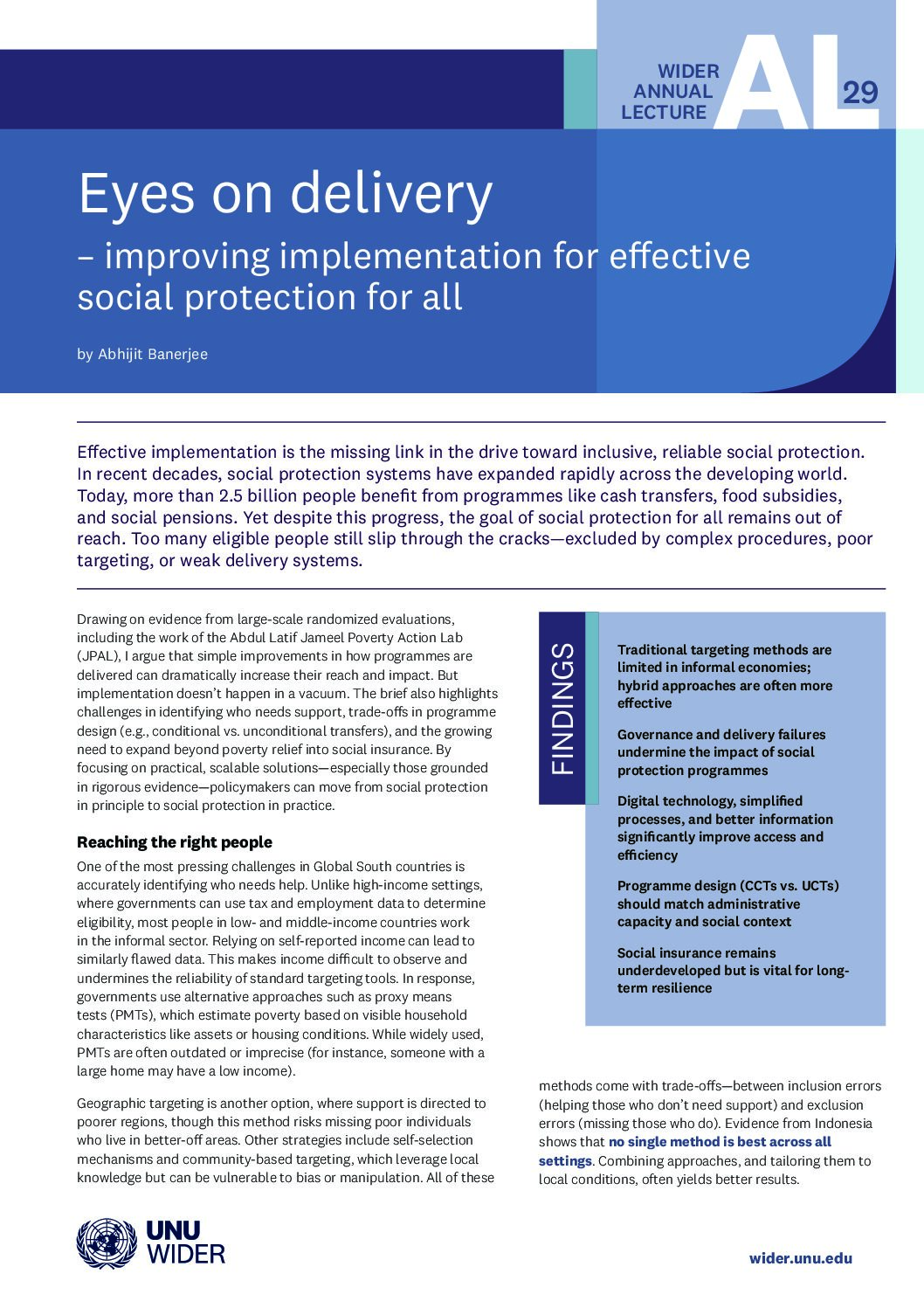
Eyes on delivery – improving implementation for effective social protection for all

By Abhijit V. Banerjee Effective implementation is the missing link in the drive toward inclusive, reliable social protection. In recent decades, social protection systems have expanded rapidly across the developing world. Today, more than 2.5 billion people benefit from programmes like cash transfers, food subsidies, and social pensions. Yet despite this progress, the goal of social protection for all remains out of reach. Too many eligible people still slip through the cracks—excluded by complex procedures, poor targeting, or weak delivery...

Annual survey on financial incentives for retirement savings. Country profiles 2024

By Organisation for Economic Co-operation and Development Countries provide financial incentives to encourage individuals to save for retirement in asset-backed pension plans. Financial incentives for retirement savings can take the form of tax incentives, which are indirect subsidies through the tax code, or non-tax incentives, which are direct government payments into pension accounts. This annual survey provides an overview of the tax treatment of retirement savings and covers non-tax incentives to promote retirement savings in OECD countries and four accession...

Income and Wealth Inequality in the United States: An Update Including the 2022 Wave

By Moritz Kuhn & José-Victor Ríos-Rull We provide a comprehensive overview of earnings, income and wealth inequality based on the 2022 Survey of Consumer Finances from the United States. We document the current state of inequality and its evolution over the last three decades organizing the data along key demographic dimensions including age, education, and marital status. The 2022 data reveal that wealth remains highly concentrated, with the top 1% holding 35% of total wealth down from a peak of...

The Early Retirement Gap: Does Job Satisfaction Matter Less for the Self-Employed?

By Raquel Justo, Adrian Merida & Juan A. Sanchis-Llopis Understanding the drivers of early retirement is increasingly important in the context of aging populations and growing concerns over pension sustainability. While extensive research has examined the retirement behavior of paid employees, the self-employed, who operate under distinct work arrangements and institutional contexts, remain comparatively understudied. This work examines whether job satisfaction influences actual retirement behavior differently for self-employed individuals and paid employees. Leveraging longitudinal data from the Survey of Health, Ageing...