September 2025

Social infrastructure law in the UK, EU and US

By Ewan McGaughey What should be the goals of social infrastructure, and the best means to achieve them? Social infrastructure is a new term to describe the welfare state, whose conceptual foundations were laid in Lord Beveridge’s Report, Social Insurance and Allied Services (1942). A good government, said Beveridge, should tackle five evil ‘giants’, namely disease, ignorance, squalor, idleness, and want. These could be overcome with a universal free health service, public education, public housing, full employment, and income insurance...
The Future of Labour: How AI, Technological Disruption and Practice Will Change the Way We Work

By Anthony Larsson & Andreas Hatzigeorgiou The Future of Labour: How AI, Technological Disruption and Practice Will Change the Way We Work is an anthology that offers a forward-looking exploration of how artificial intelligence (AI), digitalisation and technological transformation are reshaping the future of work. Through a series of studies conducted by scientists and industry professionals, this volume takes a deep dive into many of the issues related to new policies, AI and the digital transformation’s anticipated impact on the labour market....

August 2025

EU labour market – quarterly statistics

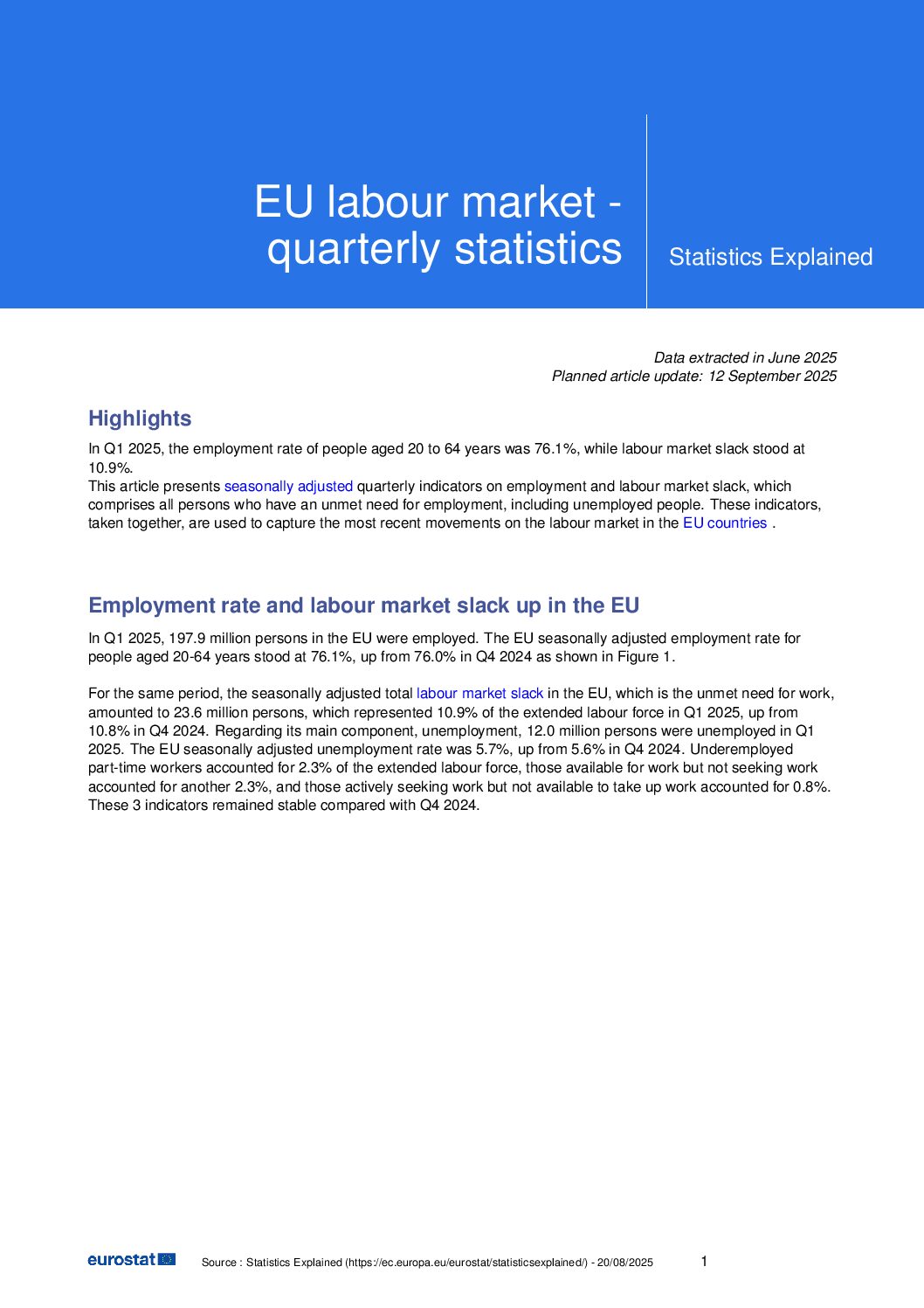
By European Union In Q1 2025, 197.9 million persons in the EU were employed. The EU seasonally adjusted employment rate for people aged 20-64 years stood at 76.1%, up from 76.0% in Q4 2024 as shown in Figure 1. For the same period, the seasonally adjusted total labour market slack in the EU, which is the unmet need for work, amounted to 23.6 million persons, which represented 10.9% of the extended labour force in Q1 2025, up from 10.8% in Q4 2024. Regarding its main component,...

The Causal Influence of Pension on the Participation of Older Workers in the Ghanaian Labour Market

By George Domfe, Kwadwo Opoku & Antoinette Tsiboe-Darko Population ageing has stirred up policy discourse on pension coverage in developing economies. While in most of these countries, a smaller proportion of older persons receive pensions in the form of regular payments from the state, a considerable proportion of them engage in active work to maintain their livelihood. These descriptions are typically true of Ghana. However, it remains unclear in the Ghanaian literature whether the absence of a pension is a...

May 2025

The Early Retirement Gap: Does Job Satisfaction Matter Less for the Self-Employed?

By Raquel Justo, Adrian Merida & Juan A. Sanchis-Llopis Understanding the drivers of early retirement is increasingly important in the context of aging populations and growing concerns over pension sustainability. While extensive research has examined the retirement behavior of paid employees, the self-employed, who operate under distinct work arrangements and institutional contexts, remain comparatively understudied. This work examines whether job satisfaction influences actual retirement behavior differently for self-employed individuals and paid employees. Leveraging longitudinal data from the Survey of Health, Ageing...

April 2025

Varying effects of public pensions: Pension spending and old-age employment under different pension regimes

By Kun Lee Socioeconomic consequences of pension reforms have often been discussed without careful consideration of institutional contexts, despite the fact that institutional designs of public pensions differ substantially across countries. This study argues that the outcomes of pension reforms vary depending on the institutional structure of public pensions, by showing that the associations between public pension spending and old-age employment rates of different socio-demographic groups vary across different institutional contexts. Using time-series cross-section data from 20 European countries and...

Retirement in the USA: The Outlook of the Workforce 25th Annual Transamerica Retirement Survey

By Transamerica Institute Retirement in the USA: The Outlook of the Workforce, a collaboration between Transamerica Center for Retirement Studies (TCRS) and Transamerica Institute, delves into the retirement prospects of the U.S. workforce including workers who are employed by others, self-employed workers, and workers who are unemployed but looking for work. Based on a survey of more than 6,100 members of the workforce, the report delves into their life priorities and outlook, personal finances, retirement expectations, and how they are saving,...

The Social Security Retirement Age

By Congressional Research Service The Social Security full retirement age (FRA) is the age at which workers can first claim full (i.e., unreduced) Social Security retired-worker benefits.1 Among other factors, the age at which an individual begins receiving Social Security benefits has an impact on the size of the monthly benefits. Claiming benefits before the FRA can substantially reduce monthly benefits, whereas claiming benefits after the FRA can lead to a substantial increase in monthly benefits. Benefit adjustments are made...

Optimal Investment-Consumption and Retirement Choice with Labor and Pension Incomes

By Hyun Jin Jang & Seon Hwa Lee This study examines lifetime optimal investment, consumption, and retirement timing decisions under a heterogeneous consumption utility function and the presence of pension earnings. Using the duality method, we derive the optimal wealth, investment-consumption strategies, and voluntary retirement region. Through simulation analysis, we assess the impact of pensions on these decisions. Our findings highlight the critical role of pensions in retirement planning, alongside wages and labor costs. Notably, pension benefits encourage earlier voluntary...

Robots and Informal Employment in China

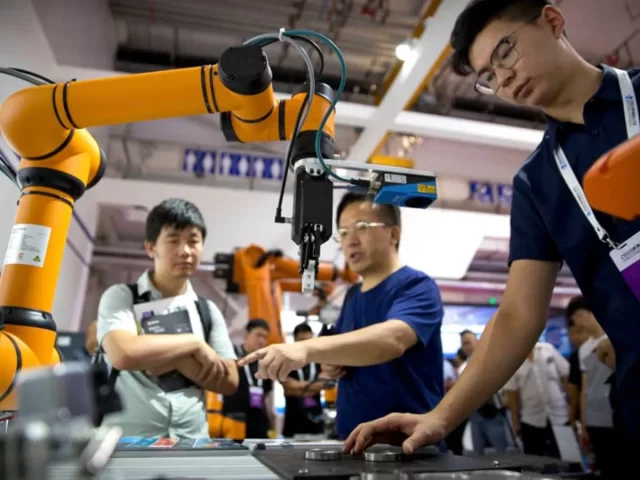
By Haiyan Lin This paper examines labor adjustments between the informal and formal sectors in response to the adoption of industrial robots in China. Using a longitudinal household data from 2010 to 2018, I find that robotization increases informal employment. Quantitatively, one more robot per thousand workers increases the share of informal employment by 1.16 percentage points. The reallocation is not driven by new entrants or re-entrants, but by workers initially employed in the formal sector. Displaced formal workers tend...