March 2026

Economía informal: un análisis comparativo entre México y países con alta informalidad

Por Héctor Iván Del Toro Ríos & Laura Verónica Santana Gómez La economía informal representa una característica estructural persistente en muchas economías emergentes, con especial relevancia en América Latina, donde constituye tanto una estrategia de subsistencia para millones de personas como un desafío crítico para el desarrollo económico y social sostenible. En el caso de México, más del 54 % de la población ocupada se encuentra en condiciones de informalidad laboral, lo que implica que más de 32 millones de...


February 2026

The modality of pension information matters: The effects of visualization and interactivity

By Kristjan Pulk, Kristian Pentus, Leonore Riitsalu, Leo Daniel Sipria, Robin Talisaar & Ene Tubelt A significant barrier to pension engagement is a lack of awareness about the pension system and contribution options. Pension information is often presented as complicated text, which can deter engagement. We test how different modalities of visual and interactive pension communication affect individuals’ subjective pension knowledge, assessment of pension sufficiency, information search, and pension decision intentions. We do so by conducting two experiments: an online experiment...

Fairness Views, Pension Benefits, and Heterogeneity in Life Expectancy

By Maria Chaykina Notional Defined Contribution (NDC) pension schemes convert accumulated pension wealth into an annuity, based on an average life expectancy at retirement. When longevity differs across social groups, a single conversion factor implies systematic transfers from shorter-lived to longer-lived individuals. This motivates proposals to differentiate benefits by socio-demographic characteristics related to life expectancy. We study whether such differentiation is perceived as fair using a survey experiment involving 3,004 Italian residents aged 18-66. Respondents completed an incentivised allocation task...

Population Aging and Pension Reforms in China

By Boele Bonthuis, Yongquan Cao & Christoph Freudenberg China is experiencing rapid population aging and a declining workforce, posing significant economic and fiscal challenges, especially to the pension system. This paper examines the evolution of China’s pension system, assesses its gaps relative to international peers, and evaluates the macro-fiscal implications of population aging and various pension reforms. Using a calibrated overlapping generations model that explicitly incorporates the rural–urban disparities, we project that population aging alone can slow annual GDP growth by...

How Incentives Can Boost Pensions for Informal Sector Workers

By Coller Pensions Institute his summary report offers a snapshot of the findings in the full paper: ‘How incentives can boost pensions for informal workers’ - prepared by the Coller Pensions Institute and D3P Global. It highlights the financial and demographic factors driving the urgent need for policymakers to increase the participation rates of informal workers in pension systems, and summarises key findings from the full paper’s review of pension programmes targeting informal sector workers in 11 emerging markets and...

Impact of iImmigration on the Japanese Economy: A Multi-Country Simulation Model

By Manabu Shimasawa To quantify the impacts of immigration and fiscal reconstruction on the Japanese economy, we present a dynamic computable general equilibrium OLG model with an overlapping generations structure. We use a total of 16 countries and regions, both including those that are industrialized, such as Japan, the US, and the EU, and developing countries, such as China, Brazil, the Philippines, and Peru. Our simulation results show that a permanent immigration flows of 150,000 will improve the Japanese economy and...

Retirement Under Policy Uncertainty

By Piera Bello, Vincenzo Galasso & Alessandro Izzo This paper examines how policy uncertainty influences retirement decisions. We develop a simple model in which individuals face a one-time choice between immediate retirement and continued employment until the statutory retirement age. In the absence of policy uncertainty, retirement decisions depend solely on the standard income–leisure trade-off. When future pension reforms are uncertain, however, individuals also take into account the perceived risk of increases in the retirement age or reductions in benefit...

The Shift from Traditional Pensions to 401(k)s: Retirement Risks and the Timing of Retirement

By Rosemary Kaiser, Xiaohui sun & Yang Xuan U.S. retirement plans have shifted sharply from defined benefit to defined contribution setups. How has this change affected retirement and savings behavior? We develop a quantitative life-cycle model where retirement plans differ in their exposure to longevity and investment risk. Holding the present-value cost of benefits fixed, these differences generate distinct savings and retirement incentives across plan types. The model replicates observed differences in savings and retirement behavior and implies that the...

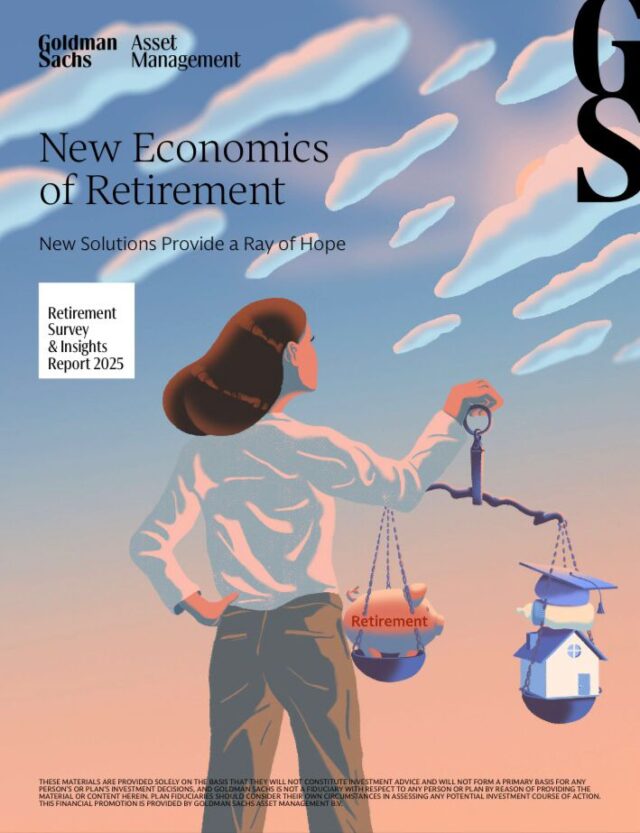
Retirement Survey & Insights Report 2025. New Economics of Retirement: New Solutions Provide a Ray of Hope

By Goldman Sachs In our annual Retirement Survey & Insights Report, we are pleased to present findings that may challenge conventional wisdom about retirement preparedness in America. While many acknowledge the looming retirement crisis, the traditional advice to simply save more may fail to account for the complex and evolving realities faced by millions of Americans. This year’s report introduces the "new economics of retirement,” as we grapple with the question “does the retirement math still work?” The report illustrates how rising costs...

Public Pensions and the Strategic Timing of Formal Employment

  By Diego Vera Cossio, Mariano Bosch, Jonathan M. Leganza, Tatiana Mojica & María Laura Oliveri We study how public pensions impact lifecycle labor supply decisions. Our analysis centers on pension eligibility rules in Ecuador. We first use administrative data to document and unpack retirement spikes at eligibility ages. Next, we use survey data and regression discontinuity to investigate whether eligibility rules influence earlier-inlife decisions about when to work formally versus informally. We find discontinuous increases in transitions to formal employment...